Are We the Body, the Mind, or the Senses?
The body changes, the senses become active and inactive, and the mind fluctuates constantly. Yet the conscious self remains. Then who are we really?
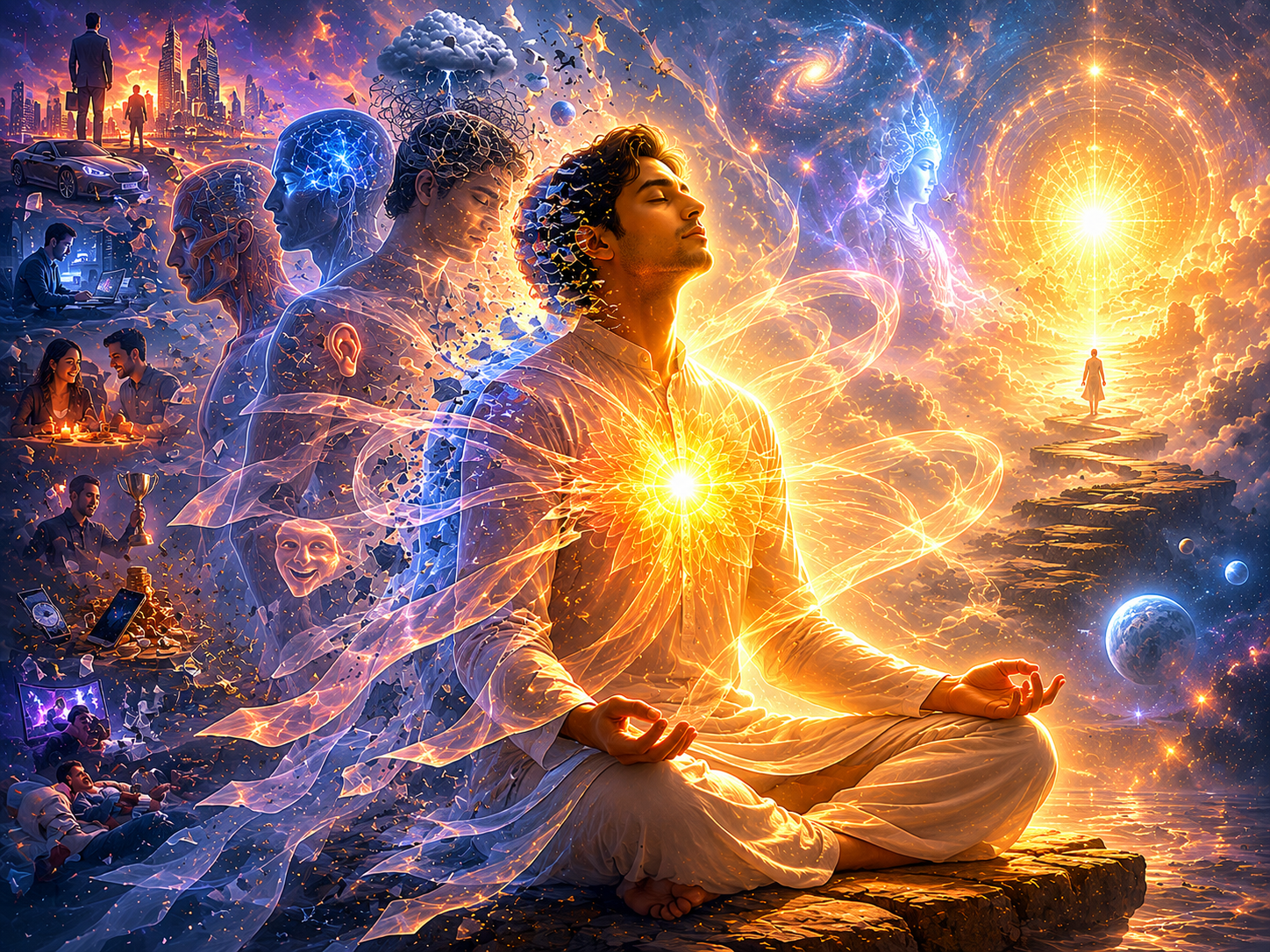
📍 Where You Are in the Inquiry
In the previous article, we reached an important conclusion.
If material happiness cannot fully satisfy the self, then the self itself cannot be material in nature.
This raises a deeper question.
If we are not material beings, then who are we really?
Ordinarily, people identify themselves with:
- the body,
- the senses,
- the mind,
- or material consciousness itself.
But are any of these truly the self?
To answer this, we must carefully examine our own direct experience.
Materialistic Explanations of the Self
Some materialistic philosophers claim that consciousness is merely a product of the material body.
According to them:
- the self is the body,
- or the senses,
- or the life force itself.
They believe that consciousness arises from the combination of material elements.
Therefore, according to this view:
- worldly enjoyment is the goal of life,
- and death is the end of existence.
Charvak philosophy states:
यावज्जीवेत् सुखं जीवेत् ऋणं कृत्वा घृतं पिबेत्
“As long as you live, live happily. Even if you must borrow money, enjoy worldly pleasure.”
And further:
भस्मीभूतस्य देहस्य पुनरागमनं कुतः
“After death, nothing remains.”
But according to Jagadguruttam Swami Shri Kripalu Ji Maharaj, this understanding is incomplete because it fails to properly examine the nature of consciousness and the continuity of the self.
Are We the Body?
The body continuously changes throughout life.
Childhood changes into youth.
Youth changes into old age.
The body constantly changes, yet the inner sense of “I” remains continuous.
A person says:
- “When I was a child...”
- “When I was young...”
- “Now I am old...”
Although the body has changed completely, the experiencer remains the same.
This reveals something important.
If the self were truly the body, then the sense of identity should also change completely along with the body.
But it does not.
Therefore, the self cannot be identical with the body.
Can Consciousness Come From Matter?
Material elements such as:
- earth,
- water,
- fire,
- air,
- and space
do not possess consciousness.
Some claim that consciousness somehow emerges once these elements combine into a physical body.
But this explanation creates serious problems.
At the time of death, the body still remains physically present.
Yet consciousness disappears.
If consciousness were merely a property of matter, then the dead body should continue experiencing awareness.
But it does not.
Furthermore, material objects can become the objects of experience, but they cannot become the experiencer itself.
Fire can burn other objects, but it cannot burn itself.
Similarly, material elements can be perceived, but they cannot become self-aware experiencers.
Therefore, consciousness cannot originate from matter.
Are We the Senses?
Now we must examine the senses.
In waking life, we say:
- “I see,”
- “I hear,”
- “I smell,”
- and so on.
But dream experience reveals something important.
During dreams, the physical senses remain inactive.
The body lies asleep, yet experience continues internally.
One still:
- sees,
- hears,
- fears,
- runs,
- and experiences pleasure or sorrow.
If the senses themselves were the self, then experience should completely stop when the senses become inactive.
But this does not happen.
Therefore, the self cannot be the senses.
Are We the Mind?
Then perhaps the self is the mind itself?
To examine this, we must observe the state of deep sleep.
In deep sleep, mental activity becomes dormant.
Thoughts disappear.
Desires disappear.
Ego-awareness disappears.
Yet upon waking, a person says:
“I slept peacefully.”
This means that even in the absence of active mental experience, the self still existed.
The experiencer remained, even though the mind had become inactive.
Therefore, the self cannot be the mind.
“I” and “Mine” Are Different
Our own language reveals this truth naturally.
We say:
- my body,
- my mind,
- my senses,
- my thoughts.
But whatever is “mine” cannot be “me.”
The owner and the possessed object must be different.
Thus:
- the body is possessed,
- the mind is possessed,
- the senses are possessed.
Therefore, the true self must be distinct from all of them.
The False Identity Begins to Break
At this point, an important realization begins to emerge.
The self is not:
- the body,
- the senses,
- the mind,
- or material matter itself.
Then who are we really?
The scriptures now reveal the true identity of the soul.
🔍 Go Deeper (Scriptural Foundations)
- Jeev (Soul)
- Chetan (Conscious Principle)
- Gyanendriya — Five Senses
- PanchPran — Five Vital Airs
- Panchkosh — Five Sheaths
- How Can the Lifeless Rule the Living?
🌱 Reflect Further
• Carrot on a Stick — The Game We Didn’t Know We Were Playing
Continue the Inquiry
(Part 3 of 5 — The Self)
⬅️ Previous: If We Seek Happiness, Why Are We Never Satisfied?
➡️ Next: The Soul Is an Eternal Part of God
🔙 Back to Hub: The Soul — The Self