
Jagadguruttam Shri Kripalu Ji Maharaj — Recognition in the Vedic Tradition
Recognized by the Kashi Vidvat Parishad in 1957 with the title “Jagadguruttam,” affirming His unparalleled mastery and reconciliation of Vedic philosophy.
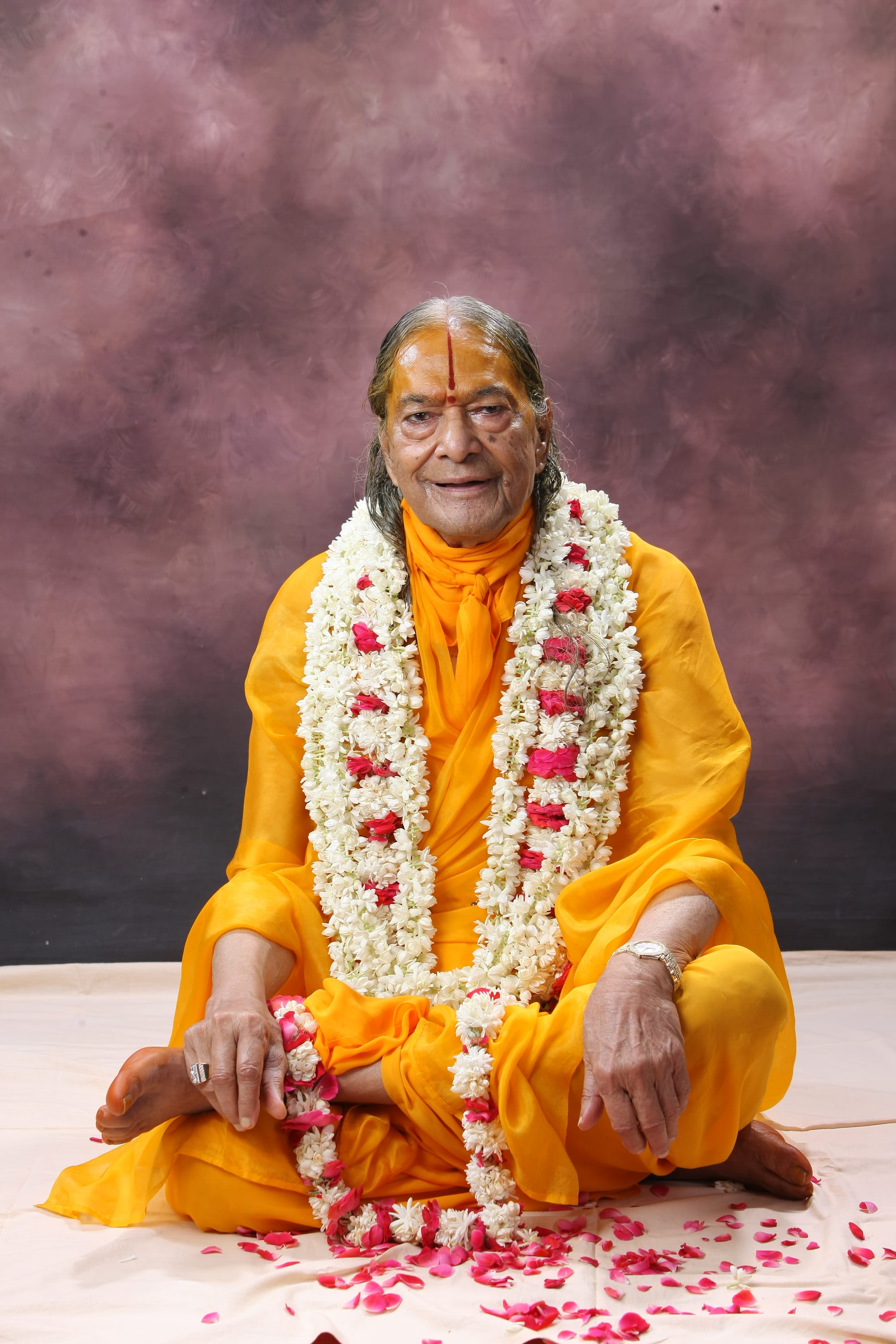
The 1957 Recognition
In 1957, the Kashi Vidvat Parishad — one of the most respected assemblies of Vedic scholars —
conferred upon Him the title:
“Jagadguruttam”
This title was documented in the Sanskrit certificate
Padya Prasunopahara.
It signifies not merely scholarship,
but the ability to reconcile and harmonize all streams of Vedic thought.
The Source of These Teachings
The teachings presented on this site are not independently derived interpretations.
They are drawn from the reconciled exposition of Vedic philosophy
articulated by Jagadguruttam Shri Kripalu Ji Maharaj
and preserved by Radha Govind Samiti (RGS).
In the Vedic tradition, truth is not invented.
It is received and transmitted.
To understand the philosophy presented here,
one must understand its source.
This reconciled understanding forms the doctrinal foundation of this site.
It is presented in a structured and systematic manner in the sections that follow.
This reconciled understanding forms the doctrinal foundation of this site.
Who Is Jagadguruttam?
In 1957, following extended scholarly deliberation by the Kashi Vidvat Parishad in Varanasi, Shri Maharaj Ji was formally recognized and conferred the title:
“Jagadguruttam” — Supreme among Jagadgurus.
He was also honored with titles such as:
Nikhil-darśan-samanvayāchārya — one who reconciles all philosophical systems.
Bhakti-yog-rasāvatār — embodiment of the path of divine love.
These titles were not honorary in a ceremonial sense.
They were conferred after examination of His mastery over scripture and His ability to reconcile the diverse philosophical conclusions of the Vedas into a unified system.
👉 Read His Introduction →
Historical Recognition (1955–1957)
Between 1955 and 1957, formal assemblies of respected scholars publicly examined his scriptural conclusions.
These were not devotional gatherings.
They were intellectual examinations.
The outcome of these deliberations established his authority within the Vedic tradition — not by proclamation, but by review.
👉 Explore Historical Recognition →
The Philosophical Foundation
The structure of teachings presented on this site rests upon core conclusions articulated by Shri Maharaj Ji:
• Clear distinction between God, the soul, and Māyā
• Reconciliation of apparent contradictions within Vedic scripture
• Supremacy of Divine Love (prema-bhakti) as the ultimate goal
• Grace as the decisive factor in spiritual realization
• The indispensable role of the true Guru
These conclusions form the backbone of the Tattvagyan explored throughout this site.
👉 Enter Tattvagyan →
Teaching and Application
Spiritual philosophy, when confined to intellectual understanding, does not yield realization.
Accordingly, Shri Maharaj Ji emphasized both clarity of doctrine and lived engagement.
Philosophy must be understood.
It must also be practiced.
Many first encountered his teachings through public lectures before deepening their practice gradually through disciplined sadhana.
The path is structured — but never coercive.
Institutional Continuity
The teachings presented here are derived from authorized publications of Radha Govind Samiti (RGS), the body responsible for preserving and disseminating his works.
This ensures fidelity to the original exposition.
👉 About RGS