Why Did Liberated Paramhansas Become Absorbed in Krishna's Bliss?
Why do some liberated Paramhansas become absorbed in the bliss of Shri Krishna?
📍 Where You Are in the Inquiry
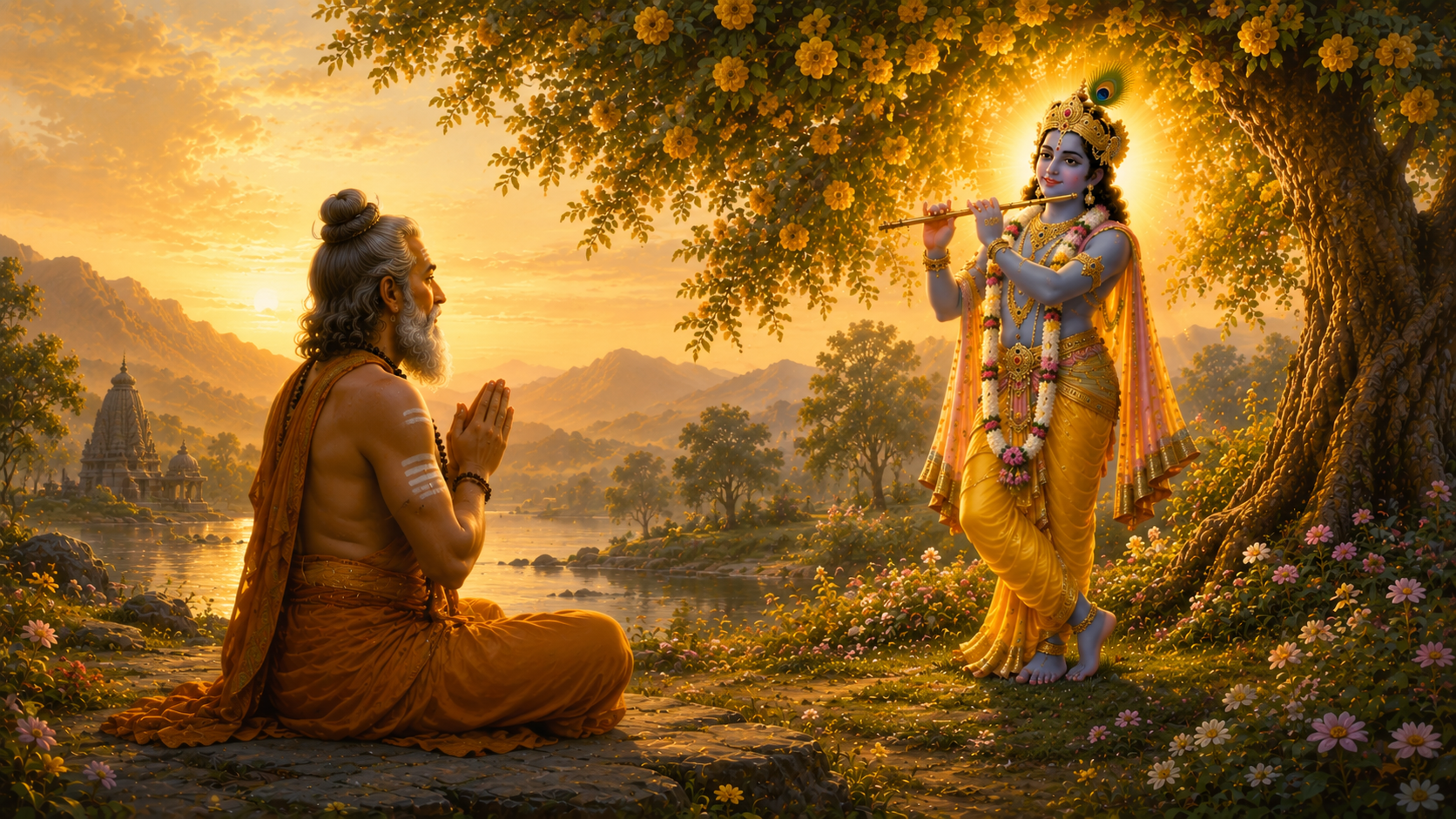
In the previous article, we saw that Brahma and Shiv, though revered as the greatest Brahm-Gyanis, became deeply attracted to Krishna’s Divine Love. Brahma longed for the footdust of the residents of Braj. Lord Shiv longed for the darshan of Shri Ram and Shri Krishna and entered the Maharas.
Yet a thoughtful reader may still ask: Brahma and Shiv are descensions of God. Does the same attraction arise in liberated souls belonging to the class of individual souls jeev (जीव | jīva)?
This article answers that question through the lives of Paramhansas who were liberated from Maya. Shri Maharaj Ji now shows that even those who attained the highest state of Brahm-Gyan became absorbed in Krishna’s Bliss.
The Testimony of Liberated Paramhansas
The scriptures first direct our attention to the four Kumaras—Sanak, Sanandan, Sanatan, and Sanat Kumar.
They were renowned as the foremost Gyanis of Satyug and were Paramhansas from birth. They were not seekers struggling toward realization. They were already absorbed in the Bliss of Brahm.
Once, the four Kumars went to Vaikunth. There, the fragrance of the Divine Tulsi leaves placed at the lotus feet of Maha Vishnu entered their nostrils.
That fragrance was not material fragrance. It was the fragrance of Divine Tulsi touching the Divine lotus feet of Bhagavan.
The Bhagavatam describes what happened:
तस्यारविन्दनयनस्य पदारविन्द-
किंजल्कमिश्रतुलसीमकरन्दवायुः ।
अन्तर्गतः स्वविवरेण चकार तेषां
संक्षोभमक्षरजुषामपि चित्ततन्तोः ॥
tasyāravinda-nayanasya padāravinda-
kiñjalka-miśra-tulasī-makaranda-vāyuḥ |
antar-gataḥ sva-vivareṇa cakāra teṣāṁ
saṁkṣobham akṣara-juṣām api citta-tantoḥ ||
(Bhagavatam 3.15.43)
"The breeze carrying the fragrance of Tulsi from the lotus feet of the lotus-eyed Lord entered their nostrils and stirred even the minds of those absorbed in the imperishable Brahm."
The fragrance entered.
Their samadhi ended.
This is the first witness.
Why Did the Sankadik Ask for Divine Love?
After experiencing this Divine sweetness, the Sankadik did not ask for liberation. They did not ask for Brahm-Bliss. They had already attained that.
Instead, they prayed:
कामी भवः स्वजनबन्धु नः स्वजातिलब्धो यदि तु ते पदयोः स्मृतिः ।
वासः पदे नरक एव यद्यस्मिन्, न त्वत्पदद्वयपरायणाः स्मः ॥
kāmī bhavaḥ svajana-bandhu naḥ svajāti-labdho yadi tu te padayoḥ smṛtiḥ |
vāsaḥ pade naraka eva yady asmin, na tvat-pada-dvaya-parāyaṇāḥ smaḥ ||
(Bhagavatam 3.15.79)
"O Bhagavan! Even if You give us residence in hell, we do not mind. Grace us only this much: may our minds remain lovingly attached to Your lotus feet."
Shri Maharaj Ji asks us to reflect on this.
After attaining the state of Paramhans and becoming absorbed in the Bliss of Brahm, what is the meaning of begging for Divine Love—even if one must live in hell?
The answer is not that Brahm-Bliss is false or material. The Kumars had attained Divine Bliss. Yet after encountering the sweetness connected with Bhagavan’s lotus feet, they desired loving attachment to Him.
Why would liberated Paramhansas desire this?
The scriptures continue answering through other witnesses.
Janak and Uddhav Confirm the Same Truth
In Treta Yug, King Janak was famous as the foremost Gyani. He earned the title Videh because he had no body-consciousness. His mind was absorbed in Nirakar Brahm.
Yet when Janak saw Bhagavan Ram, something remarkable happened.
मूर्ति मधुर मनोहर देखी ।
भएतहिं विवेक विवेक विसेखी ॥
mūrti madhura manohara dekhī |
bhaye tahiṁ viveka viveka viseṣī ||
"Seeing that sweet and captivating form, his discrimination became especially awakened."
Then:
ईषत् विलोकित अति अनुरागा ।
बरबस ब्रह्मानंद मन त्यागा ॥
īṣat vilokita ati anurāgā |
barabasa brahmānanda mana tyāgā ||
"With just a slight glance, deep love arose, and the mind naturally left Brahmanand."
This does not mean Janak’s mind went toward worldly happiness. Shri Maharaj Ji clarifies that Janak saw the same Brahm in a sweeter, visible, and relatable form.
Janak himself expressed this recognition:
ब्रह्म जेहि निमग्न प्रीति कहि जाता ।
उभय रूप धरि कीन्ह सो भ्राता ॥
brahma jehi nimagna prīti kahi jātā |
ubhaya rūpa dhari kīnha so bhrātā ||
"The Brahm in which my mind was absorbed has now appeared in both forms."
Janak’s experience shows that Divine Love did not pull him downward. It drew him toward the sweetness of the same Divine God revealed in Bhagavan Ram.
In Dwapar Yug, Uddhav was the foremost Gyani. He had great pride in his realization of Brahm-Bliss.
To reveal the greatness of Divine Love, Shri Krishna sent him to the Gopis.
Uddhav went intending to give them knowledge of Brahm. But when he returned, he did not return as their teacher. He returned overwhelmed by their Divine Love and prayed:
आसामहो चरणरेणुजुषामहं स्यां
वृन्दावने किमपि गुल्मलतौषधीनाम् ।
या दुस्त्यजं स्वजनमार्यपथं च हित्वा
भेजुर्मुकुन्दपदवीं श्रुतिभिर्विमृग्याम् ॥
āsām aho caraṇa-reṇu-juṣām ahaṁ syāṁ
vṛndāvane kim api gulma-latauṣadhīnām |
yā dustyajaṁ svajanam ārya-pathaṁ ca hitvā
bhejur mukunda-padavīṁ śrutibhir vimṛgyām ||
(Bhagavatam 10.47.61)
"O Krishna! I would consider myself most fortunate if I could be born as a creeper, bush, or blade of grass in Vrindavan, so that I might receive the footdust of the Gopis, who attained the state sought by the Vedas."
Janak saw. Uddhav was sent.
In both cases, Brahm-Gyan did not end in indifference toward Divine Love. It became humbled, softened, and drawn toward Krishna-prem.
Even Ved Vyas Was Not Satisfied
Shri Maharaj Ji next turns to Ved Vyas, the revealer of the Vedas, Puranas and Vedanta.
Ved Vyas had composed the scriptures, organized spiritual knowledge, and revealed profound truths for the welfare of the world. Yet after producing all these works, he remained inwardly restless.
Then Naradji came and explained the cause.
Revealing knowledge is one thing. Becoming immersed in the nectar of Krishna’s Divine Love is something else.
Naradji instructed him to remember and describe the leelas of Krishna. Then Ved Vyas composed the Shrimad Bhagavatam, filled with the names, forms, virtues, leelas, and sweetness of Bhagavan.
Only then did he attain peace.
This witness is distinct. The issue is no longer only a Gyani becoming attracted to Divine Love. Here, even the revealer of scripture found fulfillment only after narrating Krishna-katha.
Shukdev Paramhans
Now Shri Maharaj Ji turns to Shukdev Paramhans.
Shukdev was the son of Ved Vyas. He was not merely a scholar. He was a Paramhans from the very moment of his birth.
He remained in his mother’s womb for twelve years because he feared contact with Maya. When he emerged, he immediately appeared as a twelve-year-old boy and walked away in the state of complete absorption.
Ved Vyas followed him, calling, "Son! Son!" But Shukdev did not respond. He was not ignoring his father. In his Paramhans state, no external sound reached his awareness.
The Bhagavatam honors him:
यं प्रव्रजन्तमनुपेतमपेतकृत्यं
द्वैपायनो विरहकातर आजुहाव ।
पुत्रेति तन्मयतया तरवोऽभिनेदुस्तं
सर्वभूतहृदयं मुनिमानतोऽस्मि ॥
yaṁ pravrajantam anupetam apeta-kṛtyaṁ
dvaipāyano viraha-kātara ājuhāva |
putreti tan-mayatayā taravo ’bhinedus taṁ
sarva-bhūta-hṛdayaṁ munim ānato ’smi ||
(Bhagavatam 1.2.2)
"I bow to that sage who dwells in the hearts of all beings, whom Ved Vyas called out as son."
As Shukdev walked ahead, some women were bathing unclothed. Seeing Shukdev, they did not cover themselves. But when Ved Vyas arrived, they immediately covered themselves.
Ved Vyas was surprised and asked why they had covered themselves before him, an old man, but not before his young son.
The women replied that Ved Vyas was in the Hans state, while Shukdev was in the Paramhans state.
The Upanishads explain:
यत्र हि द्वैतमिव भवति तदितर इतरेण पश्यति...
यत्र त्वस्य सर्वमात्मैवाभूत् तत्केन कं पश्येत्...
yatra hi dvaitam iva bhavati tad itara itareṇa paśyati...
yatra tv asya sarvam ātmāivābhūt tat kena kaṁ paśyet...
(Brihadaranyaka Upanishad 2.4.14)
"Where there appears to be duality, one sees another. But where everything has become the Self, then by what and whom would one see?"
The women explained that if Shukdev had seen anything other than his Divine Self, some difference would have appeared in his glance. But there was no such difference.
Thus the scriptures themselves distinguish between the realization of a Hans and the complete transcendence of a Paramhans.
In the Hans state, the realized Saint still distinguishes truth from untruth. In the Paramhans state, even that separate perception is gone.
Shri Maharaj Ji establishes this carefully for one reason.
Shukdev had already reached the highest state of Brahm-Gyan.
Only after this does the next event become astonishing.
Why Did One Verse End His Samadhi?
Shukdev walked into the forest, and Ved Vyas returned home.
Later, Ved Vyas revealed the Bhagavatam. One of his disciples memorized a verse from it. While traveling through the forest, the disciple came near Shukdev, who was absorbed in Nirvikalp Samadhi.
The disciple recited that verse.
Shukdev heard it.
His samadhi ended.
This is not an ordinary event. A material sound cannot enter the state of samadhi. Yet this verse entered Shukdev’s samadhi and drew him outward.
Shukdev followed the disciple, returned to Ved Vyas, and studied the entire Bhagavatam.
Now the question becomes unavoidable.
Why would a Paramhans, already established in the highest realization, begin listening again?
Why Would a Paramhans Listen Again?
Shri Maharaj Ji answers by distinguishing two kinds of listening.
A spiritual aspirant listens to philosophy, reflects upon it, meditates upon it, and through prolonged practice and the grace of God may eventually attain the Paramhans state.
But Shukdev had already attained that state.
So his listening was not for the sake of attaining realization.
His listening was for the sake of relishing Krishna’s Divine Love.
Going beyond material duality and experiencing the Bliss of Nirakar Brahm is the state of a Paramhans. But after reaching the Divine state, hearing and chanting Krishna’s names, forms, virtues, abode, and leelas allows the liberated Saint to relish the ever-increasing Bliss of Divine Love.
This is the inner secret Shri Maharaj Ji is revealing.
For the seeker, hearing attaches the mind to God.
For the Paramhans, hearing Krishna-katha is the experience of Krishna-prema itself.
The Verse That Drew Shukdev Out of Samadhi
Now the question reaches its peak.
What was that verse?
The Bhagavatam says:
अहो बकियं स्तनकालकूटं
जिघांसयापाययदप्यसाध्वी ।
लेभे गतिं धात्र्यचितां ततोऽन्यं
कं वा दयालुं शरणं व्रजेम ॥
aho bakī yaṁ stana-kāla-kūṭaṁ
jighāṁsayāpāyayad apy asādhvī |
lebhe gatiṁ dhātry-ucitāṁ tato ’nyaṁ
kaṁ vā dayāluṁ śaraṇaṁ vrajema ||
(Bhagavatam 3.2.23)
"Putana smeared deadly poison on her breast and came to kill Krishna. Yet He granted her the destination of a nurse, a motherly attendant. Who else is so merciful that we could take refuge in Him?"
Putana came to kill Him.
She placed poison on her breast.
She approached Him with murderous intent.
Yet Krishna accepted the contact of her breast as a motherly offering. He did not look only at her hostility. He accepted even that faint external resemblance of motherhood and granted her a motherly destination.
This is what overwhelmed Shukdev Paramhans.
Not merely that Putana was liberated.
Krishna accepted even Putana as His mother.
If such is the grace of Shri Krishna, then who can measure His compassion?
That boundless grace drew Shukdev from samadhi and immersed him in Krishna’s Bliss.
Where This Inquiry Leads
The lives of the Sankadik, Janak, Uddhav, Ved Vyas, and Shukdev reveal the same truth from different angles.
The Sankadik were stirred by the fragrance of Divine Tulsi from Bhagavan’s lotus feet. Janak saw Shri Ram and recognized the same Brahm in a sweeter form. Uddhav went to teach the Gopis and returned longing for their footdust. Ved Vyas revealed scripture but found peace only after narrating Krishna’s leelas. Shukdev, already established in Nirvikalp Samadhi, was drawn outward by a single verse revealing Krishna’s causeless grace.
Therefore, the attraction of Krishna’s Divine Love is not limited to Brahma and Shiv. It also draws liberated Paramhansas belonging to the class of individual Jeev.
The scriptures have now shown this attraction in every age—from the Sankadik in Satyug, to Janak in Treta, to Uddhav, Ved Vyas, and Shukdev in Dwapar. Yet one final question remains. Does this same truth also appear in Kaliyug? Shri Maharaj Ji now turns to Adi Jagadguru Shankaracharya.
Go Deeper
- Kumars
- Jeev (Individual Soul): Swansh and Vibhinnansh
- God Is Kind, So Why Does He Send Us to Hell?
- Why Pursue Pure Bhakti?
Continue the Inquiry
(Part 6 of 7 — Gyan and Bhakti: The Culmination of All Spiritual Paths)
Brahma and Shiv showed that Divine personalities become absorbed in Krishna’s Divine Love. The liberated Paramhansas showed that jiva-class Gyanis also become drawn into Krishna’s Bliss.
The scriptures have now shown this attraction in Satyug, Treta, and Dwapar. One final question remains. Does the same truth continue into Kaliyug? Shri Maharaj Ji answers by turning to the life of Adi Jagadguru Shankaracharya.
- ⬅️ Previous: Why Did Brahma and Shiv immerse in Divine Love?
- ➡️ Next: Why Did Shankaracharya Worship Shri Krishna?
- 🔙 Back to Hub: Gyan and Bhakti — The Culmination of All Spiritual Paths