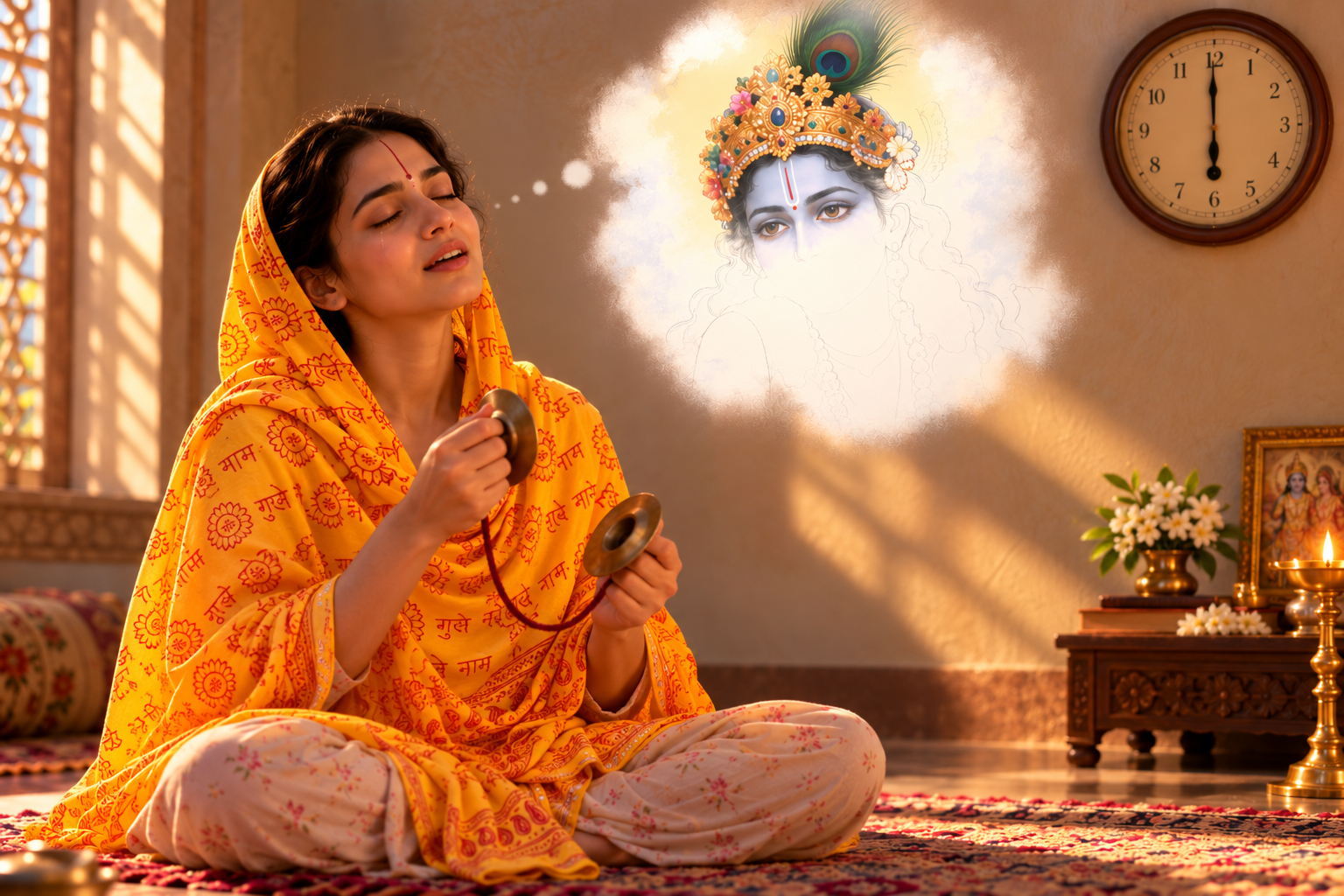
Why Is Loving Remembrance of God Essential?
How can a material mind lovingly remember a Divine God it has never seen—and how can that remembrance lead to Him?
📍 Where You Are in the Inquiry
Sadhana Bhakti (साधना भक्ति | sādhanā bhakti) must be selfless. Karm and Gyan must not be allowed to obstruct it. The devotee develops an intimate relationship with God through Bhav and directs the mind single-mindedly toward the Divine Beloved.
But all of these conditions lead to a practical question:
What are we actually supposed to do with the mind?
The fifth and most important condition of Sadhana Bhakti is loving remembrance or Roop Dhyan (रूपध्यान | rūpadhyāna).
The mind is the cause of both bondage and liberation. Whether our devotion is directed toward the world or toward God, it is the mind that performs it. If the mind is not lovingly remembering Krishn, it will inevitably run toward the world because both the mind and the material world arise from Maya (माया | māyā).
Therefore, the mind must be absorbed in the loving remembrance of God.
But this immediately creates a difficulty.
How can we remember the Divine form of someone we have never seen?
Should We See God First and Meditate Afterwards?
A natural argument might be:
Show me God just once. Once I have seen Him, I will be able to remember Him and meditate upon Him.
But consider what this request actually means.
It asks for the result of devotion before doing the devotion.
We do not first receive a degree and then take the examination. Hunger is not first satisfied and food eaten afterwards. We do not first harvest fruit and then plant the tree.
The order is the opposite.
First we perform selfless, single-minded devotion, lovingly remembering Krishn's form, name, virtues, and Leelas (लीला | līlā). Then, through His Grace, we become qualified to receive His Divine vision.
There is another reason why seeing God first would not solve the problem.
It could actually create a much greater one.
Material Eyes Cannot See God's Divine Form
God's beauty is described as surpassing the combined beauty of innumerable Kamdevs. Great Paramhansas such as Janak and Sanakadik became irresistibly attracted upon seeing His form.
Why, then, wouldn't anyone who saw God immediately become absorbed in Him?
Because the Saints did not see Him with material senses.
Tulsidasji explains:
चिदानन्दमय देह तुम्हारी ।
विगत विकार जान अधिकारी ॥
cidānandamaya deha tumhārī |
vigata vikāra jāna adhikārī ||
“O my beloved Ram! Your eternal Divine body is the embodiment of Divine knowledge and Bliss. This Divine form cannot be seen with material eyes. Only the Saints who have Divine senses can visualize Your Divine beauty.”
God's form is Divine. Our present senses are material.
Therefore, if God were standing before us while we still possessed material senses, we would not necessarily perceive the Divinity that the Saints perceive.
We could see Him and conclude that He was merely human.
Far from strengthening faith, such a perception could destroy it.
Why Did Different People See the Same Ram Differently?
The Ramayan reveals this principle when Bhagwan Ram stood in the assembly of Janakpur.
जाकी रही भावना जैसी । प्रभु मूरति देखी तिन तैसी ॥
jākī rahī bhāvanā jaisī |
prabhu mūrati dekhī tina taisī ||
(Ramayan)
Everyone perceived Bhagwan Ram according to the inner quality of the heart.
Warriors saw the embodiment of heroism. Wicked kings saw a terrifying form. Demons saw death. Gyanis perceived the universal form. Yogis perceived the peaceful effulgence of absolute truth. Devotees saw their beloved God.
And Sita's intimate loving experience of Ram was beyond description.
The same Bhagwan Ram stood before everyone.
Yet everyone did not experience the same Ram.
Shri Maharaj Ji illustrates the reason through ordinary perception. A person suffering from jaundice sees a white object as yellow. An ant carrying a grain of salt in its mouth can walk over a pile of sugar and still taste salt.
The object has not changed.
The condition of the perceiver determines what is experienced.
The Bhagwatam establishes the same principle when Krishn entered Kans's assembly:
मल्लानामशनिर्नृणां नरवरः स्त्रीणां स्मरो मूर्तिमान् ।
गोपानां स्वजनोऽसतां क्षितिभुजां शास्ता स्वपित्रोः शिशुः ।
मृत्युर्भोजपतेर्विराडविदुषां तत्त्वं परं योगिनां ।
वृष्णीनां परदेवतेति विदितो रङ्गं गतः साग्रजः ॥
mallānām aśanir nṛṇāṁ naravaraḥ strīṇāṁ smaro mūrtimān |
gopānāṁ svajano'satāṁ kṣitibhujāṁ śāstā svapitroḥ śiśuḥ |
mṛtyur bhojapater virāḍ aviduṣāṁ tattvaṁ paraṁ yogināṁ |
vṛṣṇīnāṁ paradevateti vidito raṅgaṁ gataḥ sāgrajaḥ ||
(Bhagwatam 10.43.17)
The wrestlers, ordinary people, women, Gwalbals, wicked kings, Krishn's parents, Kans, Yogis, and Yadavas all perceived the same Krishn differently.
Therefore, merely seeing God does not qualify us to perceive His Divinity.
First comes devotion.
Through devotion comes qualification.
And through Divine qualification comes Divine vision.
We Do Not Have to Experience Divine Bliss Before Seeking It
Another objection may arise.
Don't we normally experience something first and then develop a desire for it?
Not necessarily.
Someone aspiring to become a deputy commissioner may spend years studying and preparing for the I.A.S. examination. He has never experienced the happiness of holding that position.
He has anticipated it.
The intoxicating effect of alcohol cannot be experienced without drinking it. The sweetness of candy cannot be experienced merely by looking at it.
Happiness itself is not something the eyes can see.
Yet what we already know can give us some conception of something greater. Someone who knows the sweetness of raw sugar and hears about exceptionally delicious candy can become eager to taste it without having tasted it before.
Similarly, contemplation of Divine attainment can awaken Divine ambition.
Freedom from Maya. Freedom from material suffering. Eternal Divine Bliss. Divine vision. A Divine body.
We do not need to possess these before beginning devotion.
Their promised attainment gives us reason to begin.
But now we reach a much deeper problem.
If the Mind Is Material, How Can It Imagine a Divine God?
The scriptures establish:
गो गोचर जहँ लगि मन जाई ।
सो सब माया जानेहु भाई ॥
go gocara jahaṁ lagi mana jāī |
so saba māyā jānehu bhāī ||
(Ramayan)
Whatever lies within the range of the material mind and senses belongs to Maya.
The Ved also states:
यतो वाचो निवर्तन्ते अप्राप्य मनसा सह ।
yato vāco nivartante aprāpya manasā saha
(Ved)
God is beyond the reach of the material mind, senses, and intellect.
Now the difficulty becomes unavoidable.
Our mind is material.
Its thoughts are material.
God is Divine.
Therefore, whatever form of God we imagine with our present mind must also be a material imagination.
So how can meditating upon a material image created by a material mind possibly produce a Divine result?
This is the central question behind Roop Dhyan.
The Gopis Reveal the First Part of the Answer
The Bhagwatam describes Gopis who loved Shree Krishn without knowing that He was the Supreme God:
तमेव परमात्मानं जारबुद्ध्यापि संगताः ।
जहुर्गुणमयं देहं सद्यः प्रक्षीणबन्धनाः ॥
tam eva paramātmānaṁ jāra-buddhyāpi saṅgatāḥ |
jahur guṇamayaṁ dehaṁ sadyaḥ prakṣīṇa-bandhanāḥ ||
(Bhagwatam 10.39.11)
They loved Him as their soul beloved—and attained God realization.
Krishn states:
ददामि बुद्धियोगं तं येन मामुपयान्ति ते ॥
dadāmi buddhiyogaṁ taṁ yena mām upayānti te
(Gita 10.10)
Those who completely surrender to Him receive His Grace.
Shri Maharaj Ji compares this to fire. Something placed into fire is burned whether the person placing it there understands the nature of fire or not.
Similarly, during God's descension, someone may lovingly unite the mind with Him knowing that He is God, while another may truly love Him without that knowledge.
The loving attachment can lead to Divine attainment.
But that raises another tempting thought:
Wouldn't it therefore have been easier if we had lived when God descended on earth?
Seeing God During His Descension Was Not Necessarily Easier
We have already been present during uncountable descensions of God.
The problem was not God's absence.
The problem was our inability to recognize Him.
When Bhagwan Ram's Divine actions appeared materially comprehensible, people could misunderstand Him precisely because they were looking through material consciousness.
After Sita was abducted, the Valmiki Ramayan describes Ram in the ecstasy of Divine separation. He asked Lakshman who He was, why they were in the forest, and whom they were searching for. Remembering Janaki, He cried out for Her and became unconscious.
The Ramayan also describes Him asking birds, animals, bumblebees, trees, and creepers whether they had seen Sita.
To material reasoning, such behavior could appear irrational.
If an ordinary man today wandered around asking trees and animals where his missing wife had gone, we would not conclude that he was God.
We might conclude the opposite.
Thus even direct physical proximity to a Divine descension does not guarantee recognition. God's Divine but material-looking actions can bewilder a mayic mind.
So waiting to see God first is not the solution.
We return to our original problem.
How can the material mind perform Roop Dhyan and receive a Divine result?
Why Doesn't Material Imagination Produce Only a Material Result?
Suppose someone looks at a ball of cow dung and sincerely believes it to be a delicious sweet.
Will belief make it taste like candy?
No.
Suppose someone drinks milk containing poison while sincerely believing that it is pure.
Ordinary belief does not change the material properties of the poison.
So why should imagining Divinity in a material Deity, picture, or mentally created form be any different?
This objection must be answered before Roop Dhyan can be properly understood.
There are animate and inanimate material objects.
If we imagine one ordinary inanimate object to be another, imagination does not transform its material nature.
Likewise, if we look at a photograph of an ordinary person and lovingly call that person in our mind, the person in the photograph does not know what we are thinking and cannot instantly appear before us.
But God is not like that person.
God is omnipresent, omniscient, almighty, and Gracious.
That changes everything.
God Responds to the Feeling Directed Toward Him
When Divine feelings are placed in a material object or living being for God, the result can be Divine because God knows exactly what is occurring in the devotee's heart.
The material object does not create the Divine result.
God Graces the devotee in response to the sincere feeling directed toward Him.
An objection may still remain.
If faith in God produces Divine consequences, shouldn't someone be able to drink poison without dying simply because he believes God will protect him?
Only if that faith is perfect, unswerving, and single-minded.
The Divine benefit received corresponds to the degree of faith.
Meerabai drank poison and remained unharmed through her unwavering faith in Krishn. Bhakt Prahlad entered blazing fire and remained unharmed because he saw his beloved God everywhere.
Full Divine benefit requires full faith.
Our present thoughts may technically be material, but God is omniscient. He knows that the seeker's sincere intention is to attain His Divine vision and Divine love.
And He Graces accordingly.
The Same Material Mind Can Produce Two Entirely Different Destinations
Consider what happens when the mind becomes absorbed in ordinary worldly relationships.
It may become deeply attached to husband, wife, children, or others. The feelings can be intense and sincere.
But their object remains worldly.
The result therefore remains material: temporary happiness followed by sorrow, continued attachment, and continuation within the cycle of birth and death.
Now consider the same material mind lovingly absorbed in a form toward which the seeker maintains Godly feelings.
The mind is still presently material.
The imagined form is presently material.
But the sincere, selfless love is being offered to God.
God knows that intention and Graces the devotee.
Therefore, the result is Divine.
This is how selfless loving remembrance of God has led uncountable souls to God realization.
Why Deity Worship Makes Sense
This principle also explains Deity worship.
If Divine feelings can be imbued in an animate or inanimate material object, why use a Deity, picture, or mentally imagined form?
Because maintaining Divine feelings toward an inanimate object is comparatively easier.
Maintaining them toward a living person is much more difficult.
We see the person's behavior. We notice apparent faults. Worldly judgments arise. The feeling of Divinity can repeatedly disappear.
Meditation upon a true Divine Spiritual Master certainly produces a Divine result. But the devotee must continuously maintain the feeling that the Spiritual Master is Divine. Repeatedly seeing him with worldly feelings creates spiritual transgressions that damage devotion.
A lifeless object presents fewer such difficulties.
Thus Deity worship provides a practical means through which the mind can maintain Divine feelings toward God.
So What Is Roop Dhyan?
Roop Dhyan does not require us somehow to manufacture God's actual Divine form with a material mind.
For loving remembrance, we may use:
- a Deity;
- a picture;
- or a form of God created through our own imagination.
Then we lovingly meditate upon Him.
God knows every thought and intention. The important thing is to give the mind somewhere to become absorbed in the love of the all-loving and all-Gracious God.
Without that loving remembrance, devotional activity can remain merely physical.
The body may perform worship.
The mouth may chant.
The hands may carry out rituals.
But if the mind is elsewhere, the essential devotion of the mind has not occurred.
Loving remembrance is what turns devotional activity into devotion.
Why Not Simply Concentrate the Mind on Something?
Some practices attempt to control the mind by concentrating upon a dot, a candle flame, an image, or another neutral object.
But merely restraining the mind creates two problems.
First, until the mind experiences devotional love, it will continue to be attracted toward materiality.
Second, temporary concentration does not eliminate the Sanskars (संस्कार | saṁskāra) accumulated from past lives or the underlying mayic ignorance. Even if the mind becomes temporarily still, its previous worldly tendencies can return.
The objective is therefore not merely to make the mind still.
It is to make the mind love God.
Absorbing the mind in God's personal form, His name, His virtues, and His loving Leelas is natural, easy, simple, and most effective.
The mind that previously ran toward the world is progressively given a Divine Beloved toward whom it can run instead.
What Should We Feel During Roop Dhyan?
During devotion, meditate upon God's form while maintaining the feeling that He is your Divine Beloved.
Feel:
My soul beloved God is my everything.
He is always with me, everywhere.
He is mine.
He is my Protector.
This is not merely an image upon which the mind concentrates.
It is a relationship.
The form gives the mind somewhere to rest. Bhav gives that form the intimacy of the Divine relationship. Ananyata keeps the mind directed toward Him alone. Selflessness turns the relationship away from our own happiness and toward the happiness of the Beloved.
The conditions of Sadhana Bhakti are now coming together in the mind.
Roop Dhyan Does Not End When Meditation Ends
There is one final danger.
During formal meditation, we may lovingly feel:
My beloved God is here with me.
Then meditation ends.
We get up—and forget Him.
We return immediately to worldly consciousness and behave as though the Divine Beloved we were just experiencing is no longer present.
Shri Maharaj Ji gives a simple comparison.
Suppose someone earns money and shortly afterwards loses it.
What practical benefit came from earning it?
Similarly, the feeling developed during meditation should not be repeatedly gained and then lost.
The Divine Beloved is not present only while we meditate.
The feeling must gradually accompany us beyond the period of formal Sadhana:
He is always with me.
He is everywhere.
He is mine.
Where This Inquiry Leads
The fifth and most important condition of Sadhana Bhakti is loving remembrance.
The mind cannot remain inactive. If it is not absorbed in God, its natural affinity with Maya draws it toward the world. Therefore, devotion must take place in the mind through loving remembrance of God's form, name, virtues, and Leelas.
We do not need to see God's Divine form before beginning. Material eyes could not perceive its Divinity anyway. Nor does the material nature of our present imagination prevent Roop Dhyan from producing a Divine result.
The decisive factor is not whether the image presently formed by our material mind is itself Divine.
The decisive factor is whom we love through it.
God is omniscient, omnipresent, almighty, and Gracious. He knows that the seeker's selfless loving feelings are directed toward Him, and He gives the Divine consequence.
A Deity, picture, or mentally imagined form can therefore give the mind a place to become lovingly absorbed in God.
And that loving remembrance should not disappear when formal meditation ends.
The seeker gradually learns to live with the continuous feeling:
My Divine Beloved is always with me.
This establishes why Roop Dhyan is essential. But Shri Maharaj Ji now leaves us with the next question:
Which form of God is most desirable to meditate upon?
Go Deeper
- Roopdhyan — Devotional Remembrance — Explore how loving remembrance of God's form becomes the central practice of devotion.
- Is Worship of Idols Right? — Understand how worship through a material form can lead to a Divine result.
- Why Do People Worship "Idols"? — Discover why a visible form can help the material mind develop loving remembrance of God.
- Uniqueness of Shri Krishna's Divine Form — Explore the Divine nature and unique qualities of Shri Krishna's form contemplated in Roop Dhyan.
- Navadha Bhakti
- Smaran
- Nirantar
- Leela
Related Practices
Continue the Inquiry
Part 6 of 6 — Bhakti Yoga — The Path
Loving remembrance brings the five conditions of Sadhana Bhakti together in the mind. Through Roop Dhyan, the devotee lovingly absorbs the mind in the Divine Beloved and gradually carries the feeling of His presence beyond formal meditation. But having established the necessity of loving remembrance, another question naturally arises: which form of God is most desirable to meditate upon?
- ⬅️ Previous: Why Is Single-Minded Devotion Essential?
- ➡️ Next: TBD
- 🔙 Back to Hub: Bhakti Yoga — The Path