Why Is Single-Minded Devotion Essential?
Can the heart belong wholly to Shyam Sundar while it still depends upon other sources of happiness and security?
📍 Where You Are in the Inquiry
Sadhana Bhakti (साधना भक्ति | sādhanā bhakti) begins with selflessness. Karm and Gyan must not be allowed to obstruct devotion. And rather than remaining distant from God because of constant awareness of His majesty, the devotee establishes an intimate relationship with Him through Bhav.
The fourth condition now concerns where that love is directed.
Can we love Shyam Sundar while continuing to depend upon other sources for our happiness, security, and fulfillment? Can the same mind remain attached to the world, seek blessings from different Divine powers, and still be single-mindedly devoted to Krishn?
The scriptures repeatedly establish another essential condition of devotion: Ananyata (अनन्यता | ananyatā), or single-mindedness.
Its literal meaning is simple:
No other.
What Does Ananyata Mean?
Ananyata means to love only Shyam Sundar and no other.
If something other than Krishn continues to occupy the devotee's mind as an object of attachment or dependence, single-mindedness is obstructed. Krishn cannot become the devotee's Divine Beloved while the heart continues to rely elsewhere.
The Bhagavad Gita declares:
अनन्याश्चिन्तयन्तो मां ये जनाः पर्युपासते ।
तेषां नित्याभियुक्तानां योगक्षेमं वहाम्यहम् ॥
ananyāś cintayanto māṁ ye janāḥ paryupāsate |
teṣāṁ nityābhiyuktānāṁ yogakṣemaṁ vahāmy aham ||
(Bhagavad Gita 9.22)
“I take complete responsibility for those devotees who worship Me single-mindedly and remain constantly absorbed in Me.”
But what does no other actually require?
The rescue of Draupadi reveals how subtle this condition can be.
When Every Other Support Disappears
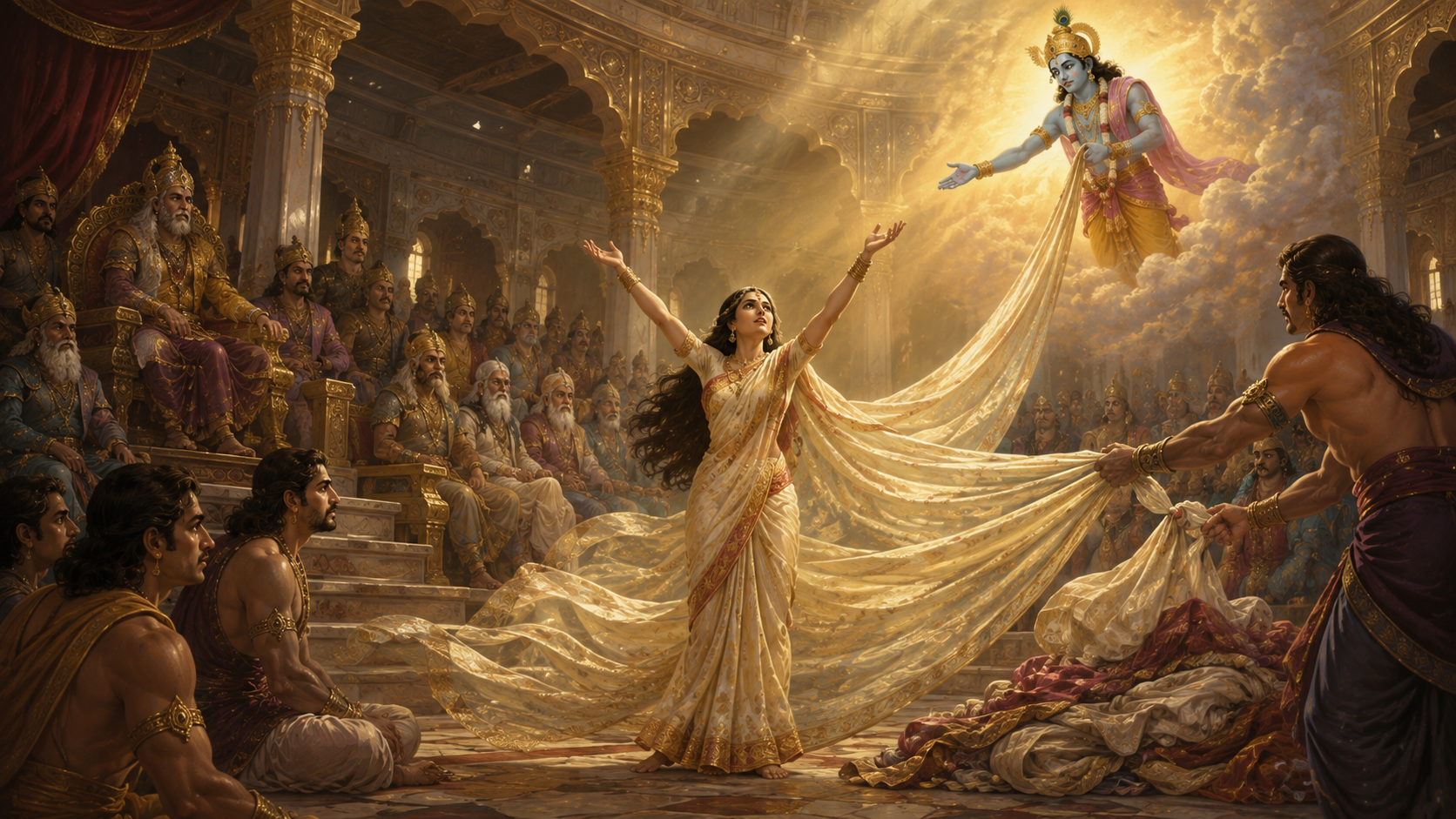
When Dushasan dragged Draupadi into the assembly to strip her, she first thought of her five husbands—Yudhisthir, Bheensen, Arjun, Nakul, and Sahdev.
Surely they would protect her.
But having lost her in gambling, they remained silent.
That support disappeared.
Draupadi then looked toward the great and wise men of the court—Bhishm Pitamah, Dronacharya, and others.
Surely they would intervene.
They too remained silent.
She looked around the assembly for someone else who might help her.
No one did.
One source of reliance after another had disappeared.
But one remained.
Herself.
Draupadi clenched her sari between her teeth, determined to protect herself. Yet what strength did she possess against Dushasan, who had the strength of ten thousand elephants?
At that very time, Krishn was eating His meal in Dwarika.
Suddenly He stopped.
A morsel remained in His mouth and another in His hand. His eyes remained open and unblinking.
Rukmini noticed His unusual state and asked what had happened.
Krishn replied that one of His devotees was in serious trouble.
Why, then, did He not go to save her?
The answer returns us to the Gita:
अनन्याश्चिन्तयन्तो मां ये जनाः पर्युपासते ।
तेषां नित्याभियुक्तानां योगक्षेमं वहाम्यहम् ॥
ananyāś cintayanto māṁ ye janāḥ paryupāsate |
teṣāṁ nityābhiyuktānāṁ yogakṣemaṁ vahāmy aham ||
(Bhagavad Gita 9.22)
Krishn assumes complete responsibility for the devotee who is fully surrendered to Him.
Draupadi had relinquished dependence upon her husbands, the elders, and everyone around her.
But she still had faith in her own strength.
Then Dushasan jerked the sari from her teeth.
That final support disappeared.
Draupadi wholeheartedly cried to Dwarkavasin Shree Krishn to save her.
She had become ananya.
Krishn instantly came to her aid, taking the form of an endless sari until Dushasan finally gave up.
Ananyata therefore concerns far more than which form of God appears on our altar. Even reliance upon one's own strength can stand between the devotee and complete single-mindedness.
This is why Ananyata is such an important condition of devotion—and one that can easily be overlooked.
There Is Only One Mind
The same principle applies to attachment.
Some people worship God while also worshipping celestial gods and maintaining worldly attachments.
But we possess only one mind.
If that mind is to belong to Shyam Sundar, subject matter belonging to the Mayic (मायिक | māyika) field cannot continue occupying it as competing objects of attachment.
This becomes especially important when worship itself is motivated by worldly desire.
People may worship different gods and goddesses, visit different temples, and seek whichever Divine or celestial power they believe may grant a particular worldly blessing.
But if God is the origin of all material and Divine powers, why is such divided devotion necessary?
Single-minded devotion to God does not dishonor the Divine powers.
On the contrary, the scriptures establish that worshipping the source satisfies them all.
Worship the Root, and the Whole Tree Is Nourished
Bhakti Rasamrit Sindhu states:
येनार्चितो हरिस्तेन तर्पितानि जगन्त्यपि ।
रज्यन्ते जन्तवस्तत्र स्थावरा जङ्गमा अपि ॥
yenārcito haris tena tarpitāni jaganty api |
rajyante jantavas tatra sthāvarā jaṅgamā api ||
(Bhakti Rasamrit Sindhu)
“By worshipping Hari, the entire universe and all beings within it are satisfied.”
Ved Vyas explains the principle through the root of a tree:
यथा तरोर्मूलनिषेचनेन तृप्यन्ति तत्स्कन्धभुजोऽपशाखाः ।
प्राणोपहाराच्च यथेन्द्रियाणां तथैव सर्वार्हणमच्युतेज्या ॥
yathā taror mūlaniṣecanena tṛpyanti tat-skandha-bhujopaśākhāḥ |
prāṇopahārāc ca yathendriyāṇāṁ tathaiva sarvārhaṇam acyutejyā ||
(Bhagavat 4.31.14)
“Just as watering the root of a tree nourishes its trunk, branches, and smaller branches, worship of Achyut satisfies all who are worthy of worship.”
When water is poured upon the root, it naturally reaches the branches, leaves, flowers, and fruits. There is no need to water every part separately.
Bhagwan Krishn is the source of all Divine powers. Therefore, worshipping Him naturally accomplishes their worship.
The reverse does not work. Pouring water separately upon the branches, leaves, flowers, and fruits neither properly nourishes them nor supplies the root.
Similarly, selfish worship of various celestial or Divine powers neither constitutes single-minded devotion to God nor fulfills the purpose of Bhakti.
The conclusion is not that others should be disrespected.
Devotion belongs to supreme God; respect belongs to all.
Love One; Respect All
A faithful wife illustrates the distinction.
She loves her husband alone in that relationship.
But does that mean she disrespects everyone related to him?
No.
She respects his brothers, the elders of his family, her mother- and father-in-law, and other relatives. Her exclusive love for her husband does not require disrespect toward them.
Similarly, Ananyata does not mean hostility toward other Divine or celestial powers.
Exclusive devotion and universal respect are entirely compatible.
The Gita then makes the consequence of different forms of worship explicit.
यो यो यां यां तनुं भक्तः श्रद्धयार्चितुमिच्छति ।
तस्य तस्याचलां श्रद्धां तामेव विदधाम्यहम् ॥
yo yo yāṁ yāṁ tanuṁ bhaktaḥ śraddhayārcitum icchati |
tasya tasyācalāṁ śraddhāṁ tām eva vidadhāmy aham ||
(Bhagavad Gita 7.21)
“Whatever form a devotee sincerely desires to worship with faith, I make that faith steady in that very form.”
And:
यान्ति देवव्रता देवान् पितॄन्यान्ति पितृव्रताः ।
भूतानि यान्ति भूतेज्या यान्ति मद्याजिनोऽपि माम् ॥
yānti devavratā devān pitṝn yānti pitṛvratāḥ |
bhūtāni yānti bhūtejyā yānti madyājino'pi mām ||
(Bhagavad Gita 9.25)
“Those who worship celestial gods attain them; those who worship the ancestors attain the ancestors; those who worship other beings attain them; those who worship Me attain Me.”
The object of worship matters.
And throughout the Gita, Krishn repeatedly directs Arjun toward Himself alone.
“Surrender to Me Alone”
Krishn declares:
मामेव ये प्रपद्यन्ते मायामेतां तरन्ति ते ॥
mām eva ye prapadyante māyām etāṁ taranti te ||
(Bhagavad Gita 7.14)
“Those who surrender to Me alone cross Maya.”
Again:
तमेव शरणं गच्छ सर्वभावेन भारत ।
तत्प्रसादात्परां शान्तिं स्थानं प्राप्स्यसि शाश्वतम् ॥
tam eva śaraṇaṁ gaccha sarvabhāvena bhārata |
tatprasādāt parāṁ śāntiṁ sthānaṁ prāpsyasi śāśvatam ||
(Bhagavad Gita 18.62)
“Take refuge in Him alone with your whole being. By His Grace you will attain supreme peace and the eternal abode.”
And finally:
सर्वधर्मान्परित्यज्य मामेकं शरणं व्रज ।
अहं त्वां सर्वपापेभ्यो मोक्षयिष्यामि मा शुचः ॥
sarvadharmān parityajya mām ekaṁ śaraṇaṁ vraja |
ahaṁ tvāṁ sarvapāpebhyo mokṣayiṣyāmi mā śucaḥ ||
(Bhagavad Gita 18.66)
“Abandon all other forms of reliance and take exclusive refuge in Me alone. I will liberate you from all sins; do not grieve.”
The repetition is significant.
Ananyata is not a peripheral feature of devotion. Scripture repeatedly establishes exclusive surrender to God as one of its central conditions.
But there is another way divided devotion can disguise itself.
“God for Liberation, Others for the World”
Someone may argue:
I worship God for liberation. I worship other powers only for worldly attainments.
But this reveals a deeper problem.
Why are worldly attainments still being sought?
The first condition of Sadhana Bhakti required freedom from selfish desires—even the desire for liberation.
If worship is being divided because the mind still wants worldly happiness, the problem begins before Ananyata. The first condition of devotion itself has not yet been fulfilled.
It also reveals that the seeker has not fully understood an earlier conclusion:
Bliss exists in God alone.
Even if, merely for the sake of argument, we assumed that worldly objects contained happiness, God is still the Master of the entire material creation. Why would it be necessary to leave Him and seek those attainments elsewhere?
The justification for divided worship therefore does not solve the problem. It exposes the material desires that remain ingrained in the mind from uncountable lifetimes.
Yet this raises an important distinction.
Does Ananyata mean that a devotee of one Divine form must reject every other Divine descension of God?
Ananyata Does Not Divide God's Divine Descensions
No.
Along with God, worship of His Divine descensions, or Avatar (अवतार | avatāra), does not obstruct Ananyata.
The error lies in regarding God's Divine descensions as separate from one another.
A devotee of Bhagwan Ram may think:
If Ram is my Ishtdev (इष्टदेव | iṣṭadeva), how can I also become devoted to Krishn? Would changing the form I worship make me disloyal to Ram?
Shri Maharaj Ji identifies such thinking as ignorance.
Treating the Divine descensions as though they were separate competing divinities misunderstands their relationship and can lead to spiritual transgression, or Namapradh (नामापराध | nāmāparādha).
At this point, however, the teaching deliberately stops.
The secret underlying the relationship among the Divine descensions is to be explained later.
We should therefore not try to resolve it here.
For now, the distinction is sufficient:
Ananyata excludes competing objects of attachment and reliance. It does not require treating God's own Divine descensions as separate from one another.
Where This Inquiry Leads
The fourth condition of Sadhana Bhakti is Ananyata—“no other.”
Its implications reach into both attachment and reliance.
Draupadi's rescue shows how subtle reliance can be. Her husbands could not save her. The elders did not save her. No one in the assembly saved her. Yet complete reliance upon Krishn arose only when dependence upon even her own strength disappeared.
The scriptures then broaden the principle.
There is only one mind. If that mind is to belong to Shyam Sundar, devotion cannot remain divided among God, worldly attachments, and other powers sought for material fulfillment.
Nor does exclusive devotion require disrespect toward anyone else.
Love one. Respect all.
Just as watering the root nourishes the entire tree, devotion to Krishn satisfies all Divine powers because He is their source. And the Gita repeatedly directs the devotee toward exclusive surrender to Him.
Ananyata therefore does not mean narrowness, sectarianism, or rejection of God's Divine descensions.
It means that the heart has no competing center.
But even if Shyam Sundar alone is our Divine Beloved, one final practical question remains.
How do we actually attach this one mind to Him?
That brings us to the fifth and final condition of Sadhana Bhakti.
Go Deeper
Continue the Inquiry
Part 5 of 6 — Bhakti Yoga — The Path
Single-minded devotion means loving and depending upon the Divine Beloved alone. But even when devotion is selfless, intimate, and single-minded, it must actually take place in the mind. This leads to the fifth and most important condition of Sadhana Bhakti: how do we lovingly absorb the mind in God through remembrance and Roop Dhyan?
- ⬅️ Previous: Move Beyond God's Majesty to an Intimate Relationship with Him
- ➡️ Next: Why Is Loving Remembrance of God Essential?
- 🔙 Back to Hub: Bhakti Yoga — The Path