Can Spiritual Teachings Become Kusang?
Can reading scripture or hearing another valid spiritual teaching become Kusang? Discover why spiritual guidance and steadfast devotion are essential.
📍 Where You Are in the Inquiry
We have seen that Kusang should be avoided before its influence becomes established in the mind. Reading, listening, and seeing provide material for repeated thought, and repeated thought can lead to attachment. Even understanding this process does not make a devotee immune to it.
But this raises a much subtler question. What if the subject being read or heard is itself spiritual?
Surely study of the Vedas, Puranas, Upanishads, and other scriptures cannot itself be called ordinary Kusang. They were revealed by God and produced by Saints. The subject matter is not material, false, or inherently bad. And yet, it can hinder rather than help the devotee because it creates confusion or doubt in the mind.
Can Reading Scripture Create Confusion?
The difficulty is not with the scriptures themselves.
The difficulty arises when a material mind and intellect attempt to determine their Divine meaning independently.
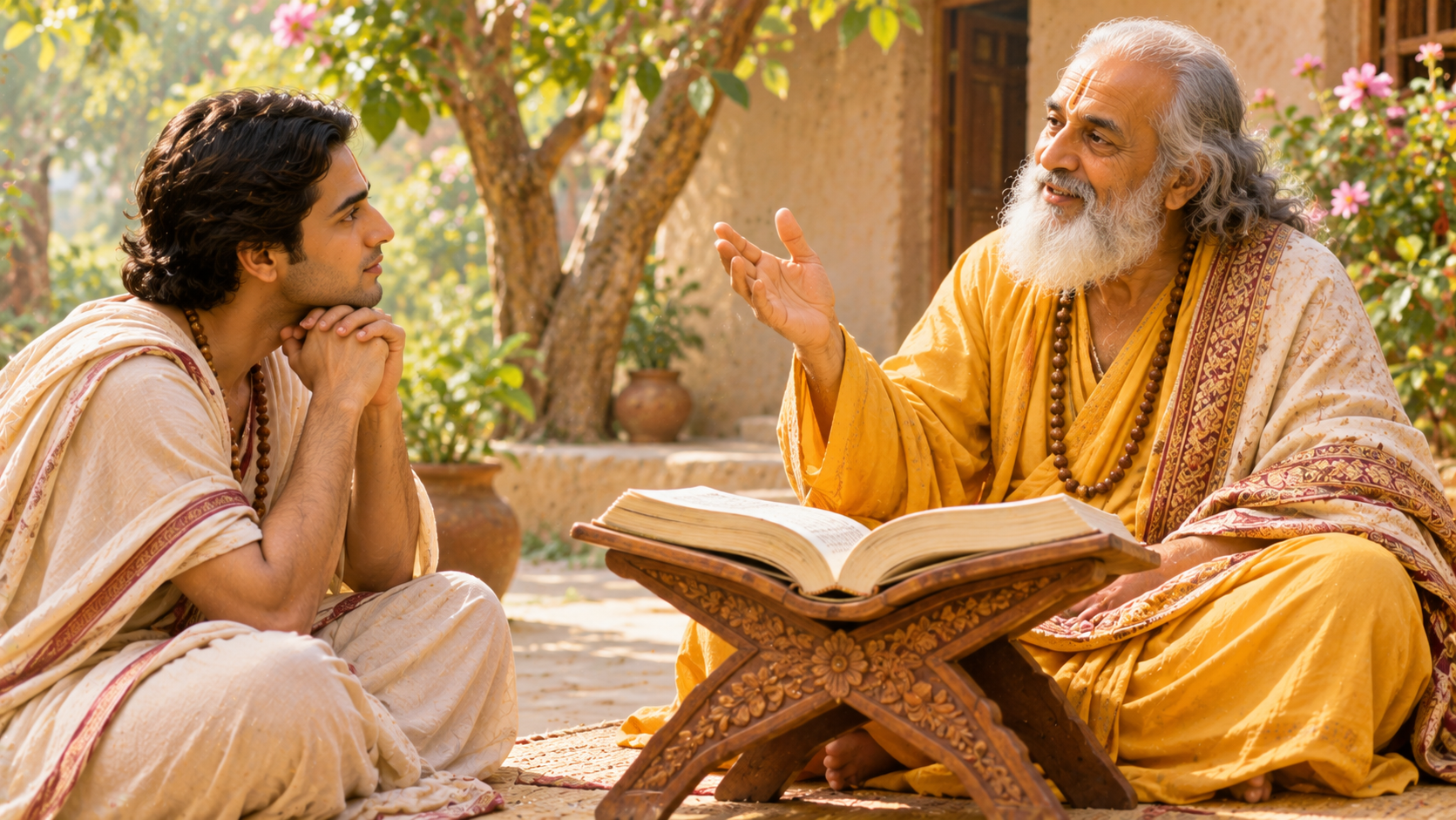
The scriptures contain Divine knowledge. Their Divine meaning cannot be independently determined by the material mind and intellect, which have no experience of the Divine reality being described. Without the guidance of a God realized Saint, attempts to reconcile their teachings will instead multiply doubts.
The Bhagavad Gita therefore directs the seeker toward a God realized teacher:
तद्विद्धि प्रणिपातेन परिप्रश्नेन सेवया।
उपदेक्ष्यन्ति ते ज्ञानं ज्ञानिनस्तत्त्वदर्शिनः॥
tad viddhi praṇipātena paripraśnena sevayā ।
upadekṣyanti te jñānaṁ jñāninas tattvadarśinaḥ ॥
(Bhagavad Gita 4.34)
“Understand this knowledge by approaching a realized teacher with humility, sincere inquiry, and service. Those who have realized the Truth will instruct you in that knowledge.”
The scripture itself therefore establishes that Divine knowledge is to be received through one who has realized the Truth.
Why Independent Interpretation Can Multiply Doubts
Saint Tulsidas gives a warning about attempting to determine scriptural truth independently:
श्रुति पुराण बहु कहेउ उपाई।
छूट न अधिक अधिक अरुझाई॥
śruti purāṇa bahu kaheu upāī ।
chūṭa na adhika adhika arujhāī ॥
“If you try to ascertain the Divine truth of the scriptures on your own without the help of a true Saint, then instead of removing your doubts, you will further increase your confusion.”
A seeker may enter the scriptures looking for the answer to one question. But without understanding the Divine principles underlying their teachings, the attempted answer will produce many additional questions.
The problem becomes even more difficult because the scriptures contain teachings given by many Rishis and Munis and, when read without the necessary understanding, may even appear to contradict one another:
मुनि बहु, मत बहु, पंथ पुराननि, जहाँ तहाँ झगरो सो।
muni bahu, mata bahu, pantha purānani, jahāṁ tahāṁ jhagaro so ।
(Vinay Patrika)
The intellect is material. Its experiences are also only material. If it attempts to interpret these Divine teachings independently, it imposes material meanings upon them. Instead of strengthening devotion, the resulting confusion further disturbs the devotional heart.
Association with scripture is therefore not itself bad association. The danger lies in trying to determine Divine truth independently with an intellect that does not possess Divine experience.
Beginning to resolve doubts requires the association of a true Saint.
What If the Other Teaching Is Also Scripturally Valid?
The difficulty does not end once a seeker accepts scripture under spiritual guidance.
There are many paths described in the scriptures. A seeker established in one path may hear the teachings of another and discover that they sound very different from what he has been taught.
Suppose a practitioner of Bhakti (भक्ति | bhakti) listens to a Gyani (ज्ञानी | jñānī) Saint teaching the path of Gyan (ज्ञान | jñāna).
He may immediately think:
This is very different from what I have heard.
Doubt enters the mind.
His limited intellect is then faced with teachings that he is not capable of fully reconciling. Rather than becoming more firmly established, he may be pulled in different directions:
इतो भ्रष्टस्ततो भ्रष्टः।
ito bhraṣṭas tato bhraṣṭaḥ ।
He remains firmly established neither here nor there.
Even Different Methods Within One Path Can Create Doubt
This danger is not limited to hearing about an entirely different spiritual path.
Even within Bhakti there are different methods of devotion.
A disciple may hear about another method and begin thinking:
Perhaps that method is superior. After all, I have not yet attained God realization through the method I am following.
The teaching itself may be valid. Yet hearing has produced doubt about the path in the mind.
This is why the scriptures do not advise the seeker to listen to or read about other paths described in scripture. The seeker should therefore remain exclusive to his path, Guru, and Deity.
The question is not whether the other path is false. The question is what that exposure does to the seeker's own devotional practice.
But Thinking Negatively About Other Paths Is Not the Solution
There is also an opposite mistake.
Having decided to remain firmly established in one's own path, the devotee might begin to think negatively about another path or another method of devotion.
That too is a spiritual transgression (namaparadh).
The disciple therefore has to preserve two things simultaneously: steadfastness in the path taught by the Guru, and freedom from negativity toward other paths.
So, think about, meditate upon, and follow the path taught by your own Guru while maintaining no negative attitude toward followers of other paths or toward those following another method within the same path.
Different forms of devotion are acceptable. The practitioner should follow what is favorable for his own devotional development.
Where This Inquiry Leads
Spiritual subject matter is not automatically spiritually beneficial merely because it comes from scripture or describes a valid spiritual path.
The Vedas, Puranas, Upanishads, and other scriptures are Divine. Yet their Divine meaning cannot be independently determined by the material intellect. Scripture itself directs the seeker toward a God realized Guru who has realized the Truth.
Similarly, another spiritual path may be completely valid and still be unsuitable for a disciple to explore while trying to become established in the path given by his own Guru, the chosen Spiritual Master. Such exposure can create doubt and weaken focused practice.
But the solution is not to conclude that other valid paths are wrong.
The devotee remains firmly established in the path taught by his Guru without developing ill feeling toward another path or its followers.
This leaves an important question unresolved:
If different Divine forms and valid devotional paths appear different, on what basis can we remain devoted to one without regarding the others as inferior?
Go Deeper
 JKP Literature

Why do genuine Vedic teachings seem to contradict one another?
 JKP Literature

Why can't my own intellect judge Divine truth independently?
 JKP Literature

Why is thinking negatively about another Divine path so serious?
Continue the Inquiry
(Part 4 of 6 — Kusang — The Danger)
A devotee should remain firmly established in the path given by the Guru without allowing other teachings to create doubt—and without developing negativity toward other valid paths. To understand how both can be true, we must next understand the relationship among the Divine forms themselves.
- ⬅️ Previous: What Forms of Kusang Should We Avoid?
- ➡️ Next: If All Divine Forms Are One, Why Choose One?
- 🔙 Back to Hub: Kusang — The Danger