If All Divine Forms Are One, Why Choose One?
If Shri Ram and Shri Krishna are the same Supreme God, why choose one for devotion? Understand how Divine unity and personal devotional attraction coexist.
📍 Where You Are in the Inquiry
The previous article established a delicate principle. A devotee should remain firmly established in the path given by your Guru, because exposure to other teachings can create doubt and disturb practice. Yet the devotee must not develop negative feelings toward other valid paths or methods.
Why not? Because difference in devotional practice does not mean difference in Divinity.
This raises the next question: if God's forms, descensions, and Saints appear different, how should a devotee understand their relationship—and why may the devotee still choose one particular form for devotion?
All Divine Names, Forms, Saints, and Descensions Are One
God's names, virtues, Leelas (लीला | līlā), abodes, and Saints are one. All Saints and all descensions of God are inseparable.
Therefore, negative feelings toward any one of them amount to negative feelings toward all.
Yet devotees commonly make precisely these distinctions. A devotee of Bhagwan Ram may criticize devotees of Bhagwan Krishn. A Shaivite may criticize a Vaishnava. Such criticism is a serious spiritual transgression (namaparadh).
This Divine knowledge must therefore become firmly established: different Divine forms do not represent competing Divinities.
But how can this be understood when their forms and Leelas appear so different?
Let us answer this through Bhagwan Ram and Bhagwan Krishn.
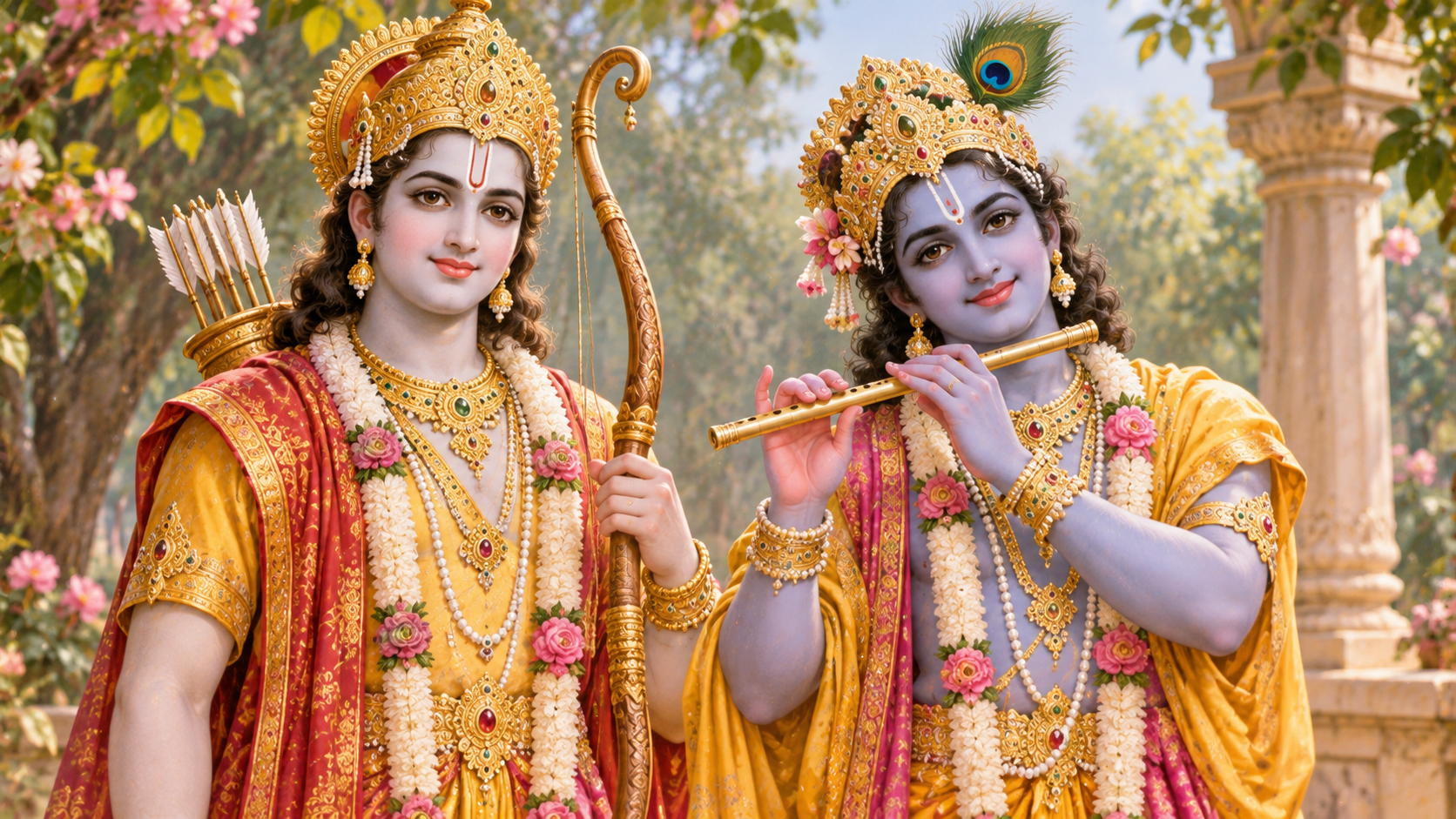
Ram and Krishn Are the Same Supreme God
Scripture itself connects the personalities who appear across these Divine descensions.
The Brahmavaivart Puran states:
त्वं सीता मिथिलायां च त्वच्छाया द्रौपदी सती।
रावणेन हृता त्वं च त्वं च रामस्य कामिनी॥
tvaṁ sītā mithilāyāṁ ca tvacchāyā draupadī satī ।
rāvaṇena hṛtā tvaṁ ca tvaṁ ca rāmasya kāminī ॥
(Brahmavaivart Puran, Ch. 124)
“O Radhika! You were Sita in Mithila, and Draupadi and others are Your reflections and expansions. Ravan abducted You, and You are the eternal consort of Bhagwan Ram.”
The Padma Puran similarly connects the two descensions:
पुरा महर्षयः सर्वे दण्डकारण्यवासिनः।
ते सर्वे स्त्रीत्वमापन्नाः समुद्भूताश्च गोकुले॥
purā maharṣayaḥ sarve daṇḍakāraṇyavāsinaḥ ।
te sarve strītvam āpannāḥ samudbhūtāś ca gokule ॥
(Padma Puran)
The sages of the Dandakarnya forest received Bhagwan Ram's boon that He would come as Krishna and Grace them with the experience of Divine love. Those sages later descended in Gokul as Gopis.
The scriptural accounts therefore do not present the descensions of Ram and Krishna as disconnected Divine personalities.
But an incident involving Goswami Tulsidas can appear, at first glance, to suggest otherwise.
Why Did Tulsidas Ask Krishna to Take Up the Bow?
When Tulsidas visited Vrindaban, he saw the Divine love form of Bhagwan Krishn playing the flute.
He said:
कहा कहौं छवि आजु की, भले बने हो नाथ।
तुलसी मस्तक तब नवै, धनुष बाण लेउ हाथ॥
kahā kahauṁ chavi āju kī, bhale bane ho nātha ।
tulasī mastaka taba navai, dhanuṣa bāṇa leu hātha ॥
Some interpret this to mean that Tulsidas refused to bow before Krishna and therefore regarded Ram and Krishna as different.
Shri Maharaj Ji points out the problem with that interpretation.
Tulsidas first addresses Krishn as “Lord.” He then asks that very Lord to take the bow and arrow.
The difference concerns Their Leelas. Krishna's flute represents the Divine love of Vrindaban, while Ram's bow and arrow represent the modest form of Divine love.
Therefore, even if the statement is understood as, I will bow when You take the form of Ram, it establishes the opposite of separation: Tulsidas is asking Krishna Himself to reveal the form of Ram.
Ram and Krishna are the same Supreme God. Their distinction here is a distinction of Leela.
Tulsidas's Own Bhav Explains His Request
Tulsidas practises Dasya Bhav (दास्य भाव | dāsya bhāva)—the devotional relationship in which one loves God as His servant. He is not relating to God as a beloved in the manner of the Gopis.
Vrindaban is the personal abode associated with the intimate loving relationship of those devotees who love God as their beloved. That is not Tulsidas's chosen Bhav.
Shri Maharaj Ji therefore understands his request to mean:
O Lord, I am Your servant, not Your beloved like the Gopis. Please take the bow and arrow and preserve the form appropriate to my relationship of servitude.
Who but Ram could fulfil such a request?
And why would Tulsidas make that request to anyone other than his own worshipped Lord?
His request to Krishna therefore does not establish separation between Ram and Krishna. It reveals the particular devotional relationship through which Tulsidas chooses to love the one Supreme God.
Tulsidas's Own Writings Join the Leelas of Ram and Krishna
The Vinay Patrika provides further evidence.
In prayers addressed to Ram, Tulsidas refers to incidents belonging to Krishna's Leelas.
In verse 199 he writes:
विन्दु गरीब निवाज राम को।
ध्रुव, प्रह्लाद, विभीषण, कपिपति, जड़, पतंग, पाण्डव, सुदाम को॥
Vindu garība nivāja rāma ko ।
dhruva, prahlāda, vibhīṣaṇa, kapipati, jaṛa, pataṅga, pāṇḍava, sudāma ko ॥
(Vinay Patrika, verse 199)
Shri Maharaj Ji points out references here to the Yamlarjun trees liberated by baby Krishna, the Pandavas, and Sudama, Krishna's childhood friend.
Elsewhere Tulsidas invokes further incidents from Krishna's descension while praying to Ram, including Kubja and Putna, as well as the Gopis and cowherds. Shri Maharaj Ji also points readers to verses 178, 83, 217, and 240 of the Vinay Patrika.
Why would Tulsidas present these acts to Ram if he believed the Lord performing Krishna's Leelas to be a different God?
His own prayers testify to the unity he understood.
Scripture Connects the Descensions Themselves
The Garg Sanhita records Bhagwan Ram declaring:
द्वापरान्ते करिष्यामि भवतीनां मनोरथम्।
dvāparānte kariṣyāmi bhavatīnāṁ manoratham ।
(Garg Sanhita 4.37)
“I will come in Dwapar yug as Krishna and fulfil your desires.”
Shri Maharaj Ji further explains that in a complete descension of God there are four expansions of His personality.
In Ram's descension these are Ram, Lakchman, Bharat, and Shatrughn.
In Krishna's descension they correspond respectively to Krishna, Balram, Pradyumn, and Aniruddh.
The scriptures thus establish the correspondence across the descensions.
Tulsidas was a Saint. To imagine that he regarded Ram and Krishna as different Gods would therefore itself be a serious spiritual transgression.
All descensions of God are one.
Oneness Does Not Require Identical Devotional Attraction
If all descensions are one, however, another question arises.
Must a devotee relate to all of Them in exactly the same way?
No.
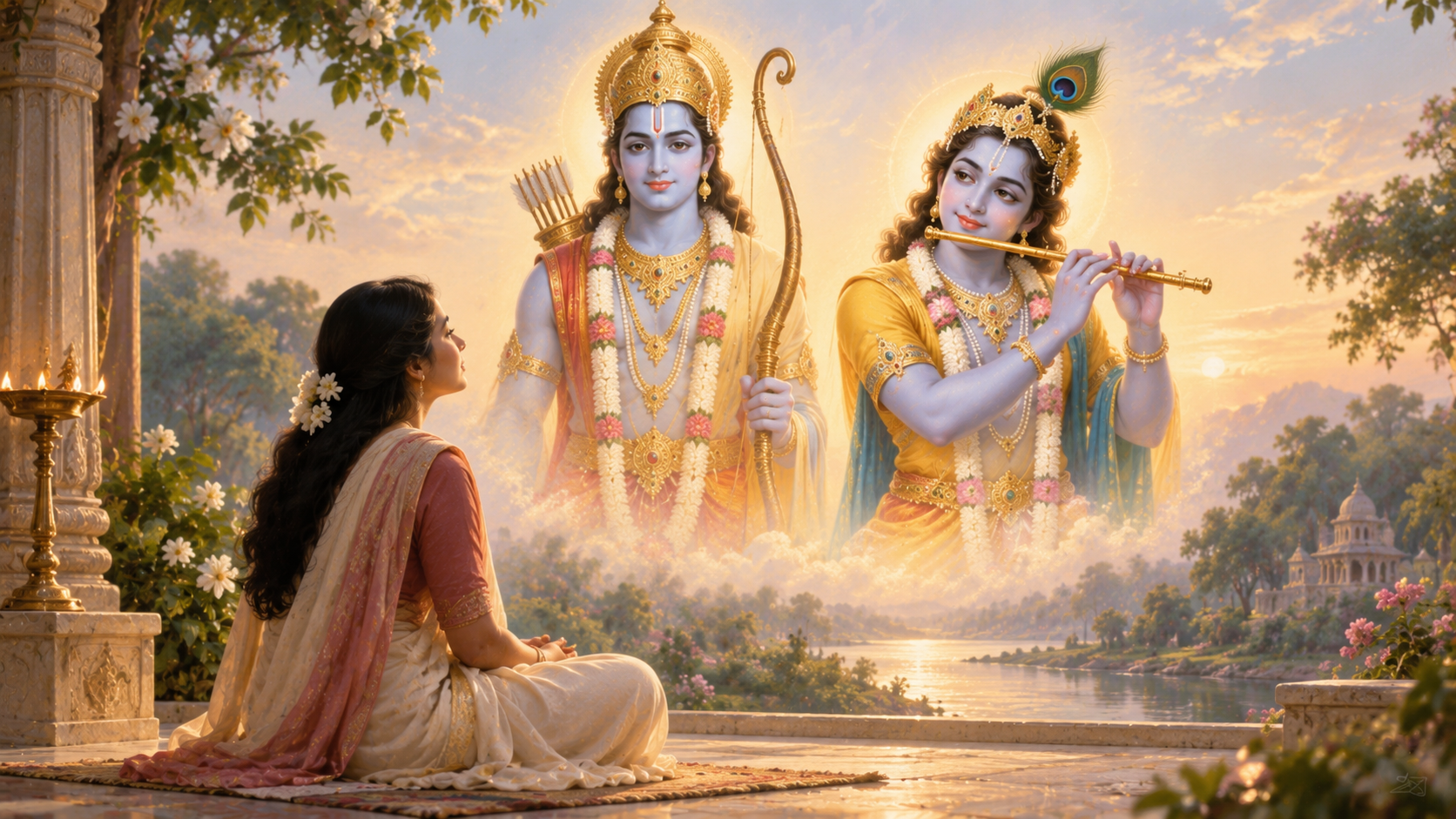
A person should devote himself to the descension whose Leelas especially attract his heart.
Some devotees of Ram may fear that becoming attracted to Krishna somehow means abandoning or changing their worshipped Lord. Shri Maharaj Ji explains why this is a misunderstanding.
Imagine a wife seeing her husband dressed in different styles of clothing. Her husband has not become another person merely because his appearance has changed.
Likewise, difference of Divine adornments and Leela does not mean difference of God.
Bhagwan Shankar Demonstrates This Freedom
Bhagwan Shankar is an incomparable devotee of Bhagwan Ram.
Yet during Krishna's descension, he came to Nand's house to see baby Krishn. He also came during the Maharas Leela (महारास लीला | mahārāsa līlā).
His devotion to Ram did not require him to regard Krishna as someone else.
The same continuity appears among the associates of the two descensions.
Lakchman appeared as Balram, Bharat as Pradyumn, and Shatrughn as Aniruddh. Sita appeared as Radha. Hanuman personally appeared on the chariot of Arjun and Krishn during the Mahabharat. Jamavant appeared again and fought alongside Krishn.
The women of Janakpur appeared as Gopis. Shurpanakha appeared as Kubja, and Ravan as Shishupal.
Thus the personalities associated with Ram's descension appear again within Krishna's descension.
The Devotee May Choose According to Attraction
The Divine unity of the descensions does not erase the distinctive sweetness of their Leelas.
Shri Maharaj Ji explains that Krishn's loving Leelas possess a special sweetness. Devotees had requested this loving sweetness from Ram during His descension, and it is revealed through Krishn's Leelas.
Philosophically, Krishna's Leelas are Ram's Leelas, because Ram and Krishna are the same Supreme God.
Yet devotional attraction may differ.
If a devotee is especially attracted to Ram's Tretayug (त्रेतायुग | tretāyuga) Leelas, he may take their support. If Krishn's Dwaparyug (द्वापरयुग | dvāparayuga) Leelas draw his heart more deeply, he may take their support.
As devotion progresses, hesitation about changing one's Ishtdev—the chosen Divine form—disappears because the devotee increasingly understands that the Divine forms are not different Gods.
For one who desires the intimate nectar of Divine love, Shri Maharaj Ji directs the devotee toward the loving Leelas of Krishn's descension.
Where This Inquiry Leads
The devotee does not have to choose between exclusive devotional focus and recognition of Divine unity.
All of God's names, virtues, Leelas, abodes, Saints, and descensions are one. Ram and Krishna are not different Gods. Scripture, the writings of Tulsidas, and the continuity of Divine personalities across Their descensions establish Their unity.
At the same time, unity does not require the devotee to cultivate identical attraction toward every Divine form. A devotee may lovingly take support of the form and Leelas that most deeply attract the heart while recognizing every other genuine Divine form as that same God.
This resolves the danger raised earlier. Remaining firmly established in one's own devotional path does not require criticism of another path, Saint, devotee, or Divine form.
But knowing this philosophically is one thing. Living among people and influences that may disturb one's devotion is another.
How should a devotee actually avoid Kusang without developing ill will toward those from whom he must remain spiritually distant?
Go Deeper
 JKP Literature
If all Divine forms are complete, how should I choose one?
 JKP Literature
Then why does devotion turn particularly toward Shri Krishna?
 JKP Literature
Where does Shri Radha fit into this Divine relationship?
Continue the Inquiry
(Part 5 of 6 — Kusang — The Danger)
The devotee can remain focused on one chosen form and path without regarding other Divine forms or valid devotional paths as inferior. The final question is therefore practical: how do we protect our devotion from Kusang while maintaining the proper attitude toward others?
- ⬅️ Previous: Can Spiritual Teachings Become Kusang?
- ➡️ Next: How Should We Avoid Kusang Without Ill Will?
- 🔙 Back to Hub: Kusang — The Danger