What Forms of Kusang Should We Avoid?
Kusang enters through reading, listening, seeing, and thinking. Discover why repeated contemplation is most dangerous and how to stop its influence early.

📍 Where You Are in the Inquiry
We have seen that Kusang can cloud the intellect itself. External association interacts with Mayic tendencies already present within the mind, and once the intellect comes under that influence, a person may no longer recognize clearly what is happening.
The solution might appear simple: keep the mind and intellect continuously absorbed in Divine subjects, and neither internal nor external Kusang will affect us.
But there is a practical difficulty. In the beginning, continuous absorption in Divine subjects is not easy. It develops gradually through regular practice of devotion.
Until that stage is reached, we must understand how Kusang enters the mind and where it should be stopped.
Four Forms of Kusang
Kusang can take many forms. There are four important ways in which we encounter subjects contrary to devotion and the philosophy related to God realization:
- Reading such subjects.
- Listening to such subjects.
- Seeing such things.
- Thinking about such subjects.
Of these four, thinking is the most dangerous.
Why?
Because reading, listening, and seeing ultimately lead to thought. What has entered through these channels can become material for the mind to repeatedly contemplate.
The Bhagavad Gita describes what follows:
ध्यायतो विषयान् पुंसः सङ्गस्तेषूपजायते ।
dhyāyato viṣayān puṁsaḥ saṅgas teṣūpajāyate ।
“A person becomes attached to whatever he repeatedly thinks about.”
This is the beginning of a progression. Continuous contemplation creates attachment, which gives rise to desire. From there, the consequences can continue much further.
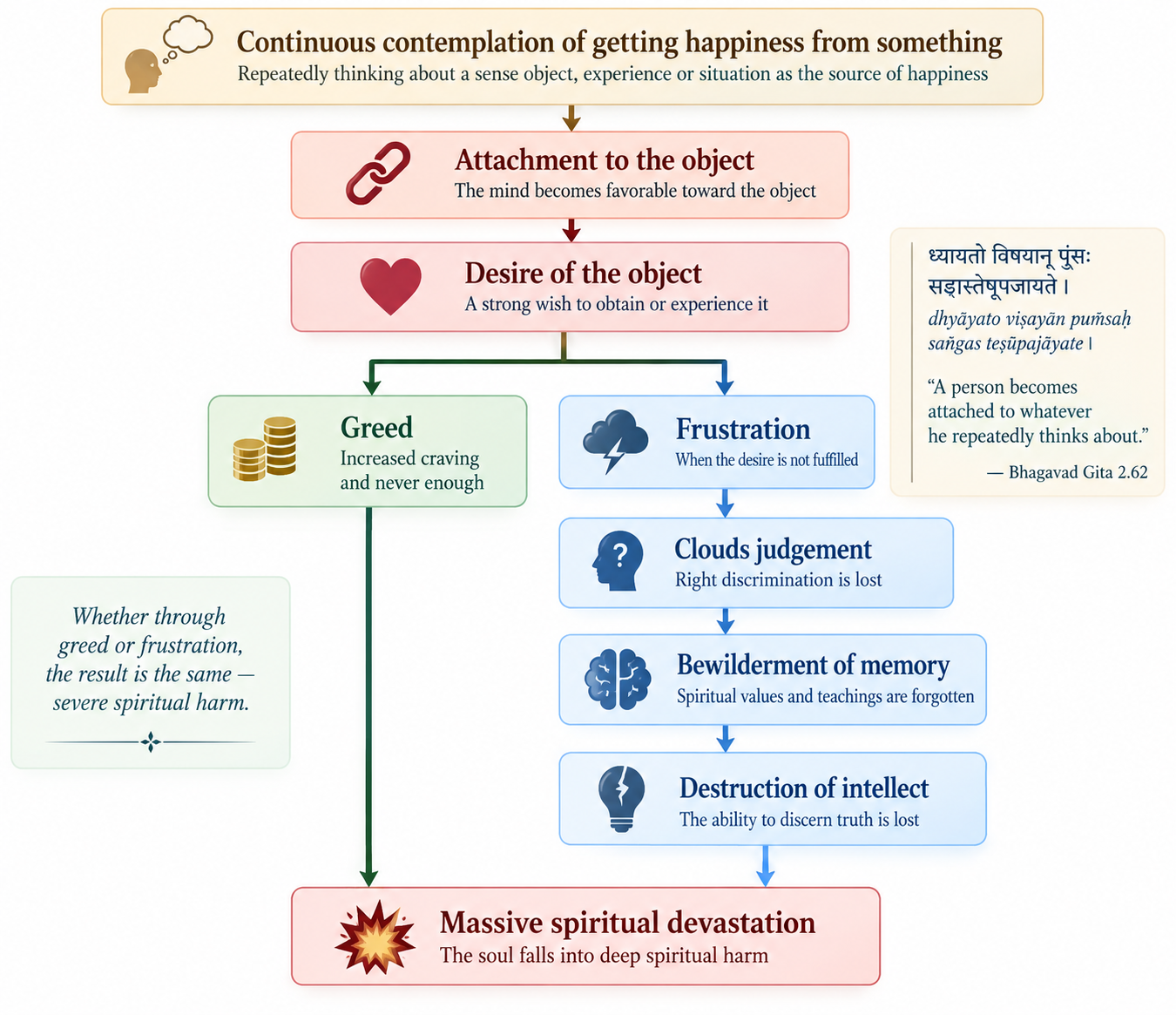
The danger therefore does not begin only when the final consequences appear. The sequence begins much earlier—with what the mind repeatedly contemplates.
And that means there is an earlier point at which the sequence has to be interrupted.
Stop Kusang at the Beginning
Repeated thinking comes later.
Reading, listening, and seeing can supply the mind with the subjects it later repeatedly contemplates.
Therefore, if we protect ourselves at the beginning by avoiding the cause, it becomes much easier to remain free from the effects of Kusang.
A fire cannot continue to grow without fuel. If wood is not supplied, how will the fire increase? And if you pour cool water over it then it will extinguish even faster.
Similarly, the fire of Kusang can gradually be extinguished by stopping its supply of fuel and pouring over it the cool water of faithful Satsang.
Avoiding Kusang stops feeding the cycle of worldly pursuit. Tattvagyan received from a Mahapurush and repeatedly recalled helps redirect the mind toward God and sadhana.
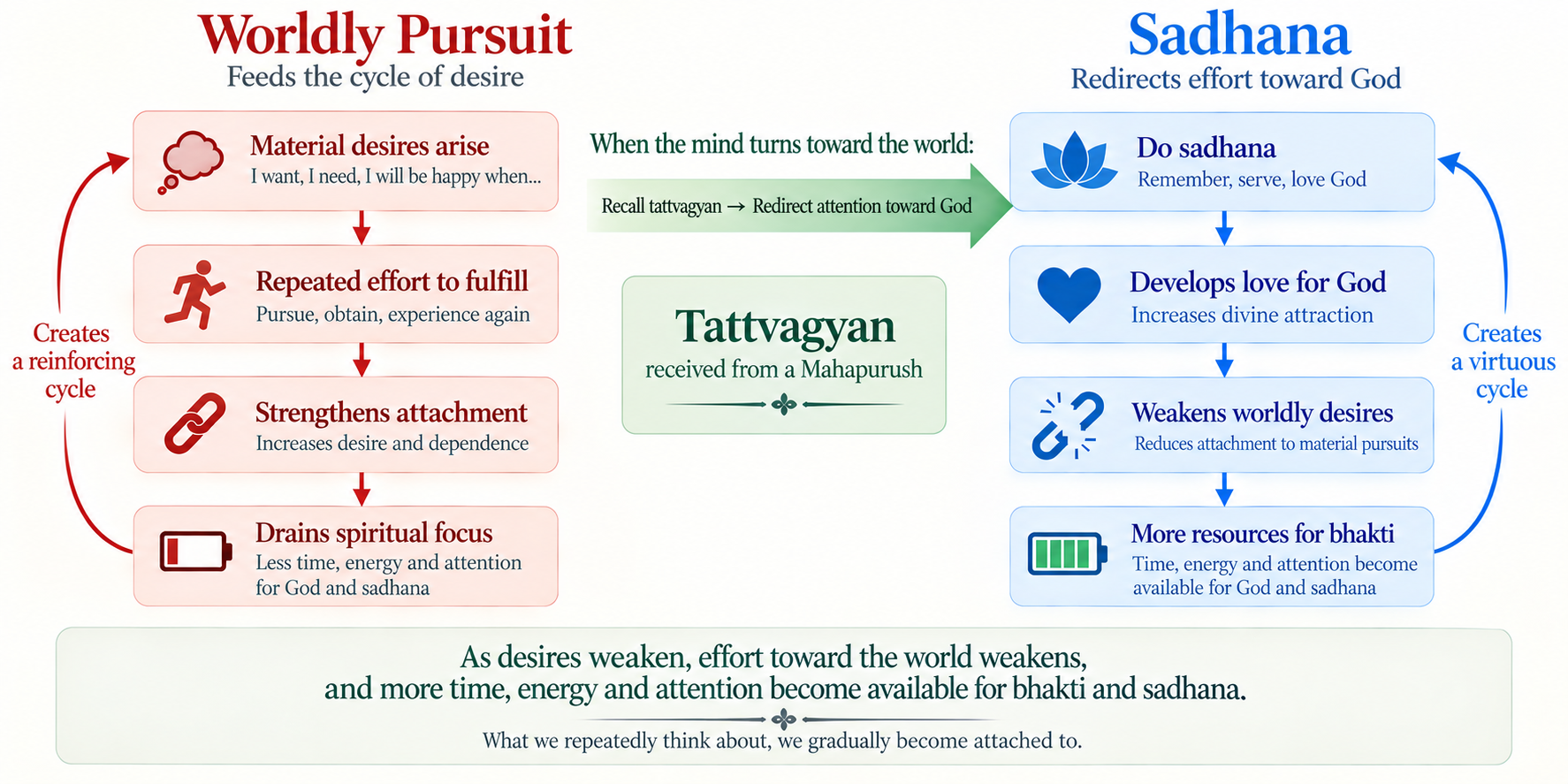
Yet even after understanding this principle, another danger remains: overconfidence.
A person may think:
What can a little Kusang do to me? I understand the philosophy.
But intellectual understanding does not make us immune to what we expose the mind to.
Knowing the Danger Does Not Make Us Immune
Say a doctor knows perfectly well that a particular poison is deadly.
Suppose the doctor decides to drink it jokingly.
Will his knowledge of the poison's properties protect him?
No. The poison will still act upon him.
In the same way, knowing spiritual philosophy does not make exposure to Kusang harmless. Understanding how Kusang works is not the same as being beyond its influence.
Therefore, even apparently ordinary Kusang should never be dismissed as insignificant.
Until God realization, every kind and class of Kusang should be regarded as a great enemy and avoided.
But this raises an obvious question.
Could someone become spiritually advanced enough that Kusang truly could no longer affect him?
Who Can Remain Unaffected by Kusang?
Tulsidas describes such a state:
अब मैं तोहि जान्यो संसार।
बाँधि न सकइ मोहि हरि के बल, प्रकट कपट आगार।
सहित सहाय तहाँ बसु जाइ जेहि, हृदय न नंदकुमार॥
aba maiṁ tohi jānyo saṁsāra ।
bāṁdhi na sakai mohi hari ke bala, prakaṭa kapaṭa āgāra ।
sahita sahāya tahāṁ basu jāi jehi, hṛdaya na nandakumāra ॥
“O Mayic world! I have understood you completely now. You cannot bind me in any way, because Shri Krishna's strength is with me. O Maya! Go with your army of warriors and settle in those hearts where Nandkumar does not reside. You cannot affect me any more.”
There is an important distinction here.
Before God realization, no one can challenge Maya or remain beyond the influence of Kusang.
Only a Divine Saint remains unaffected by it.
Rahim illustrates the condition of such a Saint:
चन्दन विष व्यापे नहीं, लिपटे रहत भुजंग ।
candana viṣa vyāpe nahīṁ, lipaṭe rahata bhujaṅga ।
(Rahim)
“Poison does not affect the sandalwood, though snakes remain wrapped around it.”
Sandalwood is cooling, and poisonous serpents may wrap themselves around it. Yet their poison does not alter the nature of the sandalwood.
In the same way, a Divine Saint remains unaffected by Kusang, regardless of how much Kusang surrounds them.
Until God realization, however, the devotee cannot safely assume the same immunity.
Where This Inquiry Leads
Kusang should therefore be guarded against at its earliest point of entry.
Reading, listening, and seeing can supply the subjects that later become repeated thought. Repeated contemplation produces attachment, attachment gives rise to desire, and the consequences can progress much further.
Knowing this process intellectually does not make us immune to it. Just as a doctor's knowledge cannot neutralize poison after he consumes it, knowledge of spiritual philosophy does not make deliberate exposure to Kusang harmless.
Until God realization, every form of Kusang must be treated seriously and avoided from the beginning. Only a Divine Saint is beyond its influence.
Yet this creates a much subtler problem.
Some influences are obviously worldly. But what about scripture and spiritual teachings themselves? Surely reading scripture or hearing about another spiritual path could never constitute Kusang.
Or could it?
Go Deeper
 JKP Literature

Why is repeatedly thinking about someone so consequential?
 JKP Literature

How do I train the mind in the opposite direction?
Continue the Inquiry
(Part 3 of 6 — Kusang — The Danger)
Kusang is not harmless merely because we believe we understand its danger. Until God realization, the safest course is to prevent adverse influences from taking root in the mind. But this raises a more difficult question when the subject itself appears spiritual.
- ⬅️ Previous: How Does Kusang Affect the Mind?
- ➡️ Next: Can Spiritual Teachings Become Kusang?
- 🔙 Back to Hub: Kusang — The Danger