Move Beyond God's Majesty to an Intimate Relationship with Him
How can we love the Almighty intimately when awareness of His majesty itself creates distance?
📍 Where You Are in the Inquiry
Sadhana Bhakti (साधना भक्ति | sādhanā bhakti) begins with selflessness. We have also seen that Karm (कर्म | karma), Gyan (ज्ञान | jñāna), austerities, and other practices must not be allowed to obstruct devotion.
But another question now arises.
How should we think of God while practicing devotion?
It may seem obvious that we should worship Him as the supreme and almighty God. Yet if His almighty majesty remains foremost in the mind, fear, hesitation, and distance naturally arise: I am an ordinary soul. He is the all-powerful God. How can I possibly love Him?
The third condition of Sadhana Bhakti addresses this distance. The Rasik Saints have established five relational sentiments, or Bhav (भाव | bhāva), through which we can develop a loving relationship with God.
Five Relationships with God
The five Bhav are:
- Shant Bhav (शांत भाव | śānta bhāva) — “I am His subject; He is my King.”
- Dasya Bhav (दास्य भाव | dāsya bhāva) — “I am His servant; He is my Lord.”
- Sakhya Bhav (सख्य भाव | sakhya bhāva) — “I am His friend; He is my Friend.”
- Vatsalya Bhav (वात्सल्य भाव | vātsalya bhāva) — “I am His mother or father; He is my Child.”
- Madhurya Bhav (माधुर्य भाव | mādhurya bhāva) — “He is my Divine Beloved; I am His beloved.”
These are not merely five different ways of addressing God. They represent progressively greater intimacy with Him.
In Shant Bhav, the relationship is that of a subject with a king. Dasya brings the devotee closer as servant to Lord. Sakhya brings the intimacy of friendship. Vatsalya allows the devotee to regard God as one's own child. Madhurya establishes the most intimate relationship: God as the Divine Beloved.
We can understand this progression to some extent through worldly relationships. A subject has little intimacy with a king or president. A servant is closer to the master. A friend is closer still. The relationship of parent and child is even more intimate, while the relationship between beloveds is the closest.
The superiority of one Bhav over another therefore lies in increasing intimacy with God.
The Higher Bhav Incorporate the Lower
There is another important relationship among the five Bhav.
Madhurya Bhav incorporates all five.
Shri Maharaj Ji illustrates this through the five elements. Earth contains the qualities associated with earth, water, fire, air, and space. Similarly, in Madhurya Bhav, the devotee may think of God as beloved, child, friend, Swami, or King.
Vatsalya incorporates four Bhav. The devotee may think of Krishn as son, friend, Lord, or King—but not as beloved.
Sakhya incorporates three: friend, Lord, and King.
Dasya incorporates two: Lord and King.
Shant contains only one: God as King.
Thus:
Shant → one Bhav
Dasya → two Bhav
Sakhya → three Bhav
Vatsalya → four Bhav
Madhurya → all five Bhav
The highest Rasik Saints do not give special importance to Shant Bhav. Therefore, devotees are usually found practicing Dasya, Sakhya, Vatsalya, or Madhurya Bhav.
But why are these relationships necessary at all?
Majesty Creates Distance; Relationship Creates Intimacy
If we regard God only as God, awareness of His almighty power remains between us and Him.
He is supreme and all-powerful.
I am an ordinary soul.
How can I love Him intimately?
The relational Bhav allow this distance to diminish.
We can see faint reflections of these different sentiments even in worldly relationships.
A wife regards her husband as her beloved. Yet while serving him food, she may display the tenderness of a mother: “You aren't eating properly. You're becoming weak. Eat some more.”
She also expresses Sakhya. She freely offers her opinions and shares matters with him that would not be discussed with others.
And Dasya is visible in her service.
Thus, even worldly love can contain glimpses of several relational sentiments.
There is, however, an important difference.
In worldly relationships, these sentiments cannot necessarily be expressed openly. A wife may care for her husband with a mother's tenderness, but she does not therefore begin calling him her son.
Divine relationships are not bound by such worldly formality.
Divine Love Is Not Bound by Worldly Formality
The Bhagwatam reveals this freedom in the words of the Gopis:
हा नाथ! रमण! प्रेष्ठ! क्वासि क्वासि महाभुज ।
दास्यास्ते कृपणायाः मे सखे! दर्शय सन्निधिम् ॥
hā nātha! ramaṇa! preṣṭha! kvāsi kvāsi mahābhuja |
dāsyās te kṛpaṇāyāḥ me sakhe! darśaya sannidhim ||
(Bhagwatam 10.30.40)
“O Lord! O my loving one! O my Beloved! O Friend! Please reveal Yourself to Your servant.”
The Gopis freely express different relational sentiments toward Krishn. In the Divine realm, there is no need for the worldly formality that would make such relationships incompatible.
The progression through these Bhav reveals what increasing intimacy with God actually makes possible.
Dasya Bhav — “I Am His Servant”
In Shant Bhav, there is no particular manifestation of Divine love. Divine love begins with Dasya Bhav.
The depth of this loving servitude is expressed in the prayer of a devotee who wants every element of his body to continue serving his Lord even after death:
पञ्चत्वं तनुरेतु भूतनिवहाः स्वांशे विशन्तु स्फुटम्
धातारं प्रणिपत्य हन्त शिरसा तत्रापि याचे वरम् ।
तद्वापीषु पयस्तदीयमुकुरे ज्योतिस्तदीयांनव्योम्नि
व्योम तदीयवर्त्मनि धरा तत्तालवृन्तऽनिलः ॥
pañcatvaṁ tanuretu bhūtanivahāḥ svāṁśe viśantu sphuṭam
dhātāraṁ praṇipatya hanta śirasā tatrāpi yāce varam |
tadvāpīṣu payastadīyamukure jyotistadīyānavyomni
vyoma tadīyavartmani dharā tattālavṛnto'nilaḥ ||
(Ved Vyas)
When his body dies, the devotee wants its five elements to remain in the service of his Lord. Its water should join the water where the Lord bathes. Its fire should enter the mirror in which He sees His reflection. Its space should merge with the space through which He walks. Its earth should join the ground touched by His lotus feet. Its air should join the breeze created when He is fanned.
Even death does not end the desire to serve.
But Dasya Bhav also carries demanding rules of servitude.
Bharat says:
सिर बल चलौं उचित अस मोरा ।
सब ते सेवक धर्म कठोरा ॥
sira bala calauṁ ucita asa morā |
saba te sevaka dharma kaṭhorā ||
(Tulsidas)
“The duty of a servant is the most difficult.”
The servant should place his head where his Lord places His feet.
Lachhman demonstrated this discipline while accompanying Ram and Sita. He walked to Their left and right to avoid stepping on Their footprints. His regard for Mother Sita was such that he later declared:
नूपुरे त्वभिजानामि नित्यं पादाभिवन्दनात् ।
nūpure tv abhijānāmi nityaṁ pādābhivandanāt |
(Valmiki Ramayan)
“Since I regularly bowed at Her feet, I recognize only Her anklets.”
The discipline of a servant is extraordinarily difficult:
सेवाधर्मः परमगहनो योगिनामप्यगम्यः ॥
sevādharmaḥ paramagahano yoginām apy agamyaḥ ||
“The discipline of service is extremely profound, difficult even for yogis.”
Yet when Divine love becomes overwhelming, something changes.
When Love Overwhelms Formality
Lord Ram once sat beneath a tree while the monkeys, His servants, sat on the branches above Him.
Ordinarily, a servant would not sit above his Master.
But the monkeys were so absorbed in love that they were unaware of this formality.
This does not mean that a devotee may casually disregard the discipline of service. Such behavior is forgivable only when the devotee is absorbed in the ecstasy of Divine love.
The monkeys were immersed in the Bliss of selfless servitude to Ram. And Ram Himself was immersed in the Bliss of His devotees' love.
The Master then becomes indebted to His servant.
Ram tells Hanuman:
प्रत्युपकार करौं का तोरा । सनमुख होइ न सकत मन मोरा ॥
सुनु सुत तोहि उरिन मैं नाहीं । देखेउँ करि विचार मन माहीं ॥
pratyupakāra karauṁ kā torā | sanmukha hoi na sakata mana morā ||
sunu suta tohi urina maiṁ nāhīṁ | dekheuṁ kari vicāra mana māhīṁ ||
(Tulsidas)
And further:
एकैकस्योपकारस्य प्राणान् दास्यामि ते कपे ।
शेषस्येहोपकाराणां भवाम ऋणिनो वयम् ॥
ekaikasyopakārasya prāṇān dāsyāmi te kape |
śeṣasyehopakārāṇāṁ bhavāma ṛṇino vayam ||
(Valmiki Ramayan)
“Hanuman! To repay even one of your favors I would have to give My life, yet I would remain indebted for your countless other services.”
This is the greatness of Dasya Bhav.
But Divine love permits still greater closeness.
Sakhya Bhav — “He Is My Friend”
In Sakhya Bhav, the devotee comes closer.
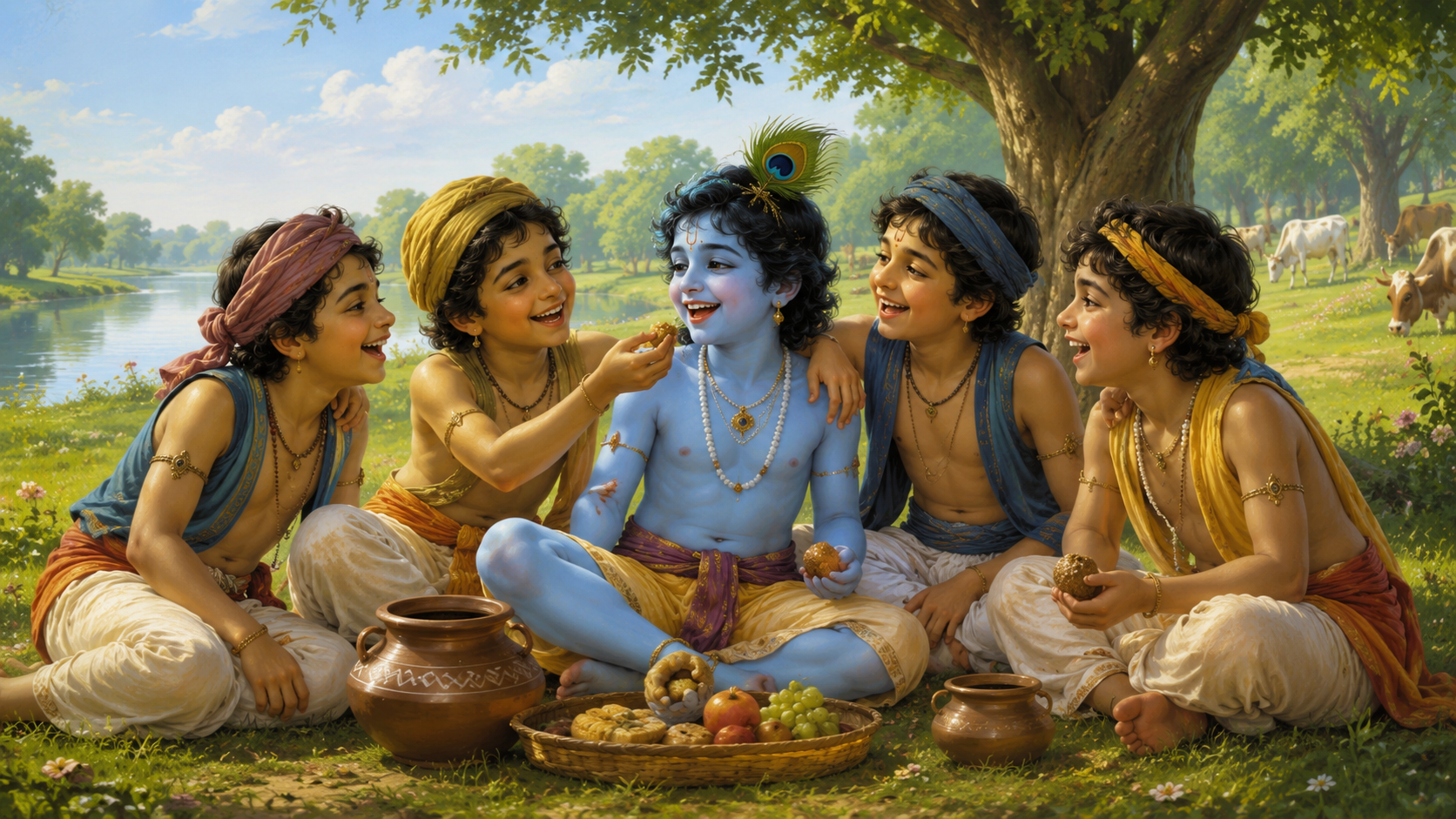
Krishn's Brajwasi friends were simple village boys. They did not stand before Him thinking, He is Almighty God.
They called Him Kanua.
They became annoyed with Him.
Krishn snatched half-eaten morsels from their mouths and ate them.
When they defeated Him in their childhood games, they made Him become a horse, climbed onto His shoulders, and rode on His back.
Even Brahma was bewildered by such intimacy.
These friends did not think of Krishn as God even in their dreams. Had they become conscious of His Godhood, the sweetness of their love would have diminished.
When Krishn lifted Govardhan, the Gwalbals held their sticks beneath the mountain and believed that they too were helping.
They remarked to one another that they were using both hands and all their strength, while Krishn was using only one little finger.
Krishn heard them and became overwhelmed with love.
Again, this freedom from ordinary formality arises from absorption in Divine love. Otherwise, friendship too has appropriate boundaries.
But beyond the intimacy of friendship lies a relationship in which Almighty God becomes one's own little child.
Vatsalya Bhav — “He Is My Child”
In Vatsalya Bhav, the devotee comes still closer to Krishn.
Mother Yashoda tied Krishn to a mortar. Holding a thin stick, she prepared to spank Him.
And Krishn cried.
He trembled before His mother and begged her to release Him, promising that He would never eat soil again.
On another occasion, Mother Yashoda carefully dressed and decorated Him before sending Him outside to play. Krishn promptly played in the dirt and returned covered in dust.
Seeing Him, she lovingly scolded:
पङ्काभिषिक्तसकलावयवं विलोक्य दामोदरं वदति कोपवशाद्यशोदा ।
त्वं शूकरोऽसि गतजन्मनि पूतनारेरिक्युक्तिस्मितमुखोऽवतु नो मुरारिः ॥
paṅkābhiṣiktasakalāvayavaṁ vilokya dāmodaraṁ vadati kopavaśād yaśodā |
tvaṁ śūkaro'si gatajanmani pūtanārer ityukti-smitamukho'vatu no murāriḥ ||
(Bhagavat)
Seeing Krishn covered in dust, Mother Yashoda told Him that He must have been a pig in His previous life.
Krishn smiled.
What she had said was true. In His previous descension, He had appeared as Varah, the Divine boar.
The Supreme God whom the ordinary soul hesitates even to approach is being tied up, threatened with a stick, and lovingly scolded by His mother.
Yet even in Vatsalya Bhav, some formality remains.
There is one Bhav in which the devotee receives still greater relational freedom.
Madhurya Bhav — “He Is My Everything”
Madhurya Bhav gives the devotee the most intimate relationship with God.
The Divine love of the Gopis is its supreme expression.
Remaining under the control of their love, the Supreme God loses His almighty majesty as Bhagwan. Krishn goes from house to house to hear the loving taunts and affectionate insults of the simple Gopis.
Even Brahma, Shiv, and great paramhansas desire the dust of their feet. They would consider it their greatest fortune merely to become a creeper, bush, or tree in Vrindaban so that the Gopis' footdust might fall upon them.
The Bhagwatam declares:
नायं श्रियोऽङ्ग उ नितान्तरतेः प्रसादः...
nāyaṁ śriyo'ṅga u nitāntarateḥ prasādaḥ...
(Bhagwatam)
Even Maha Lakchmi did not receive the Bliss of Divine love attained by the Gopis. She performed severe austerities, yet could not enter Maharas.
What makes their love so extraordinary?
“You Are the Life of Our Life”
A Gopi separated from Krishn says:
यत्ते सुजातचरणाम्बुरुहं स्तनेषु भीताः शनैः प्रिय दधीमहि कर्कशेषु ।
तेनाटवीमटसि तद् व्यथते न किंस्वित् कूर्पादिभिर्भ्रमति धीर्भवदायुषां नः ॥
yat te sujāta-caraṇāmburuhaṁ staneṣu
bhītāḥ śanaiḥ priya dadhīmahi karkaśeṣu |
tenāṭavīm aṭasi tad vyathate na kiṁsvit
kūrpādibhir bhramati dhīr bhavad-āyuṣāṁ naḥ ||
(Bhagwatam — cited in source as Bh. 10/14/34)
“O Beloved of my soul, Shyam Sundar! We place Your delicate feet very gently upon our bosom, fearing that its hardness may cause You discomfort. When You walk barefoot upon the stony paths of the forest, we wonder whether Your feet are being hurt, for You are the life of our life.”
The Gopi herself is suffering separation from Krishn.
Yet where is her attention?
On His discomfort.
On His delicate feet touching the stones.
Her own suffering has not become the center of her love.
This is the tenderness of the Gopis' Divine love.
And this is why Madhurya is the sweetest Bhav.
Its essence can be expressed simply:
“He is my everything.”
In Madhurya Bhav, the devotee may think of God through whichever loving relationship is desired—as Beloved, Child, Friend, Swami, or King.
There is full relational freedom.
There is no interference of worldly formality.
Where This Inquiry Leads
The third condition of Sadhana Bhakti therefore transforms how we approach God.
If we remain conscious only of His almighty majesty, fear, hesitation, and distance interfere with intimacy. The Rasik Saints therefore give us the five Bhav through which God becomes increasingly our own.
In Shant Bhav, He is King.
In Dasya, He is Lord.
In Sakhya, He is Friend.
In Vatsalya, He is Child.
And in Madhurya:
He is my everything.
This progression does not deny God's majesty. It progressively removes the distance that constant awareness of that majesty creates in love.
The Almighty Lord accepts the servant's service. He plays with His friends. He cries before His mother. And He places Himself under the control of the Gopis' love.
The greater the intimacy, the less Divine majesty stands between the devotee and the Beloved.
But even an intimate relationship with God does not complete Sadhana Bhakti.
The next condition asks whether our attachment to Him can coexist with attachment elsewhere—or whether love must become exclusive.
Related Concepts
Go Deeper
Continue the Inquiry
Part 4 of 6 — Bhakti Yoga — The Path
As love deepens, the devotee moves beyond awareness of God's majesty and develops an increasingly intimate relationship with Him through Bhav. But intimacy alone is not enough. If the mind continues to depend upon or seek fulfillment from anyone or anything other than the Divine Beloved, devotion is divided. This leads to the next condition: what does it mean to love God single-mindedly?
- ⬅️ Previous: What Takes Priority When Spiritual Practices Conflict?
- ➡️ Next: Why Is Single-Minded Devotion Essential?
- 🔙 Back to Hub: Bhakti Yoga — The Path