What Takes Priority When Spiritual Practices Conflict?
When devotion and religious duty pull in different directions, which should take priority?
📍 Where You Are in the Inquiry
Sadhana Bhakti (साधना भक्ति | sādhanā bhakti) begins with selflessness. We saw that selfless devotion does not mean having no Divine desire. It means becoming free from desires for one's own happiness and directing one's love toward the happiness of the Divine Beloved.
But Sadhana Bhakti has another condition.
A seeker may already follow religious duties, rituals, austerities, or disciplines associated with Karm (कर्म | karma) or Gyan (ज्ञान | jñāna). What happens when one of these practices interferes with devotion itself? If a ritual is prescribed for a particular time, must loving remembrance of God be interrupted to perform it?
The second condition of Sadhana Bhakti answers this question.
Bhakti Must Not Be Obstructed by Karm or Gyan
Roop Goswami defines uttama bhakti:
अन्याभिलाषिताशून्यं ज्ञानकर्माद्यनावृतम् ।
आनुकूल्येन कृष्णानुशीलनं भक्तिरुत्तमा ॥
anyābhilāṣitā-śūnyaṁ jñāna-karmādy-anāvṛtam |
ānukūlyena kṛṣṇānuśīlanaṁ bhaktir uttamā ||
(Roop Goswami)
“Supreme devotion is free from other desires, unobstructed by gyan, karm, and other practices, and consists of favorable devotion to Krishn.”
The first condition—anyābhilāṣitā-śūnyam, freedom from other desires—led to our previous inquiry into selfless devotion.
The second is:
jñāna-karmādy-anāvṛtam
Gyan, ritualistic actions, austerities, and similar practices should not become a hindrance to Bhakti (भक्ति | bhakti).
In other words, Bhakti is independent. Karm and Gyan are subservient to Bhakti.
This does not mean that everything belonging to Karm Marg (कर्म मार्ग | karma mārga) or Gyan Marg (ज्ञान मार्ग | jñāna mārga) must be rejected. It establishes their proper relationship to Bhakti. They may accompany devotion, but they cannot be allowed to overpower or obstruct it.
What does that mean in practice?
If It Is Time for Arti, What Takes Priority?
Consider a devotee engaged in Sadhana.
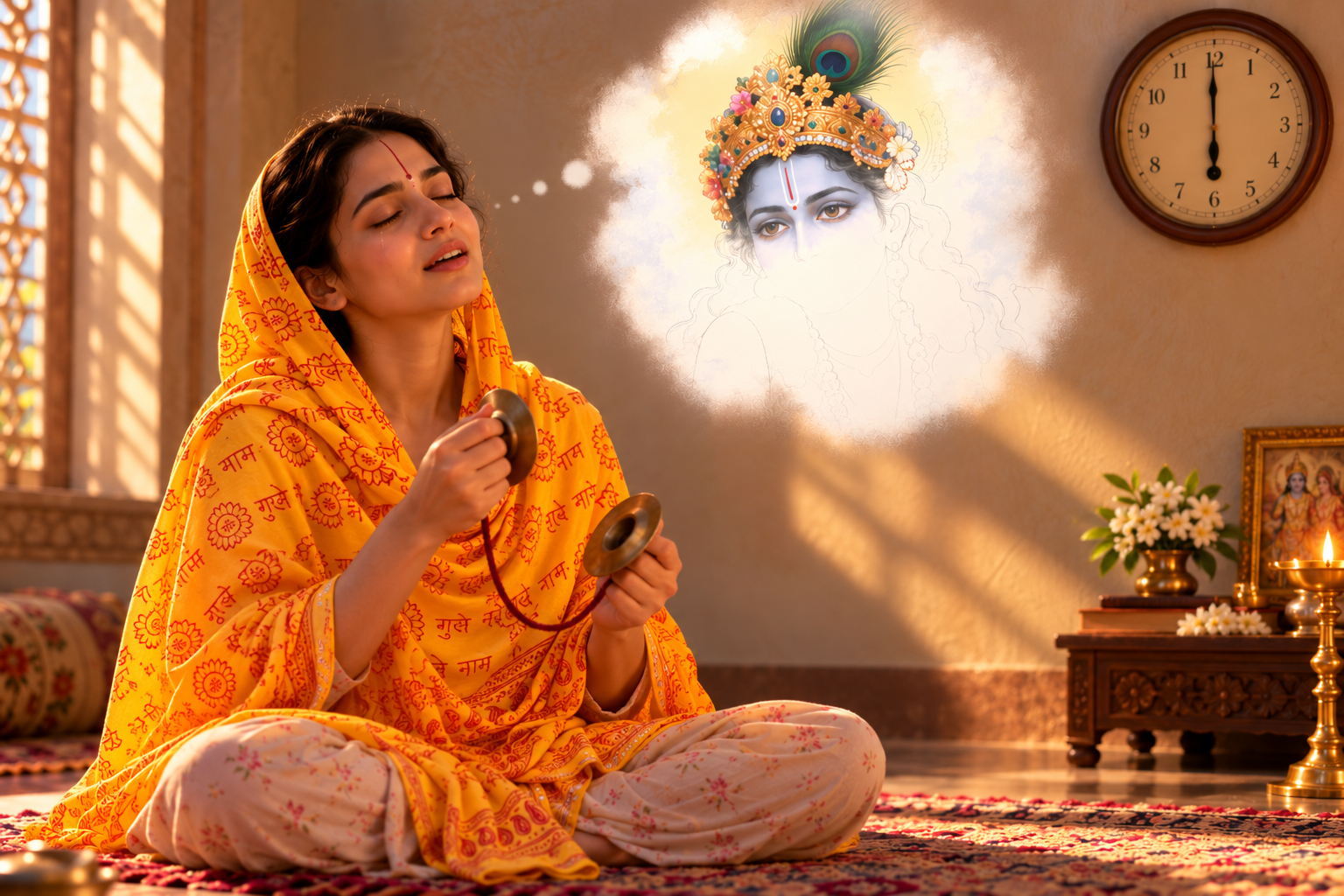
The mind is absorbed in the Divine Beloved. The devotee is remembering Him with love and shedding tears for Him.
Then the prescribed time for Arti (आरती | āratī) arrives.
Arti is important in Karm Kand (कर्मकाण्ड | karmakāṇḍa). But should the devotee interrupt loving absorption in God merely because the prescribed time for the ritual has arrived?
No.
If the prescribed time for Arti arrives and performing the ritual would require the devotee to leave that loving absorption merely to fulfill the requirement of Karm Kand, the Arti may be postponed or even forgone and the devotee may continue the Sadhana.
The point is not that Arti is unimportant. The example establishes that a requirement of Karm Kand should not displace loving absorption in God merely for the sake of fulfilling the ritual requirement.
Karm is subservient to Bhakti—not Bhakti to Karm.
When Karm Kand No Longer Governs the Bhakt
A Brahmin once followed the precepts of Karm Kand. Later, he took up the path of Bhakti and stopped performing Vedic rituals such as Sandhya (सन्ध्या | sandhyā).
Someone questioned him about this.
The Brahmin answered using a principle from Karm Kand itself. Ordinarily, when there is even one Sootak (सूतक | sūtaka), Vedic rituals are not performed.
He said that he presently had two sootaks.
His mother had died.
The “mother” was Maya (माया | māyā), which had previously controlled him.
And a daughter had been born.
The “daughter” was Bhakti.
With Maya gone and Bhakti born, he said, there were two sootaks. Therefore, he did not perform those rituals.
The illustration makes the changed relationship clear. Having entered the path of Bhakti, the bhakt (भक्त | bhakta) is no longer governed by the prescriptions of Karm Kand as though fulfilling them were a condition of Bhakti.
Bhakti is independent.
Gyan Also Has Its Own Rules
The same principle applies to Gyan Marg.
Just as Karm Marg has its prescriptions and prohibitions, Gyan Marg has its own disciplines—things that are to be done and things that are to be avoided.
A bhakt is not bound by the requirements of either Karm Marg or Gyan Marg as conditions of Bhakti.
The bhakt may perform some of these practices or may not perform them.
But one condition cannot be excused:
the mind must remain engrossed in God.
This is the significance of jñāna-karmādy-anāvṛtam. Karm and Gyan are not being denounced. They are being placed in their proper relationship to Bhakti.
They cannot be allowed to obstruct it.
Yet this raises another practical question. If the bhakt is not bound by these rituals, should they simply be abandoned regardless of circumstance?
Independence Does Not Mean Rejecting Every Ritual
Not necessarily.
Religious observances also exist within families and society. Refusing to perform an expected ritual may result in criticism, accusation, or social ostracism.
And an external conflict can create an internal disturbance.
The seeker may become angry or agitated. The mind may lose its composure. The criticism may continue occupying the mind long after the incident itself has passed.
Now the very decision made in the name of Bhakti has begun to interfere with Bhakti.
Therefore, a ritual that is not required as a condition of Bhakti may still be performed when doing so protects the mind from unnecessary disturbance.
The external action may change according to circumstance.
The governing principle does not:
Bhakti remains primary.
Why Might a Bhakt Perform Shradh?
Suppose one's father dies.
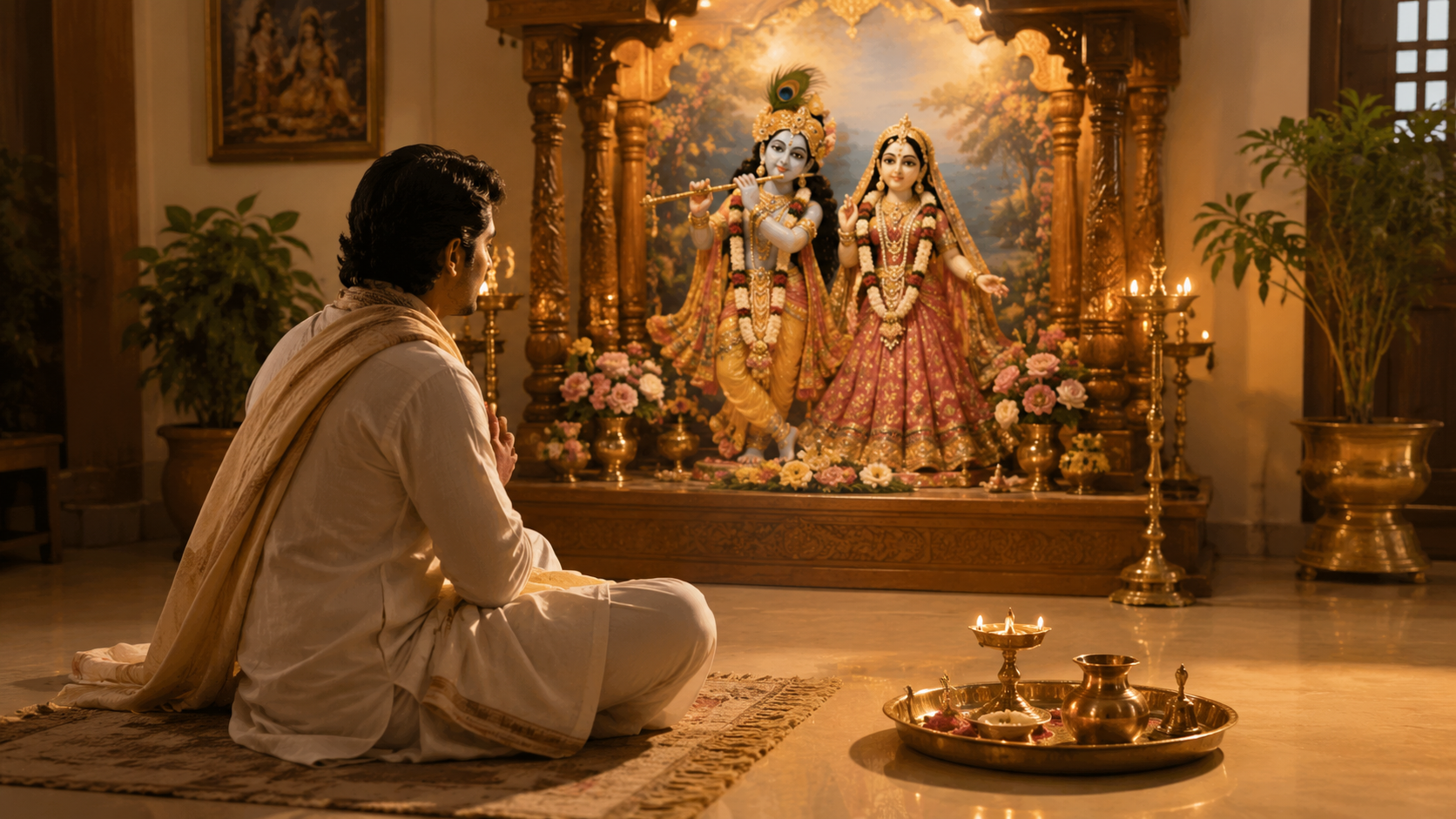
If the person does not perform Shradh (श्राद्ध | śrāddha), relatives or others may criticize him.
Perhaps the seeker is not yet unaffected by such criticism. He may become angry, defensive, or mentally disturbed.
What has been gained?
The ritual was avoided, but remembrance of God has now been disturbed.
In such a situation, perform the Shradh.
Not because Shradh has become a requirement of Bhakti.
Not because Karm Kand has acquired authority over Bhakti.
Perform it so that the resulting criticism and conflict do not disturb the mind and adversely affect Bhakti.
This produces what may initially appear to be two opposite instructions:
If performing a ritual interferes with Bhakti, the ritual may be left aside.
If refusing a ritual creates disturbance that interferes with Bhakti, the ritual may be performed.
There is no contradiction.
Both follow the same principle:
Karm must remain subservient to Bhakti.
The External Action Is Not the Governing Principle
This distinction is important.
If we reduce the teaching to an external rule—perform this ritual or do not perform this ritual—we miss the condition Shri Maharaj Ji is establishing.
In one circumstance, the devotee continues loving remembrance instead of stopping for Arti.
In another circumstance, the devotee performs Shradh.
The actions are different because neither action is itself the ultimate criterion.
The criterion is whether Karm, Gyan, austerity, ritual, or another discipline is being allowed to interfere with Bhakti.
A bhakt may therefore perform an external religious practice without making Bhakti dependent upon it. And the bhakt may leave such a practice aside without rejecting the spiritual path from which it comes.
Bhakti remains independent.
Where This Inquiry Leads
The second condition of Sadhana Bhakti is jñāna-karmādy-anāvṛtam: Bhakti must not be obstructed by Gyan, Karm, and other practices.
This does not require denouncing Karm Marg, Gyan Marg, ritual, or austerity. It establishes their relationship to Bhakti.
Bhakti is independent. Karm and Gyan are subservient to it.
If fulfilling a ritual requirement would interrupt loving absorption in God, the ritual requirement can take the back seat. If refusing a ritual would create criticism and mental disturbance that harms one's Bhakti, the ritual may be performed.
The external decision may therefore differ.
What cannot differ is the indispensable condition:
the mind must remain engrossed in God.
Having established that Sadhana Bhakti must remain unobstructed by other practices, the inquiry can now move to its next condition: how should the devotee relate to God?
Go Deeper
Continue the Inquiry
Part 3 of 6 — Bhakti Yoga — The Path
Bhakti is independent. Karm, Gyan, rituals, austerities, and other spiritual practices may accompany devotion, but they must not be allowed to obstruct it. Yet Sadhana Bhakti is not defined only by selflessness or by the practices we perform. Love itself takes the form of a relationship. This leads to the next inquiry: how should we relate to the Divine Beloved?
- ⬅️ Previous: What Does Selfless Devotion Really Mean?
- ➡️ Next: Move Beyond God's Majesty to an Intimate Relationship with Him
- 🔙 Back to Hub: Bhakti Yoga — The Path