What Must Actually Be Surrendered?
Learn why true surrender is not merely external action, but the gradual surrender of attachment, ego, and false dependence within the mind.
📍 Where You Are in the Inquiry
We have seen that surrender is not merely symbolic.
Through surrender:
- Divine Grace begins transforming the mind,
- karmic bondage begins loosening,
- dependence upon Māyā weakens,
- and the soul gradually comes under Divine shelter.
But this now raises a deeper and more practical question:
What exactly must be surrendered?
Does surrender mean abandoning the world?
Giving away possessions?
Leaving one’s responsibilities?
Rejecting action entirely?
Many people misunderstand surrender because they focus only on external renunciation.
But Jagadguruttam Swami Shri Kripalu Ji Maharaj explains that true surrender is primarily inward.
The real bondage of the soul does not lie in external objects.
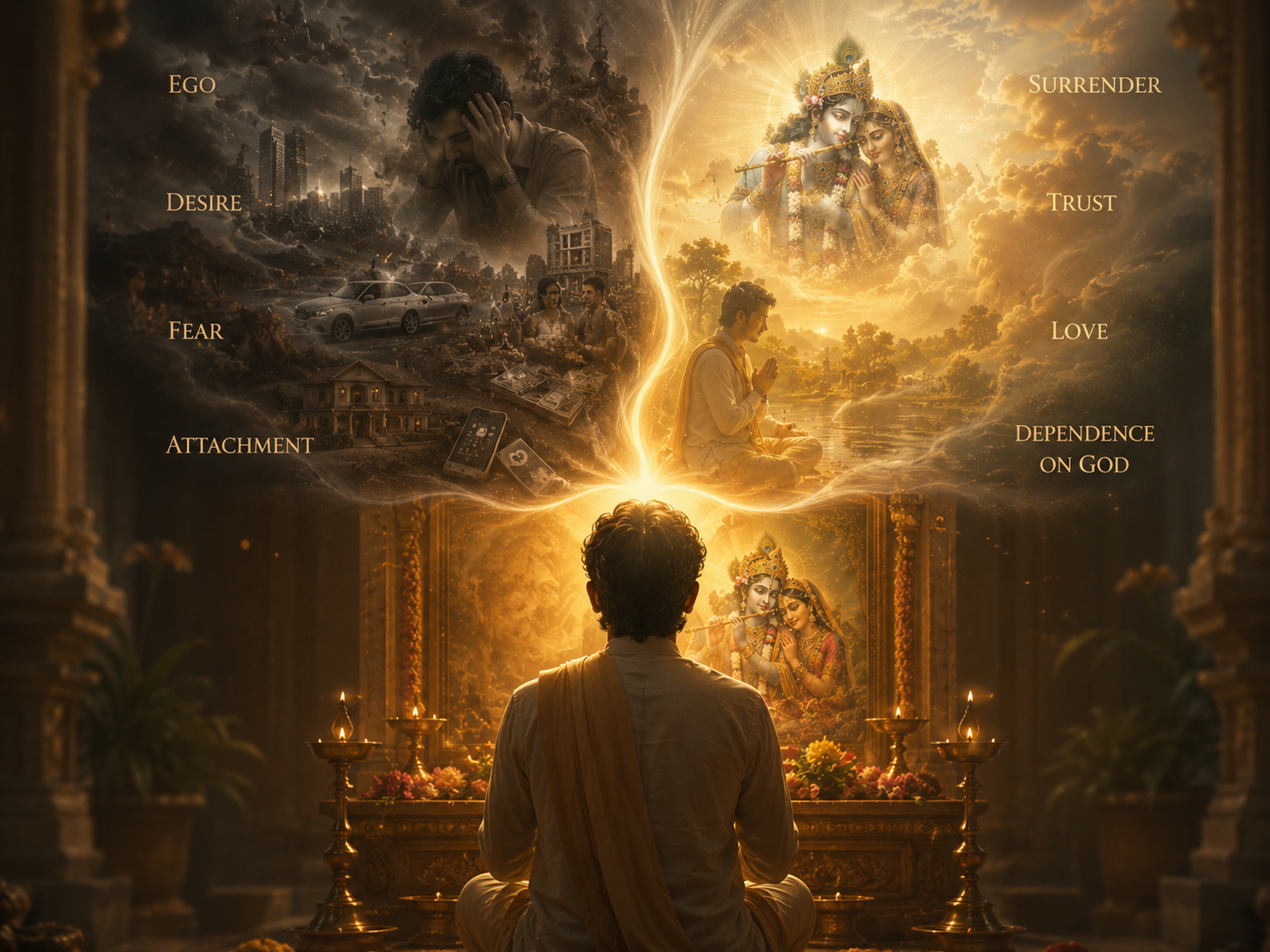
It lies in attachment, ego, and false dependence within the mind.
What Does the Soul Possess?
The soul operates through:
- the body,
- the senses,
- and the mind.
But among these, the mind is the real deciding factor.
The body and senses function according to the direction of the mind.
Thus, the true question is not merely:
“What is the body doing?”
The deeper question is:
“Where is the mind attached?”
Because the mind ultimately determines whether the soul remains bound within Māyā or moves toward God.
The Mind Determines Bondage and Liberation
The scriptures repeatedly declare that the mind alone becomes the cause of:
- bondage,
- or liberation.
The same external world exists before everyone.
Yet one mind remains absorbed in worldly attachment,
while another becomes absorbed in Divine remembrance.
Thus, bondage does not primarily arise from external objects.
It arises from the direction of mental attachment.
This is why true surrender is ultimately the surrender of the mind.
External Renunciation Alone Is Not Surrender
A person may:
- leave home,
- abandon possessions,
- wear simple clothing,
- perform austerities,
- or externally appear detached.
Yet inwardly the mind may still remain filled with:
- ego,
- desires,
- pride,
- anger,
- worldly attraction,
- and self-centeredness.
In such a condition, true surrender has not yet occurred.
Why?
Because bondage does not primarily exist in external things.
Bondage exists in mental attachment to them.
Thus, surrender is not merely changing one’s outer situation.
It is transforming the inner orientation of the mind.
Wherever the Mind Is Attached, That Is What Is Attained
The mind continuously shapes the soul’s direction.
If the mind remains attached to:
- worldly pleasure,
- ego,
- material identity,
- and finite desires,
the soul remains bound within material existence.
But when the mind becomes attached to God,
the soul gradually moves toward Divine realization.
Thus, the real question is not merely:
“What actions are being performed?”
The real question is:
“Where is the mind attached?”
Because wherever the mind becomes absorbed,
that is ultimately what the soul attains.
What Is True Devotion?
Devotion is not merely external worship.
True devotion means:
the attachment of the mind toward God.
Similarly, materiality does not merely mean living in the world.
Materiality means:
the attachment of the mind toward worldly objects.
Thus:
- mind attached to God → devotion,
- mind attached to the world → material bondage.
The direction of attachment determines spiritual condition.
Body and Senses Should Assist the Mind
This does not mean external devotional actions are useless.
The body and senses are servants of the mind.
When they are engaged in devotion:
- hearing Divine teachings,
- chanting God’s name,
- serving saints,
- worship,
- prayer,
- and satsang,
they help draw the mind toward God.
But if the body performs devotion while the mind remains deeply attached elsewhere,
the inner transformation does not happen.
Thus, external devotion becomes spiritually powerful when it helps redirect the mind toward Divine attachment.
False Ownership Must Be Surrendered
The mind falsely believes:
- “This body is me.”
- “These relationships are mine.”
- “This wealth is mine.”
- “These accomplishments are mine.”
But in reality, everything belongs to God.
The body was given by Him.
The world was created by Him.
The abilities used to achieve anything were also given by Him.
Nothing truly belongs to the soul independently.
Surrender begins when this false sense of ownership gradually weakens.
The surrendered mind gradually start viewing things as belonging to God rather than me.
The Pride of Doership Must Be Surrendered
One of the deepest forms of bondage is the belief:
“I am the independent doer.”
The ego constantly claims ownership over action:
- “I achieved this.”
- “I created this.”
- “I control outcomes.”
But the soul itself possesses no independent power.
Even the ability to think, act, breathe, and live operates through powers granted by God.
This does not mean actions stop.
Rather, the inner mentality changes.
The surrendered mind performs actions sincerely,
while recognizing dependence upon Divine Grace for everything.
The Boat That Never Moved
Jagadguruttam Swami Shri Kripalu Ji Maharaj gives a simple example.
A man rows a boat with great effort throughout the entire night.
But by morning, the boat has not moved at all.
Why?
Because the boat remained tied to the shore.
Similarly, a person may perform physical actions of:
- devotion,
- austerity,
- worship,
- and spiritual practice,
yet remain deeply attached to worldly desires and ego.
As long as attachment continues binding the mind to Māyā,
true spiritual progress remains limited.
Thus, surrender requires not merely spiritual activity,
but inner detachment and redirection of the mind toward God.
The Mind Cannot Move Fully in Opposite Directions
The mind is ultimately one.
It cannot move fully toward:
- God,
- and worldly attachment,
simultaneously.
As attachment toward God deepens,
attachment toward the world gradually weakens.
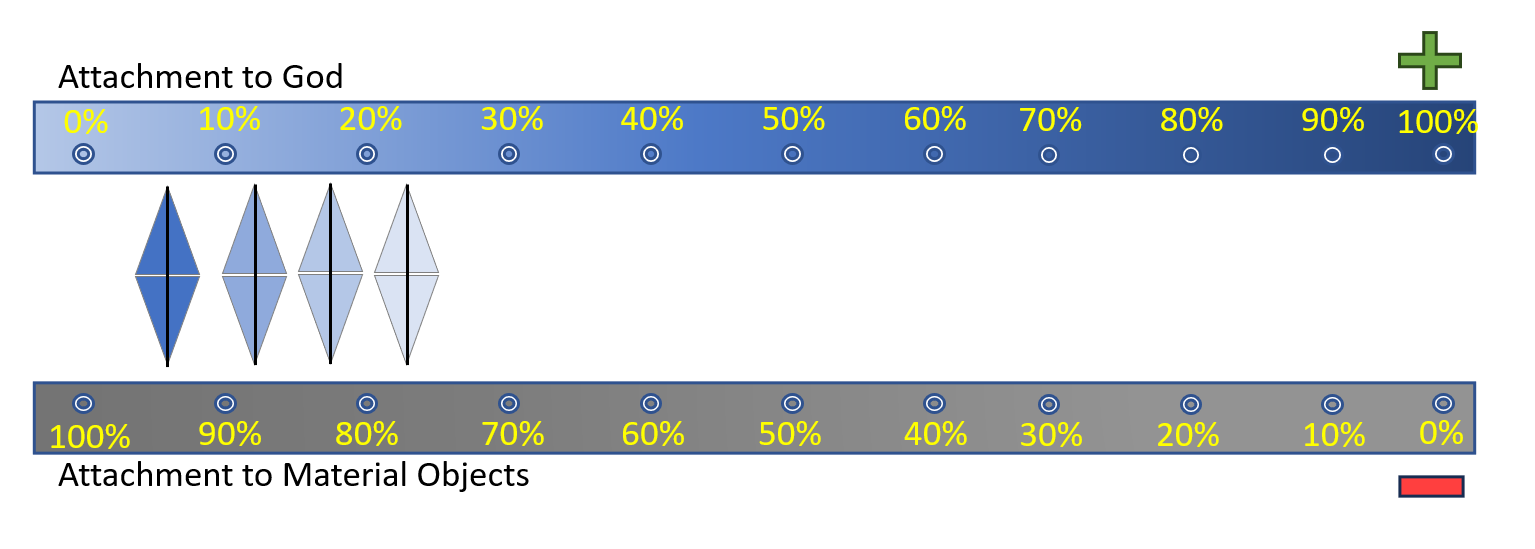
This is why surrender requires increasing single-mindedness.
As long as the mind remains deeply divided,
complete surrender cannot arise.
This increasing one-pointedness of the mind is why the scriptures repeatedly emphasize exclusiveness in devotion.
🔍 Go Deeper: Exclusiveness in Sādhana Bhakti
Complete Surrender Develops Gradually
The mind has carried worldly conditioning for countless lifetimes.
So complete surrender rarely happens instantly.
A person may gradually release certain attachments while remaining deeply bound by others.
Thus surrender deepens gradually through:
- prayer,
- satsang,
- remembrance of God,
- humility,
- spiritual reflection,
- devotional practice.
Each time the mind releases ego and attachment,
it moves closer toward true surrender.
The Final Meaning of Surrender
Ultimately, surrender means:
- releasing false independence,
- withdrawing attachment from Māyā,
- depending fully upon God,
- and offering the mind into Divine shelter.
It is not merely external renunciation.
It is the gradual transformation from:
“I belong to myself,”
to:
“I belong completely to God.”
And when this surrender becomes complete,
Divine Grace fully reveals itself within the purified heart.
🔍 Go Deeper
Deepening Surrender
Foundations of Bhakti
On Attachment and the Mind
On Karma, Bhakti, and the Limits of Action
Continue the Inquiry
(Part 4 of 5 — Surrender)
⬅️ Previous: What Happens When One Truly Surrenders?
➡️ Next: Why Detachment Becomes Necessary
🔙 Back to Hub: Surrender