Can We Remember God Constantly While Performing Our Duties?
Can constant remembrance of God really continue while the mind and intellect are occupied with demanding worldly duties?
📍 Where You Are in the Inquiry
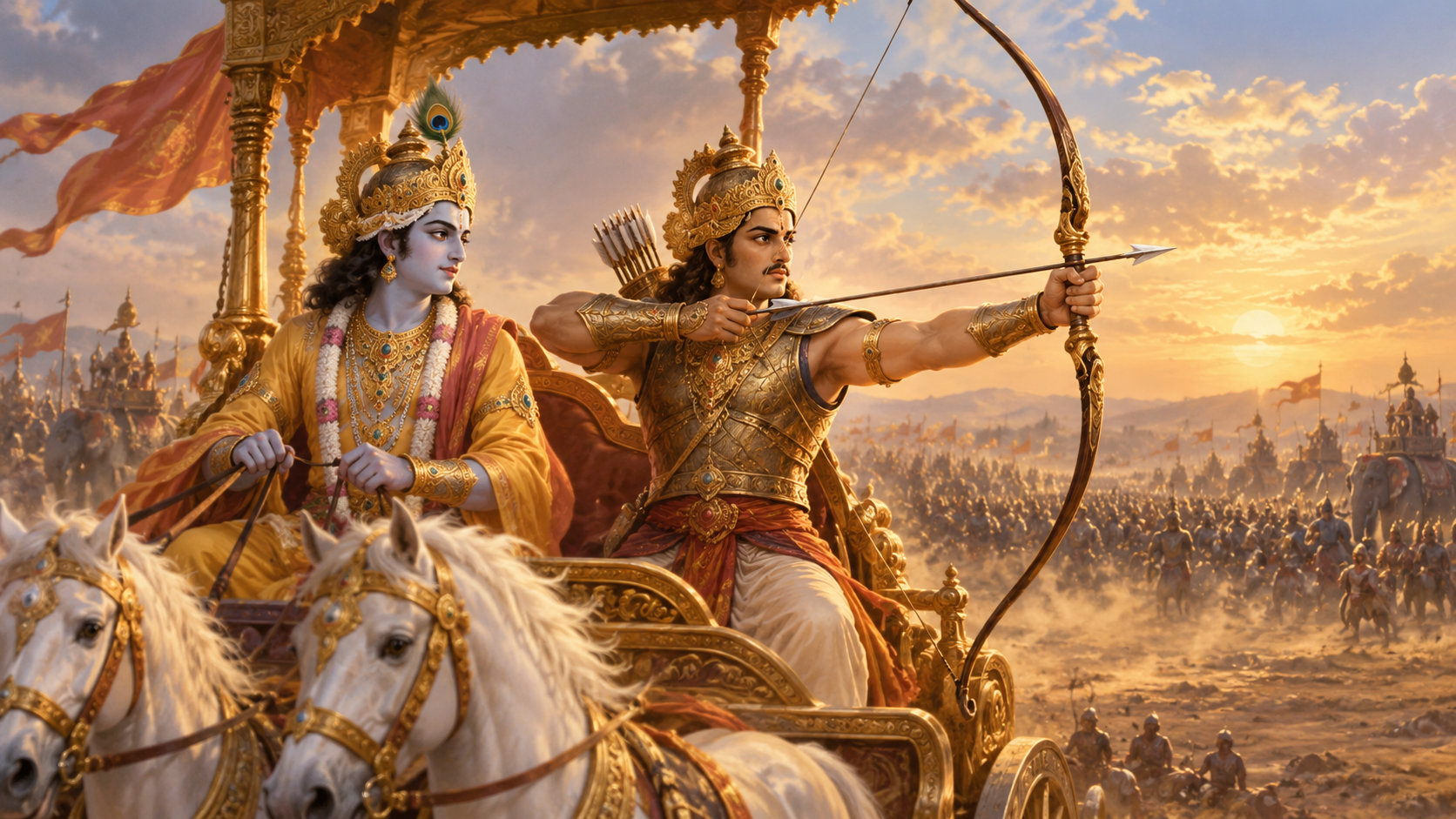
Karm Yog (कर्मयोग | karmayoga) presents what initially appears to be a practical contradiction. The Bhagavad Gita does not tell Arjuna to abandon his duties in order to remember God. Shri Krishna instructs him to remember God constantly while continuing to perform his duty.
But how can both happen at the same time?
Seeing, hearing, thinking, deciding, and performing demanding work all require the involvement of the mind and intellect. If the mind is absorbed elsewhere, the senses fail to register what is directly before them. War, the immediate duty facing Arjuna, requires extraordinary concentration.
How, then, can the mind remain absorbed in Shri Krishna while also being used to perform worldly duties?
The Gita Requires Both Remembrance and Action
Shri Krishna tells Arjuna:
तस्मात्सर्वेषु कालेषु मामनुस्मर युध्य च ।
मय्यर्पितमनोबुद्धिर्मामेवैष्यस्यसंशयम् ॥
tasmāt sarveṣu kāleṣu mām anusmara yudhya ca ।
mayy arpitamanobuddhir mām evaiṣyasy asaṁśayam ॥
(Bhagavad Gita 8.7)
“Remember Me every moment while performing your duty.”
The instruction contains both requirements. The mind is to remain absorbed in loving remembrance of Shri Krishna, while necessary duties continue.
Nor is constant remembrance an isolated instruction. The Gita repeatedly uses expressions such as yo māṁ smarati nityaśaḥ, teṣāṁ nityābhiyuktānāṁ, evaṁ satatayuktā ye, and teṣāṁ satatayuktānām—all emphasizing continual engagement in remembrance of God.
The requirement, therefore, cannot simply be reduced to remembering God whenever worldly duties happen to leave the mind free.
The remembrance is to be constant.
But Action Also Requires the Mind
This creates the difficulty that needs close examination.
Suppose the eyes are looking at something while the mind is absorbed elsewhere. Although the object is before the eyes, we fail to register what we have seen. The same thing happens with hearing: words may reach the ears, yet we do not properly hear them because the mind was elsewhere.
Ordinary experience therefore tells us that the senses alone cannot perform attentive action. The mind must participate.
The difficulty becomes even clearer in Arjuna's situation. Fighting a war could hardly be performed mechanically. It requires attention, judgment, and the active use of both mind and intellect.
Yet Shri Krishna tells Arjuna to fight and to remember Him at every moment.
If remembering God requires the mind, and performing one's duty also requires the mind, how can the same mind do both at the same time?
The Distinction That Unlocks the Problem
Shri Maharaj Ji begins resolving the apparent contradiction by drawing attention to something we already experience in everyday life.
There are two kinds of actions:
- actions in which the mind and intellect are involved; and
- actions in which the mind and intellect are not only involved, but are also attached.
That additional element—attachment—is the distinction we need to understand.
The problem arose because involvement and attachment can easily be treated as though they were the same thing. If performing an action with the mind necessarily meant becoming attached to that action, then constant remembrance of God while performing demanding worldly duties would indeed appear impossible.
But are involvement and attachment actually identical?
This is not an unfamiliar or unusual distinction. It is something we already understand through experience. We simply need to recognize it.
And once that difference is understood, the secret behind the practical performance of Karm Yog begins to become clear.
Where This Inquiry Leads
The Bhagavad Gita requires both constant remembrance of God and the performance of necessary duties. The apparent contradiction cannot be resolved by removing either requirement.
Instead, Shri Maharaj Ji directs our attention to a distinction within action itself: the mind and intellect may be involved in an action, but involvement does not necessarily mean attachment.
That gives us the question we must investigate next.
Can two people perform what appears externally to be the very same action—using the mind and intellect in both cases—while something fundamentally different is occurring within them?
Go Deeper
 JKP Literature
 JKP Literature
Continue the Inquiry
(Part 1 of 6 — Karm Yog — Living the Path)
We have identified the distinction upon which practical Karm Yog depends: involvement is not necessarily attachment. But stating the distinction is not enough. We need to see whether it actually occurs in ordinary life. Shri Maharaj Ji therefore turns next to familiar actions and shows how two outwardly similar actions can be fundamentally different.
- ⬅️ Previous: Radha and Krishn Are One in Two Eternal Forms
- ➡️ Next: Can Two Identical Actions Be Fundamentally Different?
- 🔙 Back to Hub: Karm Yog — Living the Path