The Universal Axiom of Happiness
Every action, whether noble or misguided, is driven by the desire for happiness. The methods differ, but the underlying motive remains the same.
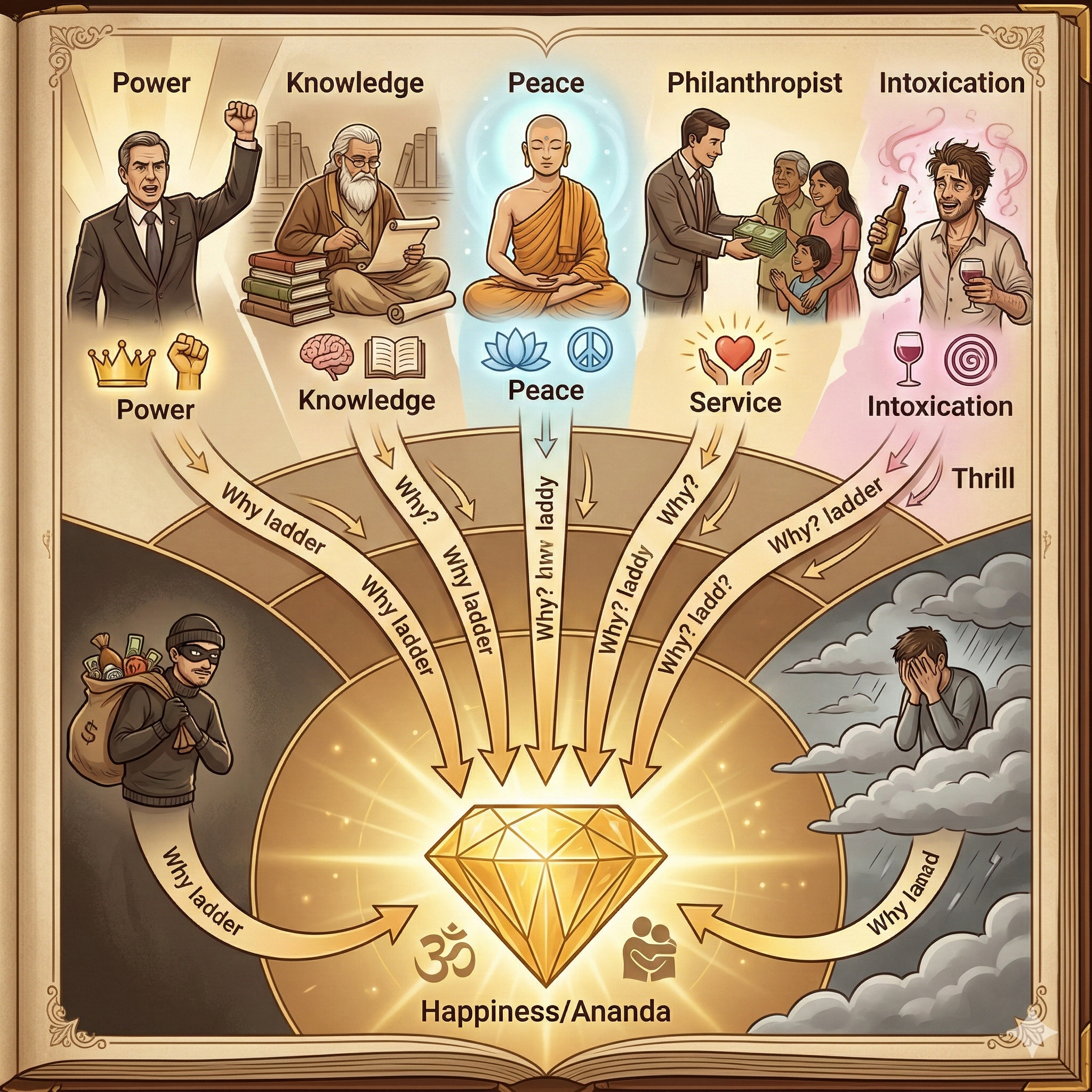
The Surface Contradiction
The world appears divided by different goals.
A politician seeks power.
A scholar seeks knowledge.
A thief seeks wealth.
A saint seeks peace.
The actions differ.
But do the goals differ?
Jagadguruttam Swami Shri Kripalu Ji Maharaj directs us to examine not the action, but the motivation behind it.
The surface differs.
The motive does not.
The “Why?” Ladder
Let us apply a simple test: keep asking “Why?”
Case 1: The Businessman
He works long hours, endures stress, sacrifices comfort.
Why?
“To earn money.”
Why?
“To secure my future.”
Why?
“So I can feel safe and comfortable.”
Why?
“Because that makes me happy.”
Case 2: The Thief
He risks imprisonment to steal.
Why?
“To get money quickly.”
Why?
“To enjoy what money provides.”
Why?
“Because enjoyment makes me happy.”
Case 3: The Philanthropist
He gives away wealth to relieve suffering.
Why?
“To help others.”
Why?
“Because seeing them relieved gives me peace.”
Why?
“Because that peace makes me happy.”
The businessman seeks happiness through accumulation.
The philanthropist seeks it through distribution.
The thief seeks it through possession.
Thus, whether one accumulates, gives, or steals,
the underlying drive is the same:
to experience happiness.
Every action is an attempt to experience ānanda — happiness.
But unless we define what true happiness is, this pursuit remains misdirected.
Define what true happiness is
The Hard Case: Extreme Despair
Even in extreme cases, the axiom remains intact.
A person in despair does not seek death for its own sake.
They seek relief from suffering.
Relief is perceived as preferable.
And what is preferable is what appears to bring happiness.
This confusion arises because we mistake temporary relief for real happiness.
Temporary relief for real happiness
Thus, even here, the movement is toward perceived happiness.
Misconceptions Clarified
Myth: “We should act without seeking happiness.”
Even one who performs selfless duty experiences inner satisfaction.
If action produced only misery, no one would continue it.
The soul cannot act against its nature.
It seeks happiness because happiness is intrinsic to it.
Myth: “Some people enjoy pain.”
In cases where individuals appear to enjoy pain, the pleasure does not arise from pain itself. It arises from the mental interpretation, or emotional association connected to it.
Pain is used as a means to produce a mental state that is experienced as satisfying.
The object differs.
The pursuit remains the same.
The Only Freedom We Possess
We are free in how we search.
We are not free in what we search for.
You may choose different careers.
Different lifestyles.
Different philosophies.
But you cannot choose to desire misery for its own sake.
The desire for happiness is built into the structure of the soul.
Since this desire cannot be eliminated, the intelligent question is not whether to seek happiness.
The question is:
Where is it actually found?
To answer this, we must first understand what true happiness actually is.
Continue the Inquiry
(Part 2 of 7 — The Goal of Life)
- Previous: Why Every Being Seeks Happiness
- Next: The Definition of True Happiness
- Back to Goal Hub