Is God Real?
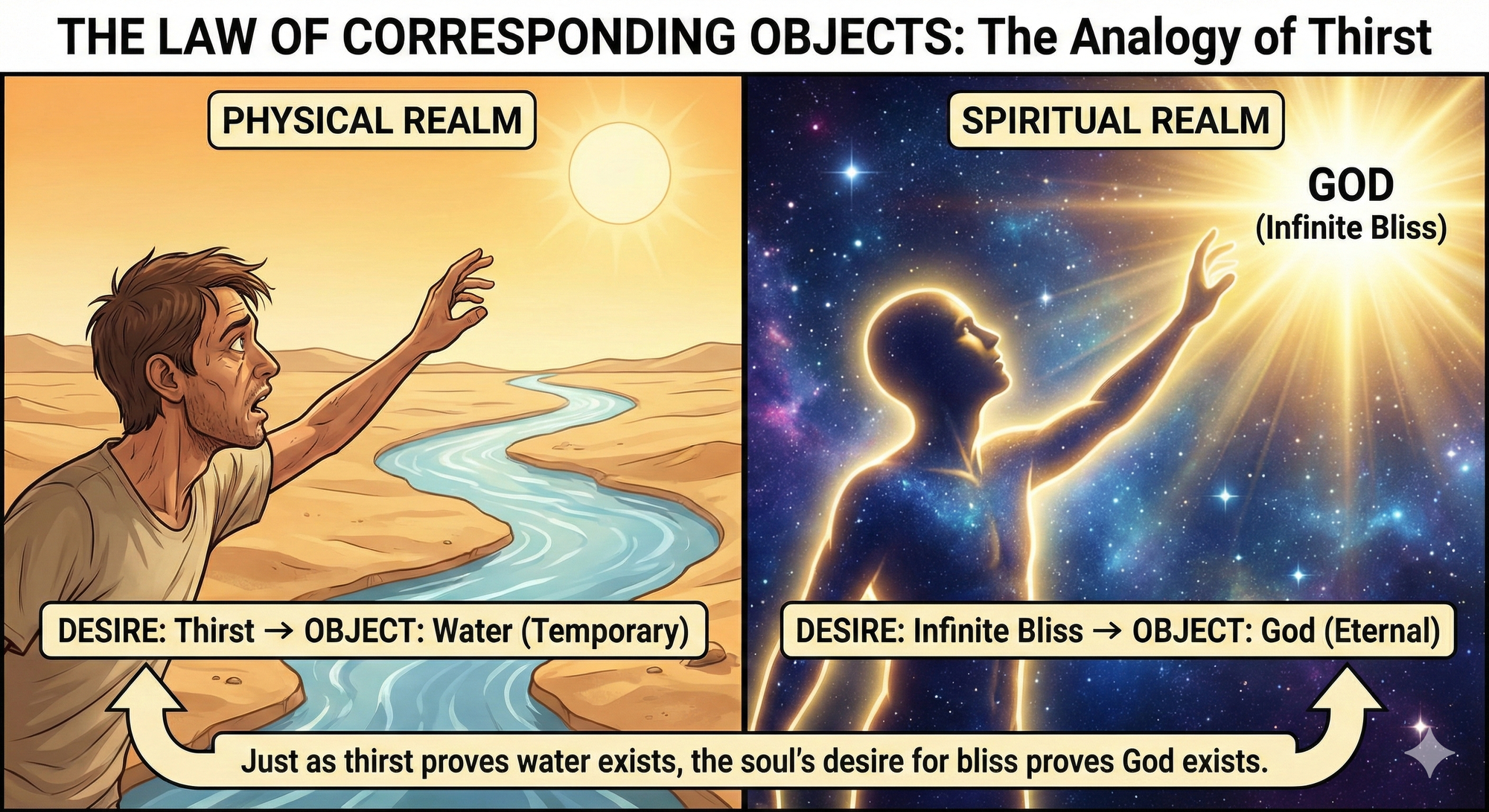
The soul’s longing for infinite happiness points to a real source. Just as thirst proves the existence of water, our desire for bliss points to God.
The Skeptic’s Challenge
In the previous chapters, we reached a logical conclusion:
We desire True Happiness — Infinite, Eternal, Ever-New.
The material world cannot provide True Happiness.
Therefore, its source must lie beyond the material.
We refer to that Reality as God.
If such a source exists, then the question is no longer about proof.
It is about what the soul is meant to attain.
what the soul is meant to attain
But a skeptic will interrupt here:
“Pause. You are defining God as Infinite Happiness. But does such a Being actually exist? Perhaps we desire ‘infinite happiness’ the way a child desires a flying unicorn — emotionally appealing, but imaginary.”
This is not an unreasonable objection.
If the object of our search does not exist,
the search itself would be meaningless.
Jagadguruttam Swami Shri Kripalu Ji Maharaj does not answer this with blind belief.
He answers it with law.
The Law of Corresponding Objects
Nature does not produce meaningless desires.
Every innate desire corresponds to a real object.
Thirst points to water.
Hunger points to food.
The desire itself indicates the existence of its object.
The Supreme Desire
Now examine the human condition.
Beyond food, water, and sleep lies a deeper hunger — one that does not disappear even after survival needs are met.
The desire for Perfect, Unlimited Happiness.
We are never satisfied.
Give a person security — they seek status.
Give status — they seek power.
Give power — they seek permanence.
The longing expands without limit.
This thirst for the Infinite is not taught.
It is not cultural.
It is innate.
This desire is not for something finite extended indefinitely.
It is for something categorically different —
Infinite, unending, ever-satisfying.
This is the same universal drive that governs all actions of all living beings.
universal drive
Such a desire cannot arise from finite experience alone.
It points to a Reality beyond the finite.
The Design Argument
Even external observation leads to the same conclusion.
The Watchmaker Principle:
If you discover a functioning watch in the desert, you do not assume wind and sand accidentally assembled gears and springs.
Complex, purposeful design implies intelligence.
Consider any system that operates with order and precision.
Such order does not arise from randomness.
Law implies order.
Order implies intelligence.
The universe functions through consistent laws.
Thus, its existence points to an intelligent cause.
God is not a psychological crutch.
God is the Necessary Being required to explain:
Why there is something rather than nothing.
Why law exists rather than randomness.
Why we long for perfection in an imperfect world.
Misconceptions Clarified
Myth: “I cannot see God. Therefore, He does not exist.”
The senses operate within a limited range.
Reality is not confined to what the senses can perceive.
We infer many realities through their effects.
God is known in the same way —
through creation, and through the inner pull toward the Infinite.
Myth: “God was invented to cope with fear of death.”
Fear may produce superstition.
But it cannot explain the longing for Infinite Bliss.
If survival were the highest goal,
human life would be satisfied with safety alone.
Yet the soul seeks truth, love, and transcendence —
even at the cost of survival.
This indicates a connection to a higher Reality.
If the Infinite exists,
and the soul seeks it,
then God is not a hypothesis.
He is the destination toward which the soul is already moving.
The question is no longer whether God exists.
The question is:
What is my relationship to Him?
Continue the Inquiry
(Part 5 of 7 — The Goal of Life)
- Previous: Temporary Pleasure vs Eternal Bliss
- Next: The Eternal Goal of the Soul
- Back to Goal Hub