Temporary Pleasure vs Eternal Bliss
Material pleasure diminishes, disappoints, and often arises from the removal of pain. Divine bliss, by contrast, is ever-increasing and self-existing.
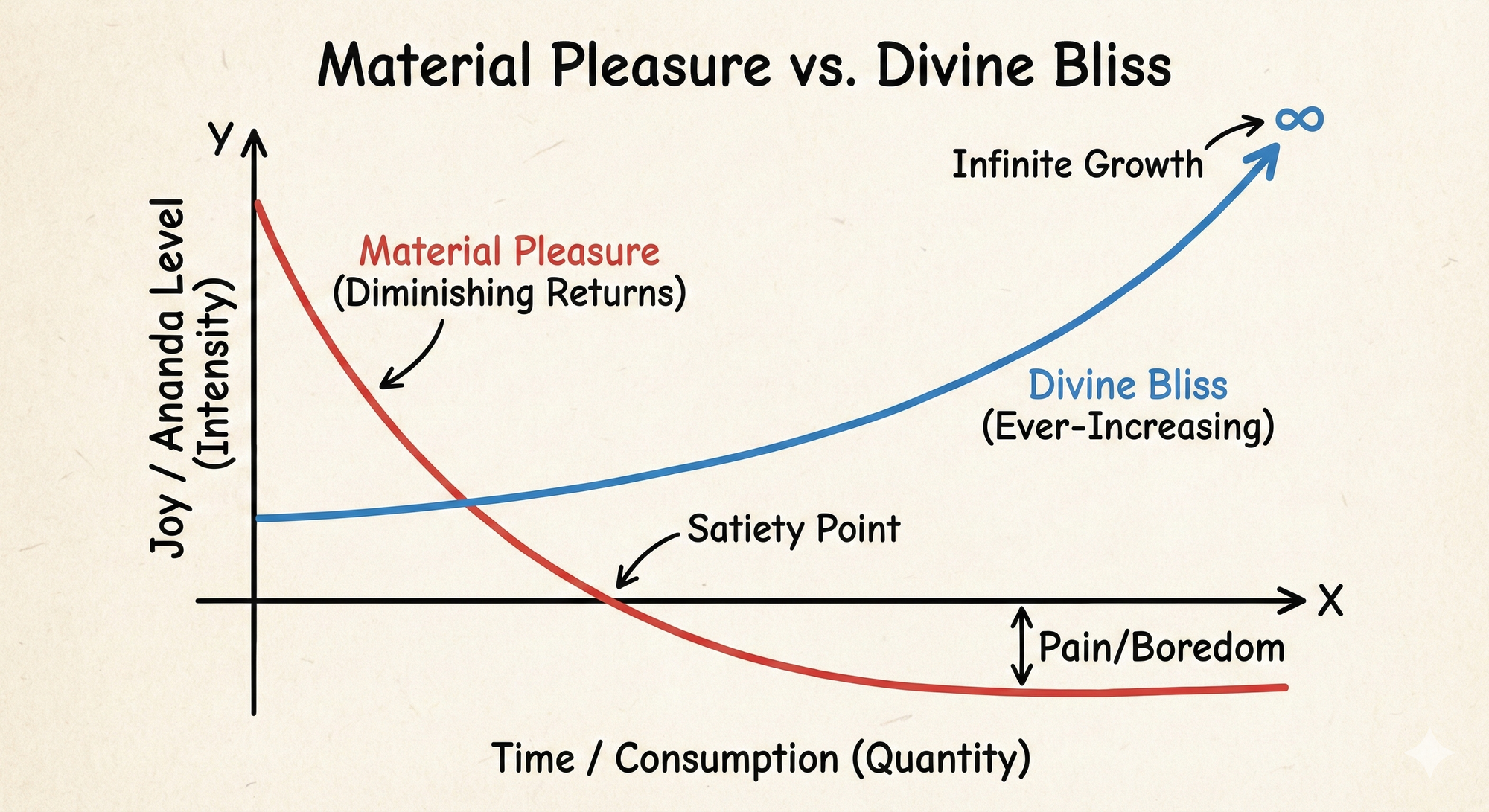
The Illusion of Similarity
We have defined True Happiness as Infinite, Eternal, and Ever-New.
Now we examine why material pleasure fails to meet this definition.
If what we seek is not found in the material world, the question becomes unavoidable:
Does such a source of happiness actually exist?
such a source of happiness actually exist
Material Pleasure (Preya) and Divine Bliss (Shreya) appear similar.
A man eating a delicious meal smiles.
A saint absorbed in meditation smiles.
The external reaction is the same.
The experience is not.
We think:
“If I accumulate enough money, enough pleasure, enough recognition, enough comfort — these small joys will eventually become Big Happiness.”
Material pleasure is not a smaller version of Divine Bliss.
It is a different substance altogether — governed by opposite laws.
This is because what we call happiness does not meet the true definition.
true definition
This is the essential difference between temporary pleasure and eternal happiness.
Law 1: The Law of Diminishing Returns
Material pleasure follows the law of diminishing returns.
The first contact gives the greatest excitement.
The second gives less.
The third gives almost none.
The fourth produces discomfort.
Example: You love rasgullas.
1st rasgulla: “Delicious.” (+10 units of joy)
2nd rasgulla: “Good.” (+5 units)
3rd rasgulla: “Enough.” (+1 unit)
4th rasgulla: “No more.” (0 units)
5th rasgulla: Discomfort. (-5 units)
If happiness were in the object, repetition would increase or maintain joy.
Instead, it declines.
And eventually becomes discomfort.
Thus, happiness is not in the object.
Law 2: The Paradox of Possession
The problem is not repetition alone.
Even possession destroys the illusion.
We desire intensely before attainment.
Once attained, the intensity collapses.
Before attainment, the mind imagines fulfillment.
After attainment, the limitation of the object becomes clear.
A person believes:
“When I attain this, I will finally be happy.”
The object is attained.
The mind adjusts.
The charm fades.
Why?
Because the happiness was never in the object.
It was in the imagination projected upon it.
When reality reveals that the object is finite, inert, and incapable of sustaining fulfillment, the mind immediately searches for the next target.
Thus material life becomes a cycle of pursuit, brief excitement, disappointment, and renewed pursuit.
Law 3: Pleasure Is Often the Removal of Pain
A deeper misunderstanding is this:
What we call “happiness” in the world is frequently nothing more than the temporary removal of discomfort.
The Heavy Bag:
You carry a heavy load for hours. It causes pain.
Someone removes it. You feel relief.
Did “not carrying” create joy?
No.
The pain stopped. That absence feels pleasant.
The Itch:
Scratching feels good only because irritation existed first.
Without irritation, scratching would cause harm.
Worldly pleasure is often negative — it is the subtraction of discomfort.
Divine Bliss is positive — it is the addition of infinite joy.
One depends on prior suffering.
The other is self-existing.
Thus, material pleasure fails in three ways:
It diminishes.
It disappoints upon attainment.
It often arises from the removal of pain.
Therefore, it cannot be true happiness.
Misconceptions Clarified
Myth: “Money can buy happiness.”
Money can purchase comfort.
Comfort is not happiness.
One may possess luxury and still experience anxiety, fear, or emptiness.
Comfort is external.
Happiness is internal.
Myth: “Spiritual people reject enjoyment.”
Spiritual philosophy does not oppose happiness.
It refuses mediocrity.
It says:
Do not settle for what decays.
Do not mistake temporary stimulation for fulfillment.
Do not confuse relief with bliss.
Renunciation is not the rejection of joy.
It is the rejection of the inferior for the sake of the Infinite.
If material pleasure fails,
then true happiness must lie beyond it.
We must now examine whether such a source exists.
Continue the Inquiry
(Part 4 of 7 — The Goal of Life)
- Previous: The Definition of True Happiness
- Next: Is God Real?
- Back to Goal Hub