The Definition of True Happiness
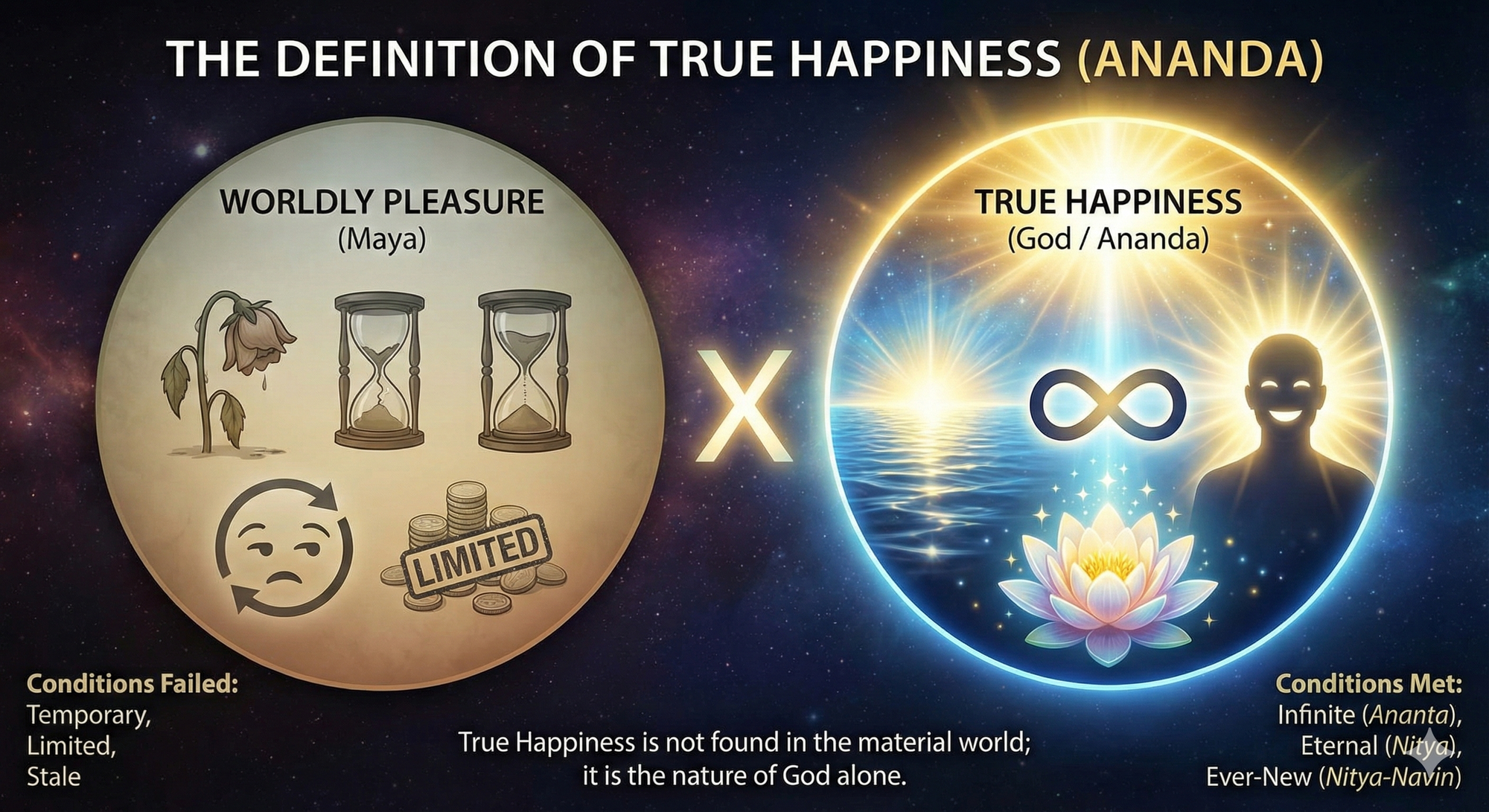
True happiness must be infinite, eternal, and ever-fresh. Anything that fades, diminishes, or becomes stale cannot satisfy the soul’s eternal nature.
The Blind Search
We have seen that every soul seeks happiness.
Yet a problem remains:
If everyone seeks happiness,
why does satisfaction not last?
We see people gain wealth, recognition, comfort—and still feel empty. Clearly, much of what we call “happiness” is not the real thing.
To find something, one must know what it is.
If a person cannot distinguish a diamond from broken glass,
they will repeatedly choose what only appears valuable—and suffer.
Jagadguruttam Swami Shri Kripalu Ji Maharaj gives a precise definition by which true happiness can be identified. It must satisfy three conditions. If even one condition is missing, it is not true happiness—it is only temporary relief or stimulation.
Condition 1: It Must Be Infinite (Ananta)
True happiness must be unlimited.
Worldly pleasure is always limited.
Even a favorite sweet, repeated too much, stops giving the same joy. Enjoyment declines, and eventually becomes discomfort.
If happiness is true, it should not diminish with experience.
Condition 2: It Must Be Eternal (Nitya)
True happiness must not be threatened by time.
Worldly joys expire:
- objects decay
- relationships change
- status fades
- the body itself ends
Even before loss happens, the fear of loss weakens the joy of possession.
If happiness is true, it must remain. Once attained, it must not be taken away by separation, time, or death.
Condition 3: It Must Be Ever-Fresh (Nitya-Navayman)
This is the subtle test.
Even when pleasure continues, the mind becomes habituated.
What once excited becomes ordinary.
Then boredom arises.
True happiness must never become stale.
It must feel fresh at every moment—new without end.
When we apply this definition, it becomes clear that what we usually call happiness does not qualify.
What we usually call happiness
The Verdict: World vs. God
Now apply the three tests to worldly happiness:
Is it infinite? No. It is limited by the body and mind.
Is it eternal? No. It ends with time, change, and separation.
Is it ever-fresh? No. Repetition leads to dullness.
This raises the question of whether such a source actually exists.
Whether such a source actually exists
So the issue is not that we have not found the right worldly object.
The issue is that the material category itself cannot satisfy the definition.
Therefore, true happiness must exist beyond what is finite, temporary, and exhaustible.
And since the soul seeks this happiness,
it is, knowingly or unknowingly, seeking God.
Thus, worldly happiness fails all three conditions.
It is limited.
It is temporary.
It becomes stale.
Therefore, true happiness cannot belong to the material realm.
Only God satisfies all three conditions:
- Infinite (Ananta)
- Eternal (Sat)
- Ever-fresh Bliss (Nitya-Navayman)
Misconceptions Clarified
Myth: “Happiness is only a state of mind.”
If we could create happiness at will, we would never suffer.
But we cannot.
The mind can interpret experience,
but it cannot generate infinite and lasting bliss.
Ānanda belongs not to the mind,
but is God.
Myth: “Heaven (Swarga) is the goal because it is eternal happiness.”
The Vedas declare that Swarga is not eternal.
It is experienced as long as one’s accumulated merit lasts.
When that is exhausted, the soul returns.
Thus, Swarga cannot be the goal.
If true happiness lies beyond the material world,
then what we commonly experience must be something else.
We must now examine the difference between temporary pleasure and true bliss.
Continue the Inquiry
(Part 3 of 7 — The Goal of Life)
- Previous: The Universal Axiom of Happiness
- Next: Temporary Pleasure vs Eternal Bliss
- Back to Goal Hub