Liberation vs. Divine Love
Liberation removes suffering, but divine love grants infinite, ever-increasing bliss. The soul’s ultimate goal is not freedom alone, but loving relationship with God.
The Two Destinations
We have established that the goal of life is to attain God.
But God is realized in two ways:
as Brahm — the impersonal Absolute,
or as Bhagavan — the personal God.
The destination depends on what is sought.
Many assume these two are equal.
Jagadguruttam Swami Shri Kripalu Ji Maharaj clarifies:
Both are eternal.
But they are not equal in experience.
The choice is not between good and bad.
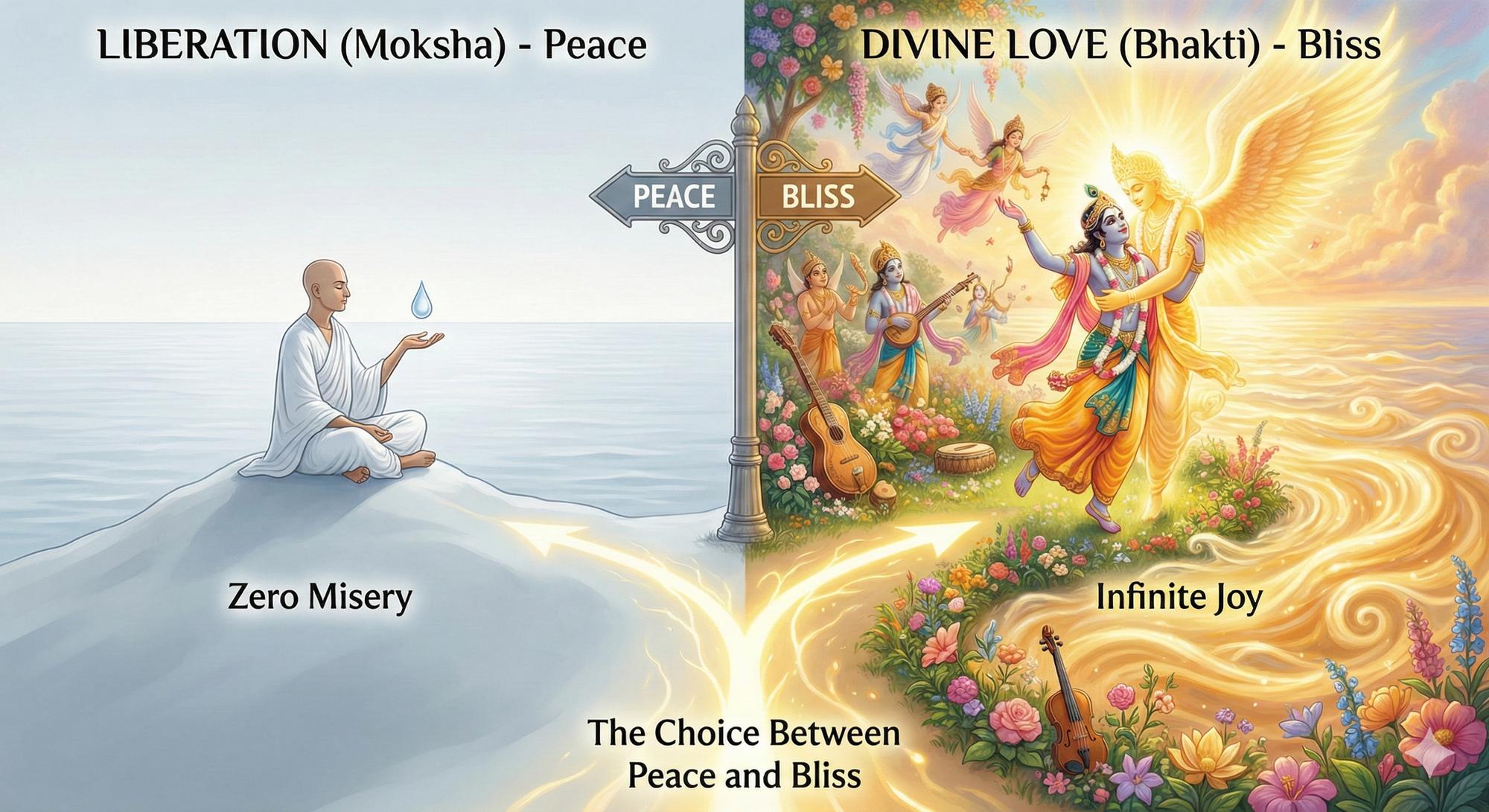
It is between freedom — and infinite bliss.
What Liberation Actually Grants
Liberation ends suffering.
It ends rebirth.
It ends bondage.
But what does it positively grant?
Consider a person in continuous suffering.
When that suffering ends,
he feels relief.
But has he received a gift?
A feast?
A loving embrace?
No.
He has received the absence of pain.
Moksha is the zero point.
It is duḥkha-nivṛtti — the removal of suffering.
It is not ānanda-prāpti — the attainment of positive bliss.
In Moksha, the individuality of the soul is not experienced.
There is no relationship,
no loving exchange,
no service.
There is peace.
There is freedom.
But there is no love.
What Divine Love Grants
Divine Love includes liberation,
and goes infinitely beyond it.
The same man is no longer beaten.
But now he is welcomed.
Fed.
Embraced.
Loved.
This is Prema.
In Divine Love:
The soul does not become God.
The soul serves God.
Moksha says:
“I want to become sugar.”
Bhakti says:
“I want to taste sugar.”
If one becomes sugar,
there is no one to taste.
If one remains distinct,
the sweetness can be relished eternally.
The bliss of Prema is dynamic.
Ever-increasing.
Nitya-navīn — eternally fresh.
The liberated soul is free from suffering.
The loving soul participates in infinite bliss.
Peace is static.
Love is dynamic and ever-increasing.
This is the culmination of the goal we have been establishing step by step.
goal we have been establishing
Why Freedom Is Not the Final Goal
Freedom from suffering is not the same as fulfillment.
Happiness begins where suffering ends —
but it does not end there.
Liberation clears the field.
Divine Love gives the prize.
The soul does not merely seek escape.
It seeks relationship.
It seeks exchange.
It seeks ever-expanding ānand.
An eternal being requires eternal experience — not eternal neutrality.
The Verdict of the Saints
The scriptures declare:
The happiness of Moksha is like a drop.
The happiness of Prema is like an infinite ocean.
A Rasik devotee does not seek Liberation.
If offered Moksha, he prefers loving service.
He does not seek dissolution.
He seeks relationship.
He does not want silence.
He wants loving exchange.
The Real Choice
Liberation offers freedom from suffering.
Divine Love offers infinite, ever-increasing bliss.
Liberation ends bondage.
Divine Love begins eternal exchange.
The goal is not merely freedom.
It is Infinite Bliss.
Misconceptions Clarified
Myth: “Bhakti is only a means to Moksha.”
Bhakti can grant Moksha.
But Moksha is not its highest fruit.
Bhakti is both the means and the eternal end.
Myth: “Duality is false.”
The duality of ignorance creates suffering.
But the eternal distinction between soul and God
is the basis of divine love.
There is difference,
but no conflict.
Only ever-increasing bliss.
Once the goal is clear, the next question arises:
Who is God, and how is He understood?
Who is God?
Final Conclusion
Liberation removes suffering.
Divine Love fulfills the soul.
Freedom is relief.
Love is completion.
The eternal soul does not seek mere release.
It seeks Infinite Bliss.
Continue the Inquiry
(Part 7 of 7 — The Goal of Life)
- Previous: The Eternal Goal of the Soul
- Next: God Is Unknowable (The Limit of Material Mind)
- Back to: Goal Hub