Why Every Being Seeks Happiness
Every being seeks happiness because the soul is a part of God, whose nature is infinite bliss. This desire is not learned; it reveals the soul’s true nature.
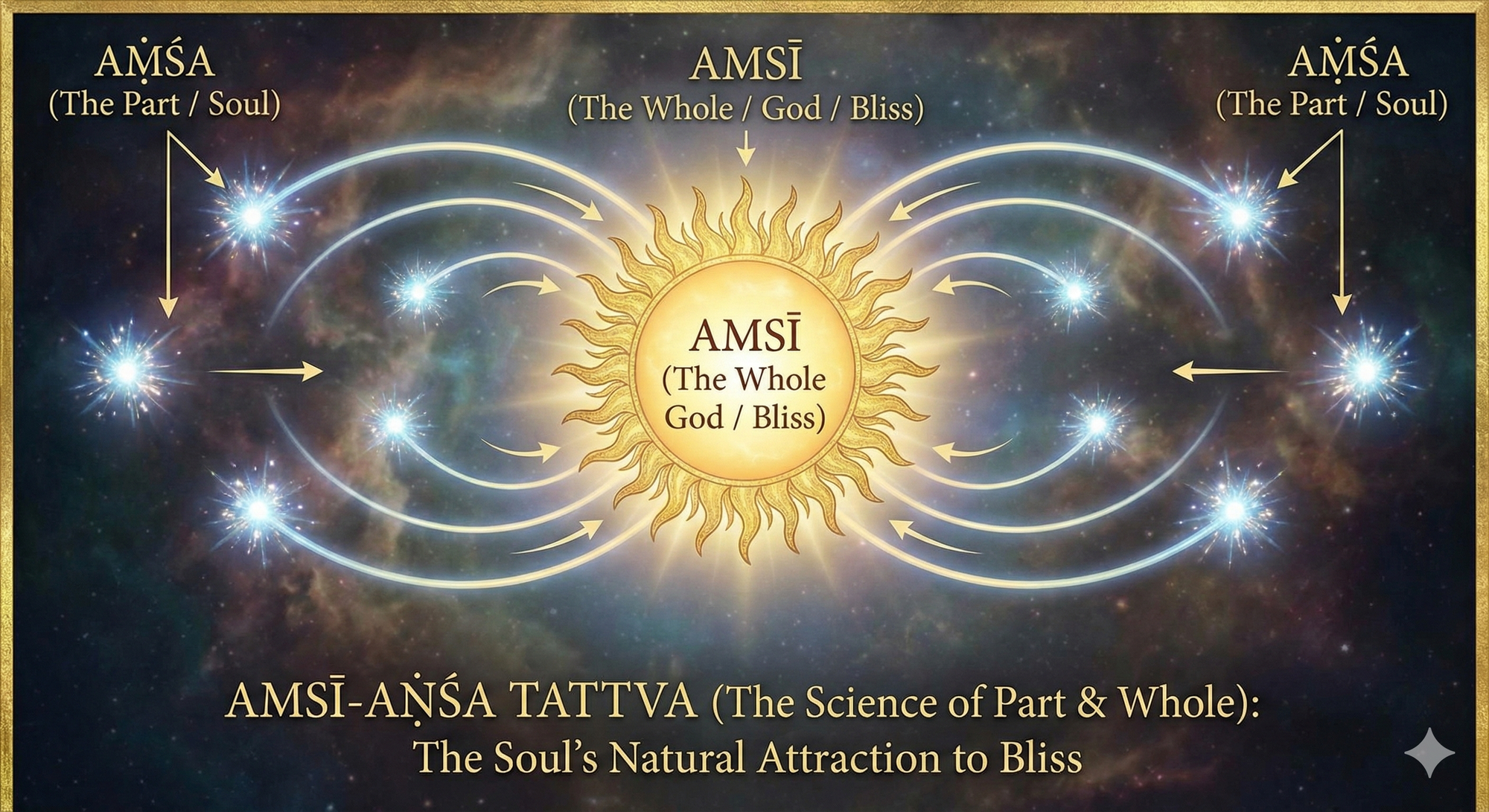
The Undeniable Fact
Observe any living being — a newborn child, a scholar, or even an animal — and one fact becomes undeniable:
Every being seeks happiness.
A child cries for milk.
A bird builds a nest for comfort.
A person works for security.
The methods differ.
The motivation does not.
No one voluntarily chooses suffering for its own sake.
This raises a fundamental question:
Why?
Why is the desire for happiness so constant, so urgent, and so universal?
Who taught the soul to love happiness?
This universality is not accidental—it follows a deeper law that governs all human action.
Deeper law that governs all human action
The Source of the Instinct
No school taught us to desire joy.
This desire is not learned.
It is innate.
And what is innate reveals nature.
We feel hunger because the body requires food.
We feel thirst because the body requires water.
Similarly, if the soul feels an unending thirst for happiness, that indicates that happiness is its natural nourishment.
Desire reveals design.
Aṁśa and Aṁśī — The Relationship of Part and Whole
The scriptures reveal the reason for this instinct.
The relationship between the soul and God is that of Aṁśa (part) and Aṁśī (whole).
īśvara aṁśa jīva avināśī, cetana amala sahaja sukha rāśī
“The soul is a fraction of God — immortal, conscious, pure, and naturally blissful.”
(Ramcharitmanas)
God is defined in the Vedas as:
- Sat — Eternal Existence
- Chit — Supreme Consciousness
- Ānanda — Infinite Bliss
If the Whole is Bliss, the part naturally reflects that nature.
Just as a drop of ocean water contains the same essence as the ocean, the soul shares the qualitative nature of God.
Therefore, the soul is not accidentally seeking happiness.
It is seeking its source.
The Law of Spiritual Attraction
In nature, the part is drawn toward its source.
A river flows toward the ocean.
A stone returns to the earth.
This is not choice.
It is law.
Similarly, the soul is drawn toward God.
This attraction manifests as desire.
We do not merely “prefer” happiness.
We are compelled to seek it.
As long as the part feels separated from the Whole, the pull remains.
This pull is experienced in human life as longing.
The First Realization
Here the first major conclusion of Siddhānt emerges:
The desire for happiness is not a flaw.
It is intrinsic to the soul’s nature.
It is the call of the Whole drawing the part toward itself.
The problem is not desire.
The problem is direction.
We attempt to satisfy a spiritual thirst with material objects.
We search for the Infinite within the finite.
And thus dissatisfaction continues.
To understand why this misdirection happens, we must first understand a fundamental principle governing all human action.
Continue the Inquiry
(Part 1 of 7 — The Goal of Life)
- Next: The Universal Axiom of Happiness
- Back to Goal Hub