Did the Great Vedic Acharyas Teach Different Philosophies?
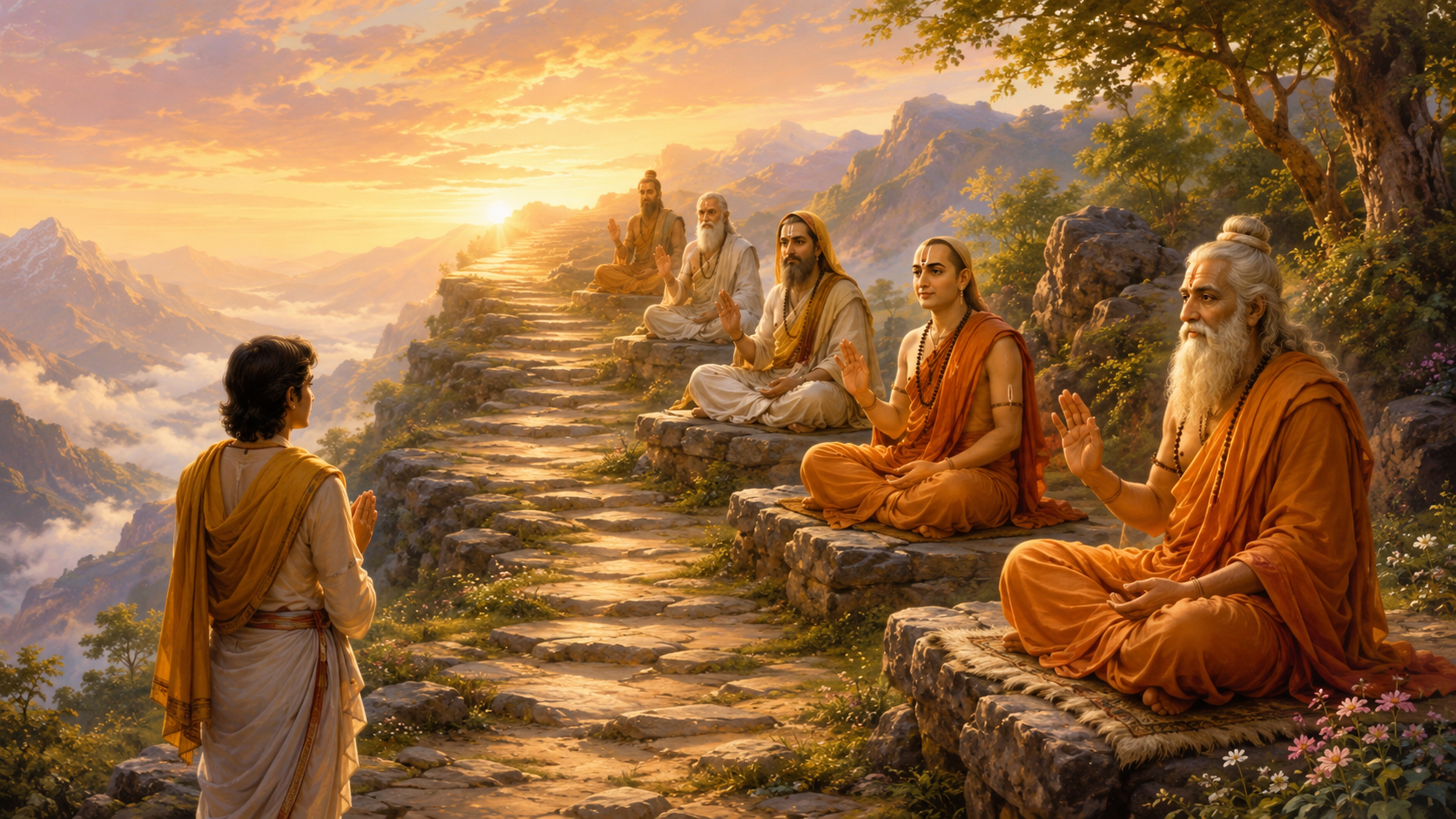
Do the great Vedantic Acharyas contradict one another, or do their teachings guide seekers toward one Divine truth?
Why Do the Great Vedantic Acharyas Seem to Contradict One Another?
📍 Where You Are in the Inquiry
In the previous articles, we explored the path of Gyan and saw that true knowledge (gyan) ultimately culminates in devotion to God.
Still many seekers approach Vedic scriptures with genuine sincerity only to encounter an unexpected difficulty. Different acharyas seemingly teach very different philosophies.
Some declare that the soul is Brahm. Others teach that the soul is eternally God's servant. Some describe Maya as an indescribable illusion, while others explain Maya as an eternal power of God. As a result, many sincere seekers begin to wonder:
"Do these great teachers contradict one another?"
"Whom should I believe?"
"Are Vedic scriptures hopelessly confusing?"
These questions are natural. The Vedic tradition contains many philosophical schools, each established by great God-realized acharyas.
If different acharyas explain the relationship between God, soul, and Maya differently, do they teach different spiritual goals? Do they lead seekers toward different destinations? Or do they ultimately guide souls toward the same Divine truth?
This article addresses those questions.
Despite their philosophical differences, several themes recur throughout the Vedantic traditions.
Before concluding that these teachings are contradictory, however, we must first understand what each acharya actually taught and what they ultimately sought to give humanity.
By fairly examining the teachings of the major Vedantic acharyas, we will discover that although their explanations differ, the later Vedantic traditions progressively place greater emphasis on Divine Grace, surrender, and loving devotion.
The Apparent Contradiction
The philosophical differences among the Vedantic schools are real.
A follower of the path of Gyan may say:
- The soul is Brahm.
- Maya is indescribable.
- Only Brahm truly exists.
A follower of the path of Bhakti may say:
- The soul is an eternal power of God.
- Maya is also a power of God.
- God, soul, and Maya eternally exist.
At first glance, these teachings appear irreconcilable.
Is the soul Brahm or God's servant?
Is Maya illusion (make believe) or a real power of God?
Does liberation dissolve all distinction, or does loving relationship with God continue eternally?
These questions naturally arise in the minds of sincere seekers and, if left unresolved, can create confusion and hinder spiritual progress.
Adi Shankaracharya and Advaita Vedanta
Adi Jagadguru Shankaracharya is the principal acharya of Advaita Vedanta.
Shankaracharya re-established the authority of the Vedas and revitalized Vedic learning.
According to his philosophy, the soul is not ultimately separate from Brahm. The apparent distinction between the individual soul and Brahm exists due to ignorance (avidya).
Shankaracharya described Brahm as formless, attributeless, actionless, and without any internal or external distinctions. Maya is described as an indescribable phenomenon. The world, as experienced by the soul, appears through ignorance.
The Upanishadic statement:
तत्त्वमसि
tat tvam asi
(Chandogya Upanishad 6.8.7)
"You are That."
is central to Advaita.
The culmination of spiritual realization is expressed as:
अहं ब्रह्मास्मि
ahaṁ brahmāsmi
(Brihadaranyaka Upanishad 1.4.10)
"I am Brahm."
According to Advaita, liberation culminates in the realization of one's oneness with Brahm.
Nimbarkacharya and Dvaitadvaita Vedanta
Jagadguru Nimbarkacharya taught that the soul is simultaneously one with and different from God.
Just as a golden ornament is made of gold and yet remains distinct from the gold itself, the soul is a power of God and therefore shares a fundamental unity with Him while still remaining distinct.
Nimbarkacharya emphasized that God's personal form is primary and that liberation is possible only through devotion to Him.
According to his philosophy:
- the soul is eternal,
- God alone is independent,
- souls and Maya are dependent upon Him,
- and Divine Grace is indispensable.
- God Himself became the universe, yet remained forever independent of it.
He taught that through devotion, surrender to a God-realized Guru, and complete purification of the heart, Divine Love awakens and the soul becomes eternally fulfilled.
Ramanujacharya and Vishishtadvaita Vedanta
Jagadguru Ramanujacharya taught that Brahm is one, yet possesses real internal distinctions in the form of souls and the material world.
According to his philosophy:
- souls are real,
- the world is real,
- Maya is a power of God,
- and God possesses infinite Divine qualities.
He described the souls and the world as the body of God.
The soul is an infinitesimal part of God and eternally dependent upon Him.
Ramanujacharya gave special emphasis to prapatti—complete surrender to God. He taught that ultimate Divine happiness can be attained only through wholehearted surrender and Divine Grace.
For him, the soul is eternally God's servant, and selfless devotion is the means to liberation.
Madhvacharya and Dvaita Vedanta
Jagadguru Madhvacharya taught that God, souls, and Maya are three eternally distinct realities.
According to his philosophy:
- the soul never becomes God,
- God alone is omnipotent and omniscient,
- and only Bhakti can grant God realization.
Madhvacharya encouraged constant remembrance of God, offering all actions to Him, and making devotion the center of daily life. He emphasized that one who remembers God throughout life will naturally remember Him at the final moment.
For him, devotion to God is indispensable for liberation.
Vallabhacharya and Pushti Marg
Jagadguru Vallabhacharya established Pushti Marg, the path of Divine Grace.
He taught that
- the soul is distinct from God
- God's personal form is real,
- loving devotion to Shri Krishna is essential,
- Divine Grace (pushti) is indispensable,
- and eternal loving service to Shri Krishna is liberation.
Vallabhacharya taught that Shri Krishna is the Supreme Personal God and emphasized Pushti (Divine Grace), loving devotion, and Madhurya Bhav. He regarded the Bhagavat as the supreme authority for devotion.
He especially emphasized surrender, loving remembrance, and devotional absorption in Shri Krishna's Divine pastimes.
Shri Chaitanya Mahaprabhu and Pure Divine Love
Shri Chaitanya Mahaprabhu propagated the path of pure, selfless devotion to Shri Krishna.
His Shikshashtak is regarded as the essence of devotional philosophy. Through both His teachings and His own life, He demonstrated that the highest perfection of the soul is pure Divine Love.
Shri Chaitanya Mahaprabhu especially emphasized Naam Sankirtan as the supreme practice for Kali Yuga. In the Shikshashtakam He described the progressive purification of the heart through devotion, culminating in Radha Bhav and Mahabhav.
For Shri Chaitanya Mahaprabhu, loving devotion to Shri Krishna is both the means and the ultimate goal of spiritual life.
What Do All These Great Acharyas Agree Upon?
These philosophical traditions arose in different historical contexts and emphasized different aspects of spiritual life. Understanding their teachings in context helps us appreciate both their differences and their contributions.
Although the great acharyas differ in their explanations, several important themes repeatedly appear throughout these traditions.
God-realization is the highest goal of life.
All direct the soul away from worldly attachment and toward God.
The Bhakti traditions consistently emphasize Divine Grace as indispensable.
Whether they speak of Bhakti, Prapatti, Pushti, or Divine Love, all acknowledge that God's Grace is essential for ultimate spiritual attainment.
Surrender is necessary.
Each tradition emphasizes humility, self-surrender, and dependence upon God.
Loving devotion to God is essential.
Although their philosophical explanations differ, all ultimately direct the soul toward devotion to God.
Different Philosophies, One Direction
The Vedantic traditions differ in how they explain the relationship between God, soul, Maya, and the world. However, beginning with Ramanujacharya, the major Bhakti traditions progressively place greater emphasis on surrender, Divine Grace, and loving devotion to God.
Understanding these teachings in their proper context helps remove unnecessary confusion. Rather than viewing the great acharyas as simply contradicting one another, we can appreciate the distinct contribution each made to the preservation and unfolding of Vedantic thought.
All of these great teachers direct souls toward:
- God realization,
- Divine Grace,
- surrender,
- and loving devotion.
Thus, although the Vedantic traditions differ in their philosophical explanations, the later Bhakti traditions increasingly emphasize surrender, Divine Grace, and loving devotion to Shri Krishna. Rather than creating confusion, understanding these teachings helps the sincere seeker appreciate the rich spiritual heritage of Vedanta and continue the journey toward God.
This realization should inspire confidence rather than confusion.
Go Deeper
Continue the Inquiry
(Part 1 of 7 — Gyan and Bhakti: The Culmination of All Spiritual Paths)
If all these acharyas value Bhakti, an important question naturally arises.
Does liberation actually mean becoming God and ending all relationship with Him? Or does loving relationship with God continue eternally?
The answer to this question lies at the heart of one of Vedanta's most important debates.
- ⬅️ Previous: Bhakti Produces Knowledge and Detachment
- ➡️ Next: Did Shankaracharya Reject Bhakti?
- 🔙 Back to Hub: Gyan and Bhakti: The Culmination of All Spiritual Paths