Is God Omnipresent?
If God is everywhere, why do the scriptures say He lives in Golok? Discover how His Para Shakti makes both truths simultaneously possible.

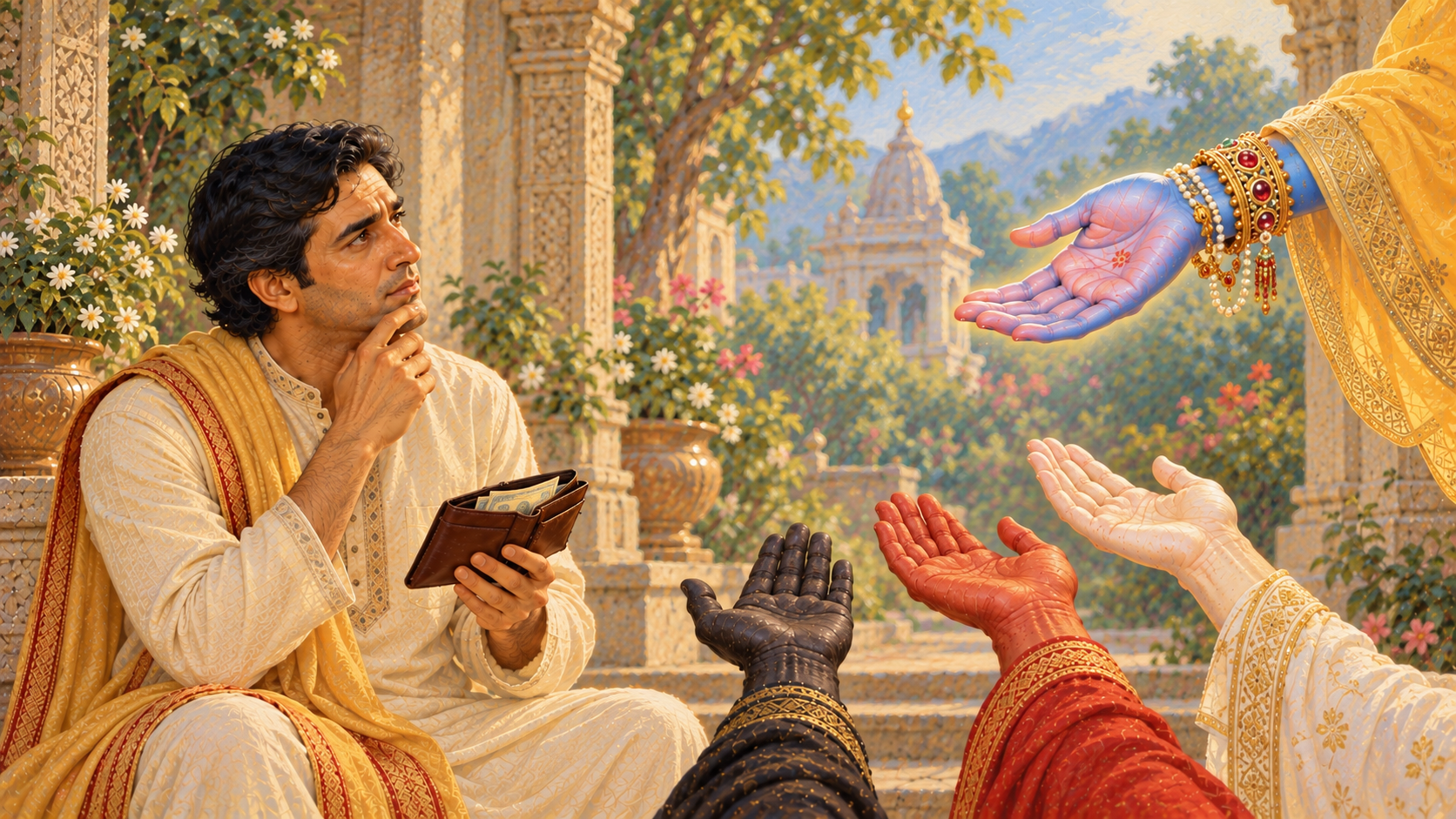
The Vedas repeatedly declare that God is all-pervasive (सर्वव्यापक | sarvavyāpaka). At the same time, they also describe Him as eternally residing in His own Divine Abode of Golok.
At first glance, these statements appear contradictory. If God is everywhere, how can He also live in one particular place?
The answer lies in God's Para Shakti (परा शक्ति | parā śakti)—His inconceivable Divine Power.
By His Para Shakti, God is simultaneously:
- present within every Jeev (जीव | jīva),
- present within every Swansh (स्वांश | svāṁśa),
- present in every particle of the material creation,
- present throughout Paravyom, the eternal Divine Realm,
- and eternally residing in His supreme abode, Golok.
He remains fully present everywhere in His eternal Divine Form while simultaneously performing His eternal Divine Leelas in Golok.
Unlike material beings, God is not limited by space or subject to the laws governing the material world. Through His infinite Para Shakti, He does not need to choose between residing in one place and being present everywhere. Both are eternally true at the same time.
The Vedas therefore teach that God eternally resides in His Divine Abode while simultaneously remaining fully present throughout all creation. This is not a contradiction but an expression of His infinite Para Shakti.
Related Concepts
Go Deeper
- Why Is Every Particle of Golok Divine?
- The Abode of Contradictory Qualities: Beyond Logic
- The Diverse Roop of God