What Do You Really Want?
In Mahabani Ji’s home in Pratapgarh, in the afternoon people used to visit Shri Maharaj Ji. They would ask Shri Maharaj Ji to explain some spiritual concepts, clarify misconceptions. Once in a while when someone important came to visit him and wanted to hear a lecture then Shri Maharaj Ji would give a lecture. But those were far and few in-between.
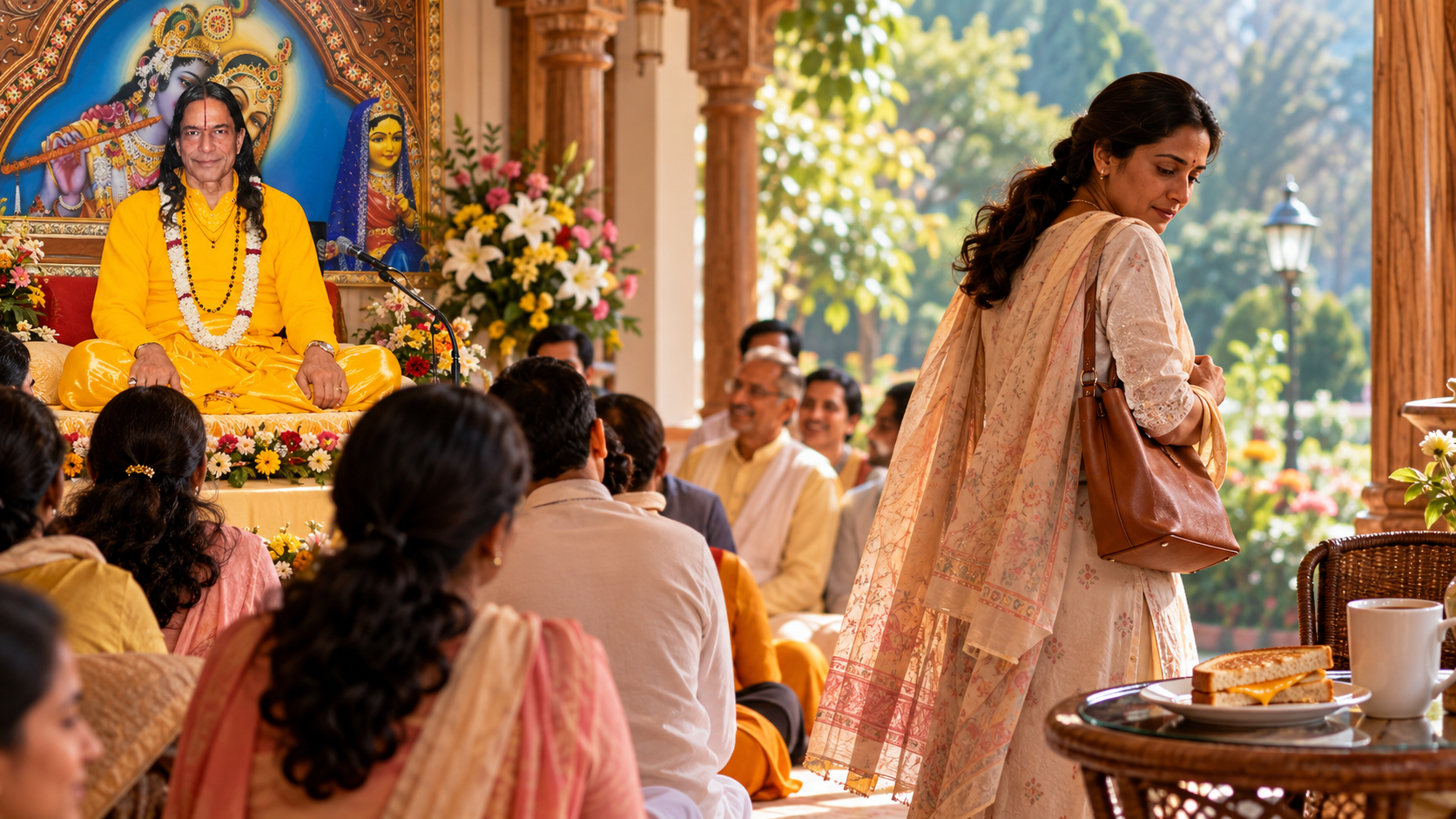
One afternoon, Shri Maharaj Ji was sitting alone in the courtyard. Banchary Didi approached Shri Maharaj Ji and asked him “will you give a lecture today”? He asked “Why the question?” She replied,”I want to eat a cheese sandwich with coffee. If you don’t plan to give a lecture then I'll go out to eat it”. Maharaj Ji told her “go”.
She went and after about 45 min as she was about to enter the house she heard “Albeli sarkar ki jai”. This is how Shri Maharaj Ji used to end the lecture! Hearing those words she hurried into the house.
Shri Maharaj Ji had already gone inside his room. She suspected some important person might be there, but all she saw were some senior women sitting in the courtyard and praising the lecture.
Banchary Didi asked those women, "Did He give a lecture?” She was told it was an amazing lecture on “Golok”. She asked each and every woman “what did Maharaj Ji say about Golok?”. None of them remembered anything. All they could say was “it was amazing!”.
She was a little miffed. She went to Shri Maharaj Ji’s room and complained, "you said you won’t give a lecture. No important person was here and yet everyone is saying you gave an awesome lecture on Golok. And I missed it”. Maharaj Ji said,”Go eat cheese sandwich”.
What Did She Really Miss?
Banchary Didi had not disobeyed Shri Maharaj Ji. She asked whether he would give a lecture, and when he said no, she asked permission to leave. He allowed her to go.
Yet an ordinary desire had entered her mind. She followed it—and while she was away, Shri Maharaj Ji spoke about Golok.
Her story gives us something to think about. Shri Maharaj Ji instructs us to remember God and Guru nirantar—continuously, without interruption. The mind, however, is continuously active. When it is not engaged in Divine remembrance, worldly thoughts and desires enter.
What happens when they do?
We sing:
नित सेवा माँगूँ श्यामा श्याम तेरी, न भुक्ति न ही मुक्ति माँगू मैं ॥
तेरी इच्छा में इच्छा बनाती रहूँ, तेरे सुख में ही सुख नित पाती रहूँ ।
We ask for nit seva—continuous service. We say we do not seek bhukti, material enjoyment. We pray that His wish become our wish, and that His happiness become ours.
But singing it is easier than living it.
A desire for our own happiness arises in the mind. Do we return the mind to Him—or do we follow the desire?
Banchary Didi followed one such thought to a cheese sandwich and coffee. What she discovered afterward was what that choice had cost her: an opportunity to hear Shri Maharaj Ji speak about Golok.
And this struggle does not take place only in our outward actions. It begins in the mind. Thoughts themselves are actions. That is why putting these words into practice—not merely through our actions, but through our thoughts—requires practice.
Many jeev like Tulsi, Soor, Meera, Kabir, Nanak and Tukaram have done it before us. With practice, we too can become selfless and attain gopi prem.
Go Deeper
 JKP Literature
 JKP Literature
 JKP Literature
 JKP Literature
 JKP Literature
 JKP Literature