Why Do Scriptures Appear to Criticize Other Divine Forms?
If criticizing another Divine form is a mistake, why do the Puranas themselves sometimes appear to do exactly that?
📍 Where You Are in the Inquiry
We have established that God's uncountable names, forms, virtues, leelas, abodes, and Saints are all one. A devotee may follow whichever awakens love in the heart, but should not use personal preference to make distinctions or criticize another Divine name, form, virtue, leela, abode, or Saint.
Yet this creates an apparent contradiction.
If making such distinctions is a spiritual mistake, why do the Puranas themselves sometimes appear to praise one Divine form while criticizing another?
Preference Is Not a Basis for Criticism
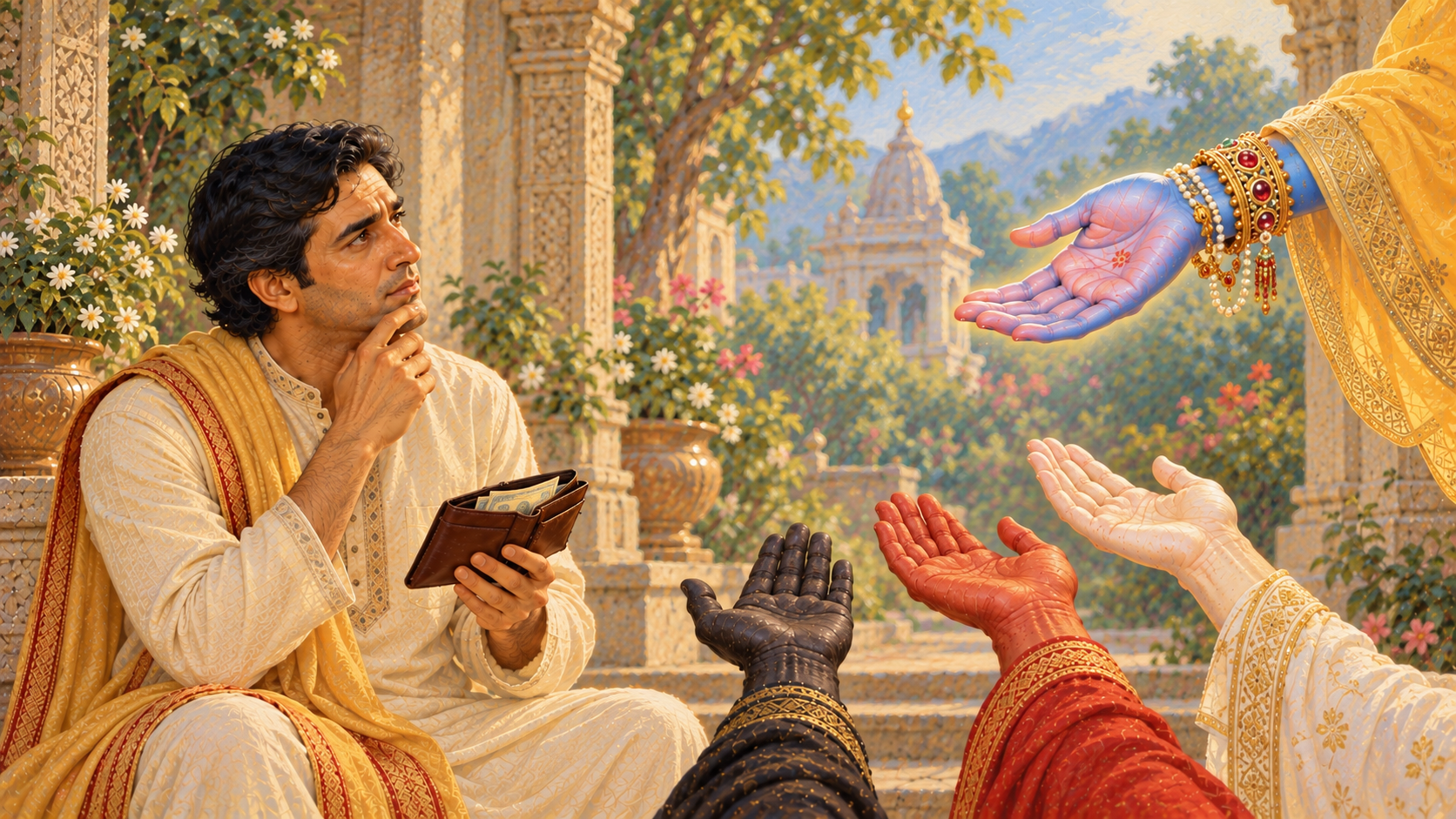
In the world, worshippers commonly favor a particular form, name, or virtue of God. But sometimes this preference leads them to criticize those who worship another Divine name, form, or virtue.
Shri Maharaj Ji calls this a great mistake.
A devotee may have a deeply personal attraction to Shri Ram, Shri Krishna, a particular Divine name, or a particular Divine virtue. The problem is not that preference. The problem arises when preference becomes a judgment that another Divine object of devotion is inferior.
But someone could object that similar distinctions seem to appear even in the Puranas.
How should those statements be understood?
Apparent Criticism May Actually Be Praise
The scriptures give a principle for understanding such passages:
न हि निन्दा निन्द्यं निन्दितुम्।
na hi nindā nindyaṁ ninditum
“The intent is not to condemn that which appears to be criticized.”
Shri Maharaj Ji explains that such scriptural statements are simulations. Their specific purpose is to enhance devotion toward the form of God being praised. The intention is praise of one's own side, not condemnation of the other.
This distinction prevents an apparent comparison from being turned into an actual hierarchy among Divine forms.
The words may sound like criticism when read literally, while their devotional purpose is something entirely different.
Surdas Challenges Tulsidas
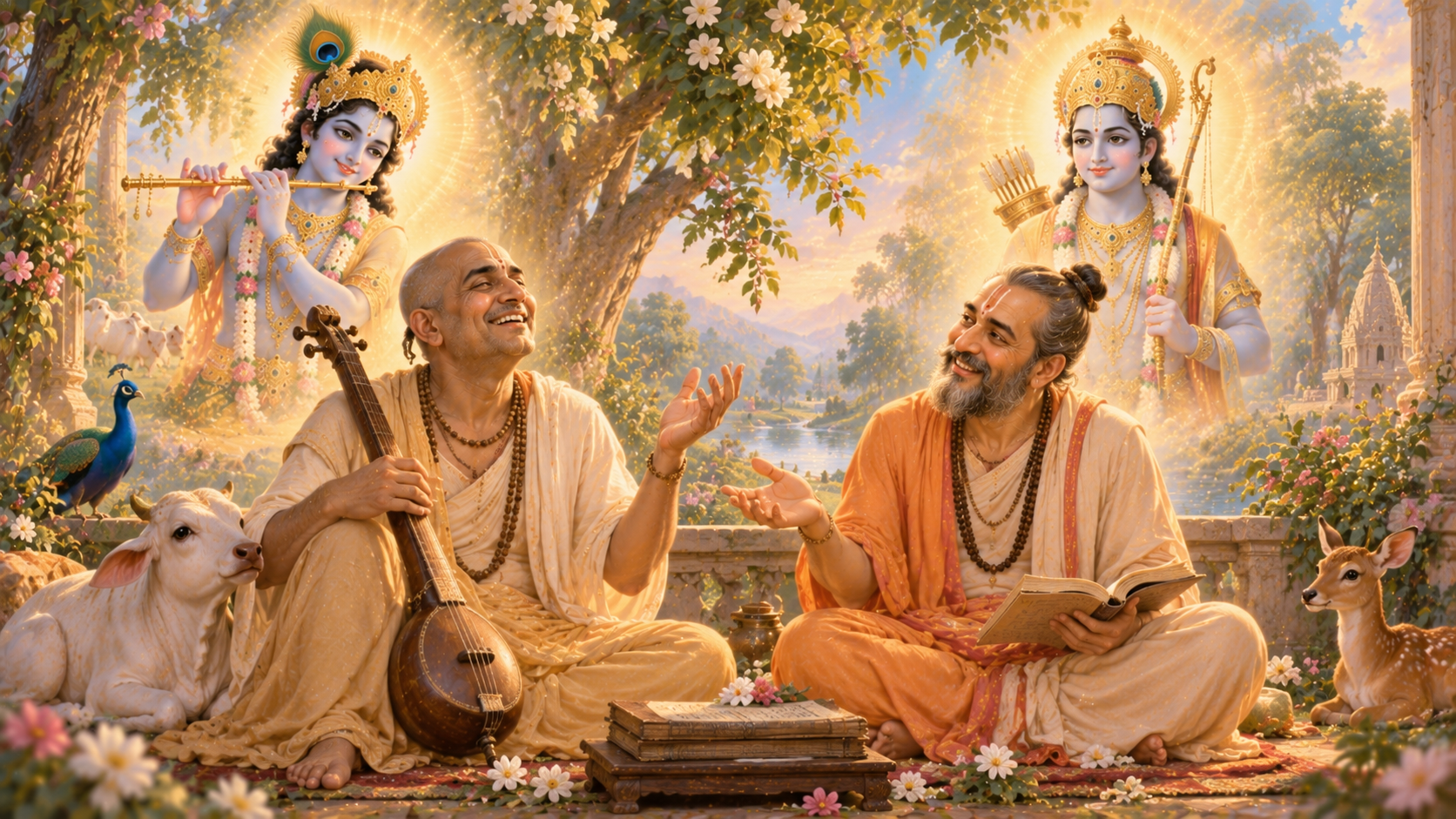
Shri Maharaj Ji illustrates this through a humorous exchange between Surdas and Tulsidas.
Surdas once asked Tulsidas:
Shri Krishna manifests all sixteen aspects of Divinity—solah kala. Shri Ram manifests only twelve. Why, then, do you worship Shri Ram?
Tulsidas could have given a doctrinal answer.
Instead, he replied just as playfully:
Until now, I knew only that Ram was my beloved prince. Today I have learned that He is an Avatar manifesting twelve Divine aspects. My devotion to Him has increased twelvefold!
Tulsidas does not enter into the proposed comparison at all. Learning of Shri Ram's twelve manifested Divine aspects simply becomes another reason for him to love his beloved Ram even more.
The Language of Rasik Saints
Shri Maharaj Ji explains that this is the language of Rasik Saints (रसिक सन्त | rasika santa).
Such Saints are internally one, yet they may sometimes joke with one another, just as people who are close in the world may playfully tease each other.
Seen only from the outside, their words may appear to express disagreement or criticism. But that is not their actual intent.
The exchange between Surdas and Tulsidas therefore illustrates the same principle Shri Maharaj Ji gives for understanding apparent criticism in the Puranas: words that appear to diminish another Divine form need not have condemnation as their purpose.
Where This Inquiry Leads
A devotee's special love for one Divine form does not justify criticizing another. Likewise, when the Puranas appear to criticize one Divine form while praising another, the apparent criticism may be a devotional device whose true purpose is to intensify love for the form being praised.
The humorous exchanges of Rasik Saints must be understood in the same way. Saints who are internally one may speak in the language of apparent rivalry without actually establishing opposition between the Divine forms they love.
But scripture presents another kind of apparent distinction that cannot be explained merely as devotional praise: it explicitly classifies God's descensions in different ways.
If every Avatar is complete, what do those classifications actually mean?
Continue the Inquiry
Part 6 of 7 — Avatar
Apparent criticism of another Divine form may serve to intensify devotion to the form being praised rather than establish that another form is inferior. Yet the scriptures also explicitly classify God's descensions in different ways. If all Avatars are complete, what do these classifications actually mean?
- ⬅️ Previous: Are All Divine Abodes and Saints One?
- ➡️ Next: What Do Avatar Classifications Really Mean?
- 🔙 Back to Hub: Avatar Tattva — The Descent