What Do Avatar Classifications Really Mean?
If every Avatar is complete, why do scriptures classify some descensions as partial and others as complete?

📍 Where You Are in the Inquiry
We have established that every Avatar is complete. God does not become divided into greater and lesser portions when He descends, and the amount of Divinity present in one descension is not less than in another.
Yet the scriptures themselves appear to create precisely such distinctions. They speak of Anshavatar, Poornavatar, Aveshavatar, Kalavatar, and other classifications of Divine descensions.
If every Avatar is complete, what do these classifications actually mean?
Why Do the Scriptures Classify Avatars?
The scriptures describe different kinds of Divine descensions.
Anshavatar (अंशावतार | aṁśāvatāra) refers to a partial descension, while Poornavatar (पूर्णावतार | pūrṇāvatāra) refers to a complete descension. Other classifications describe a descension associated with a particular purpose or mission, or one manifesting particular Divine qualities, such as Aveshavatar (आवेशावतार | āveśāvatāra) and Kalavatar (कलावतार | kalāvatāra).
At first, this seems difficult to reconcile with what has already been established.
If one Avatar is called partial and another complete, does that not mean that one possesses only part of God's power while another possesses all of it?
The distinction lies not in how much Divine power the Avatar possesses, but in how much Divine power is manifested for a particular purpose.
A particular descension reveals only as much power as is required at that time. The scriptural classification corresponds to the degree of Divine power being manifested, not to the total Divine capacity of that descension.
Shri Maharaj Ji clarifies this with a simple worldly example.
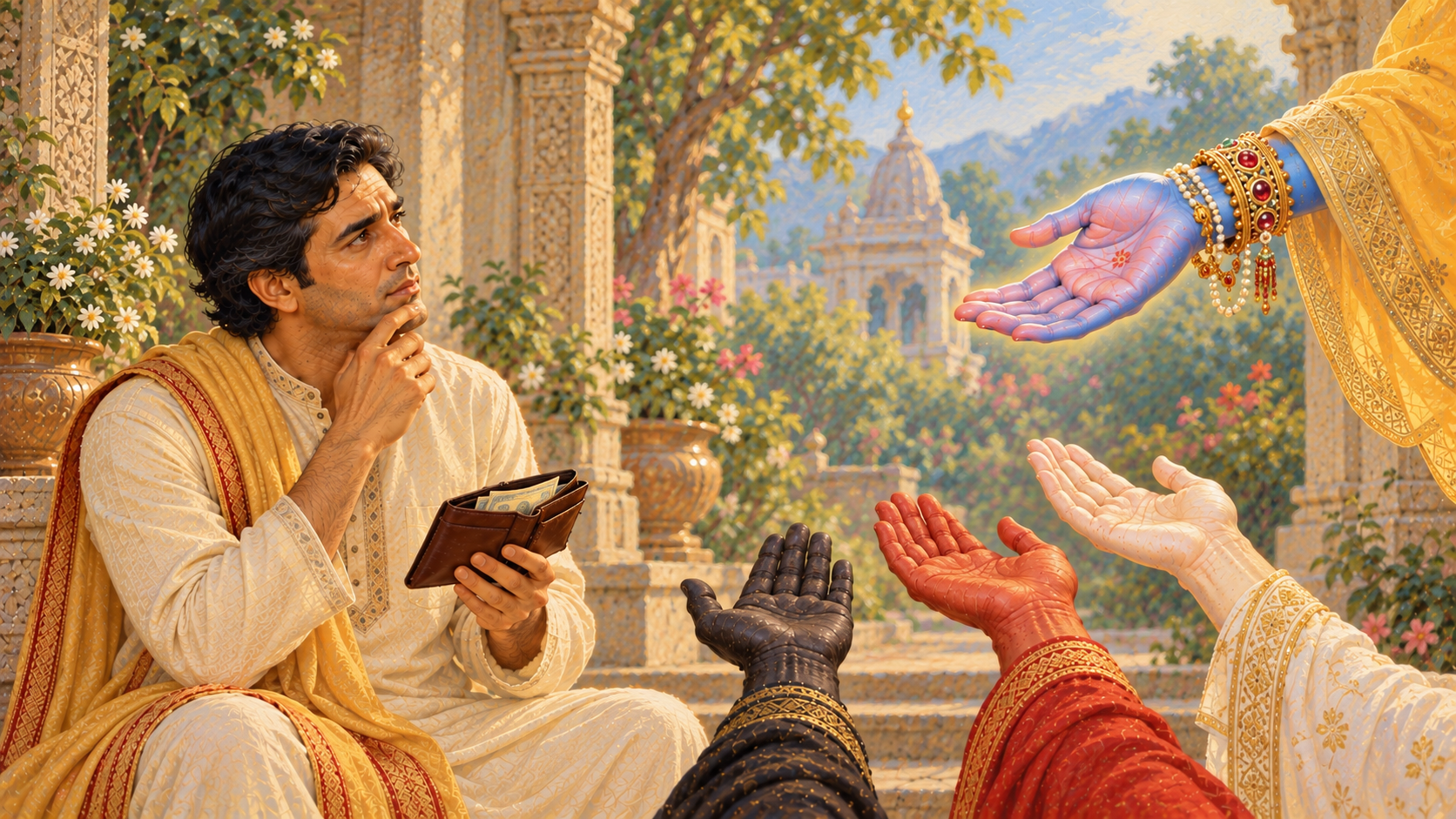
The University Professor and His Child
Imagine a university professor teaching his young child:
A, B, C, D.
Someone watching him could hardly conclude that the professor knows only four letters.
His full intellectual ability remains with him. He is simply manifesting the degree of ability appropriate to the situation.
The same professor may speak differently in different circumstances. With his little child, he may use the broken language of young children. With his wife, he may speak her mother tongue. With his servant, he may use the servant's native dialect. When he stands before his students at the university, he may reveal his full intellectual abilities.
The professor himself has not become greater or lesser in these situations.
Only the amount of his ability being displayed has changed.
The classifications of God's descensions should be understood in the same way.
Manifested Power Is Not Total Power
An Avatar may descend for a particular purpose for which only certain Divine powers need to be revealed.
Another descension may reveal considerably more.
The scriptures can therefore distinguish between these descensions according to the Divine power that becomes manifest without implying that God's actual power has been divided.
This resolves the apparent contradiction.
Terms such as Anshavatar, Poornavatar, Aveshavatar, and Kalavatar describe the manifestation of Divine power appropriate to a particular descension. They do not establish different quantities of God.
Just as the professor teaching the alphabet has not lost the intellectual abilities he displays at the university, a Divine descension does not cease to possess unlimited Divine power merely because that power is not being manifested.
Where This Inquiry Leads
The scriptural classifications of Avatars do not contradict the completeness of God's descensions.
A particular Avatar manifests the degree of Divine power required for the purpose of that descension. The classifications correspond to what is revealed, not to a limitation in God's total Divine capacity.
The distinction is therefore between different degrees of manifestation, not different degrees of Divinity.
Once this is understood, another practical question arises. If God's descensions are complete and their classifications describe manifested power rather than greater or lesser Divinity, which Avatar should a devotee choose for meditation?
That is where the inquiry turns next.
Go Deeper
 JKP Literature
 JKP Literature
Continue the Inquiry
Part 7 of 7 — Avatar
The scriptural classifications of Avatars describe the degree of Divine power manifested for a particular purpose, not a limitation in God's total Divine capacity. If these classifications do not make one Avatar more or less complete than another, the practical question remains: which Avatar should a devotee choose for meditation?
- ⬅️ Previous: Why Do Scriptures Appear to Criticize Other Divine Forms?
- ➡️ Next: Which Form of God Should I Worship?
- 🔙 Back to Hub: Avatar Tattva — The Descent