Why Do Scriptures Say God and the Soul as One?
Why do scriptures sometimes describe God and the soul as one? Learn how the Vedic scriptures reconcile both distinction and intimate connection.
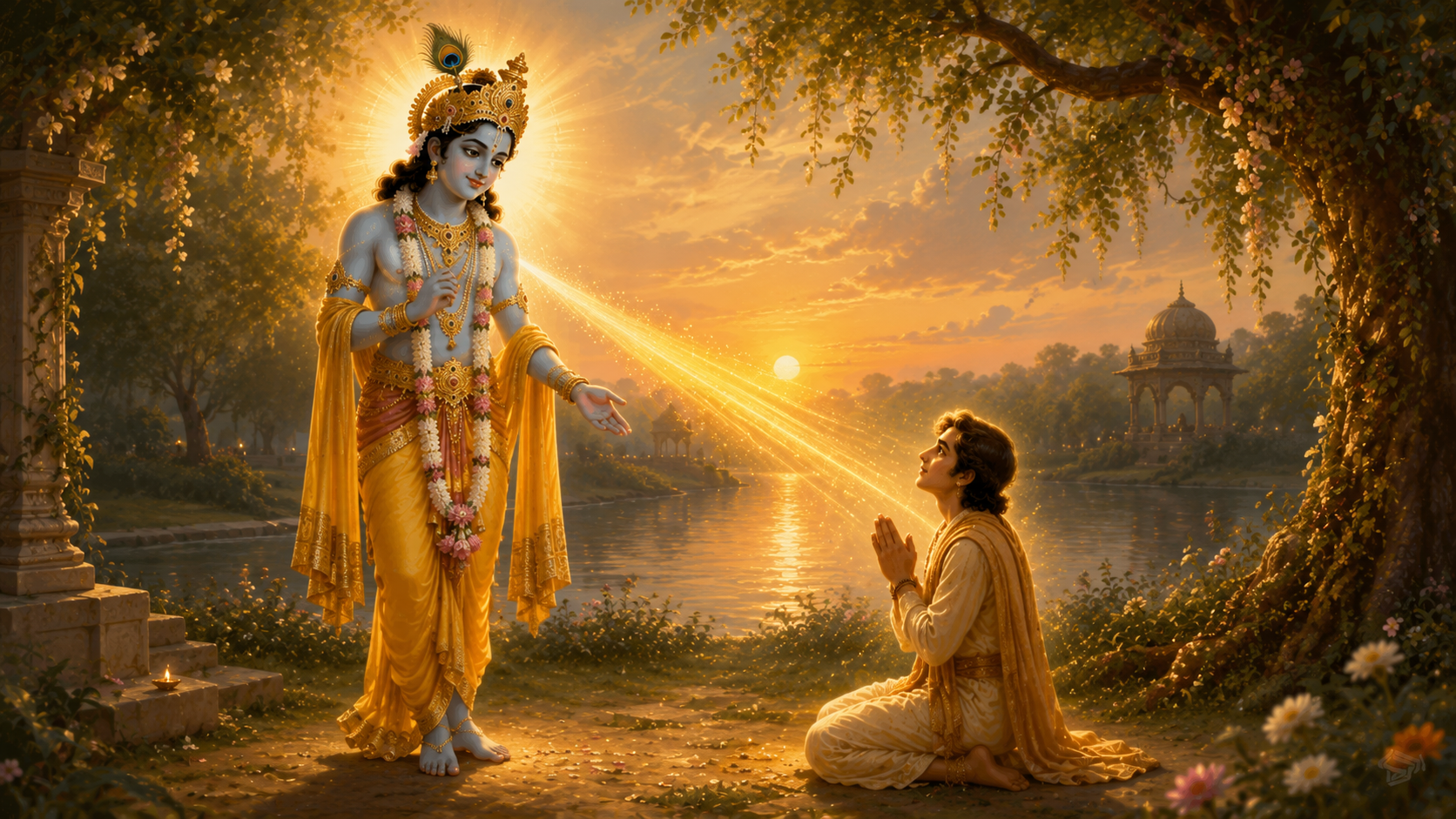
Vedic scriptures frequently use words such as Brahm, Atma, Jeev, and Akash in different contexts.
As a result, seekers often become confused when they encounter scriptural passages that appear to identify the individual soul with God.
On one hand, the scriptures repeatedly describe profound differences between Brahm and Jeev.
On the other hand, they sometimes refer to both using the same words or speak of them as one.
How can both statements be true?
Understanding this apparent contradiction is essential for understanding Atma-Gyan, Brahm-Gyan, Bhakti, Grace, surrender, and liberation.
The Scriptures Teach Both Difference and Non-Difference
The scriptures teach that Brahm and Jeev are eternally related.
The soul is an infinitesimal part (ansh) of God, who is the Supreme Whole (Anshi).
Because of this relationship, the soul shares certain qualities with God.
Both are eternal (were never born and will never die).
Both are conscious.
Both are divine.
However, similarity does not imply equality.
The scriptures also repeatedly teach that God is infinite, all-knowing, all-powerful, independent, and eternally beyond Maya, whereas the soul is infinitesimal, dependent, limited in knowledge and power, and is bound by Maya.
Thus, the scriptures teach both difference and non-difference simultaneously.
The Soul Is the Body; God Is the Indwelling Self
The Vedas describe the relationship between Brahm and Jeev as analogous to that between the body and the self.
God is the indwelling Self (Atma) of all souls.
The soul exists within God and is completely dependent upon Him.
Some scriptural passages therefore describe Jeev as the body of God and God as the Atma of Jeev.
Because of this intimate relationship, the scriptures sometimes speak of them together.
However, inseparable relationship does not imply absolute identity.
The body and the self are intimately related, yet they are not identical.
Similarly, Brahm and Jeev are eternally related, yet they remain distinct entities.
Ordinary Language Uses the Same Principle
This usage is not unique to the scriptures.
It occurs in ordinary language as well.
A person says:
"I went to Delhi."
Strictly speaking, the soul is the true self, while the body is merely an instrument.
If only the soul had gone, the body would have remained behind.
If only the body had gone, the soul would have remained behind.
In reality, both traveled together.
Yet no one says:
"My soul and body went to Delhi."
The body is naturally understood within the statement:
"I went to Delhi."
Similarly, Brahm is the principal reality, while Jeev is His dependent powers (shakti).
Because of their inseparable relationship, the scriptures sometimes refer to the whole along with its dependent powers using a single term.
Similarity Does Not Imply Identity
A spark and a blazing fire both possess heat and light.
However, the spark is not equal to the fire.
Similarly, the soul shares a divine nature with God, yet it never becomes equal to Him.
God remains:
- Sarvajna (सर्वज्ञ | sarvajña) — all-knowing.
- Sarva Shaktiman (सर्वशक्तिमान् | sarvaśaktimān) — all-powerful.
- Sarva Tantra Svatantra (सर्वतन्त्र स्वतन्त्र | sarvatantra svatantra) — completely independent.
The soul remains:
- Alpajna (अल्पज्ञ | alpajña) — possessing limited knowledge.
- Alpa Shaktiman (अल्पशक्तिमान् | alpaśaktimān) — possessing minute powers.
- Paratantra (परतन्त्र | paratantra) — dependent.
Thus, shared qualities do not erase the profound distinctions between Brahm and Jeev.
The Scriptures Sometimes Use the Principal to Refer to the Whole
God is the principal reality.
Jeev and Maya are His dependent powers.
Because of this relationship, scriptural passages sometimes use the name of the principal entity to refer to the whole.
For this reason, words such as Atma, Jeev, and Akash may sometimes be used for the Supreme God.
Such usage emphasizes the intimate relationship between God and His powers.
It does not imply that all distinctions disappear.
Why This Distinction Matters
Many philosophical misunderstandings arise when scriptural statements of oneness are interpreted in isolation.
If only difference is emphasized, the soul's intimate connection with God is lost.
If only oneness is emphasized, Bhakti, Grace, surrender, and Divine Love become impossible.
The complete understanding embraces both.
The soul is eternally related to God, yet it never becomes God.
The Essential Conclusion
The scriptures sometimes refer to God and the soul as one because of their intimate and inseparable relationship.
However, this does not mean that Brahm and Jeev are absolutely identical.
The soul is the eternal ansh.
God is the eternal Anshi.
Difference and non-difference coexist simultaneously.
Understanding this principle resolves many apparent contradictions found in the scriptures and provides the proper foundation for understanding Bhakti, Grace, and liberation.