Differences between Brahm and Jeev
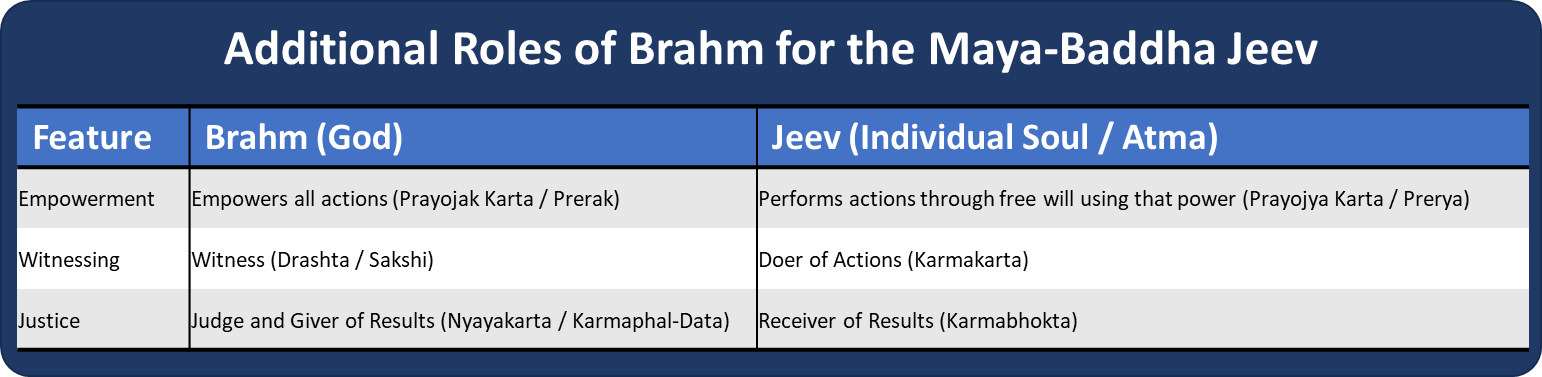
Both Brahm and Jeev are spiritual in nature, yet they are not identical. God is infinite, omniscient, and the master of Maya, while the individual soul is infinitesimal, limited, and dependent upon Him.
Vedic scriptures frequently use words such as Brahm, Atma, Jeev, and Akash in different contexts.
Because Brahm and Jeev are both eternal, conscious, and divine, seekers often become confused regarding the distinction between them.
The scriptures teach that the soul shares certain qualities with God because it is His infinitesimal part (ansh). Yet the scriptures also repeatedly describe profound differences between Brahm and Jeev.
Understanding these distinctions is essential for understanding Atma-Gyan, Brahm-Gyan, Bhakti, Grace, surrender, and liberation.
Both Are Divine, Yet They Are Not Equal
The scriptures describe both Brahm and Jeev as conscious and eternal.
However, similarity does not imply equality.
A spark and a blazing fire both possess heat and light, yet they are not equal in power.
Similarly, the soul shares a divine nature with God, but it never becomes equal to Him.
God Is the Master; the Soul Is the Servant
God is Swami (स्वामी | svāmī)—the eternal Master.
The soul is Dasa (दास | dāsa)—the eternal servant.
The soul's perfection lies not in becoming God, but in lovingly serving Him.
God Controls; the Soul Is Controlled
God is Niyanta (नियन्ता | niyantā)—the supreme controller.
The soul is Niyamya (नियम्य | niyāmya)—one who is governed.
The soul is subject to the laws established by God, including the laws of karma, birth, death, and rebirth.
God Is Omniscient; the Soul Possesses Limited Knowledge
God is Sarvagya (सर्वज्ञ | sarvajña)—all-knowing.
The soul is Alpagya (अल्पज्ञ | alpajña)—possessing limited knowledge.
The soul acquires knowledge gradually and may even forget what it has learned.
God, however, eternally possesses complete and perfect knowledge.
God Is the Infinite Ocean of Bliss; the Soul Seeks Bliss
God is Anandakand (आनन्दकन्द | ānandakanda)—the infinite ocean and source of all bliss.
The soul constantly seeks happiness because bliss is its intrinsic need.
However, the soul cannot generate infinite bliss independently. It can attain lasting happiness only through union with God.
God Is the Master of Maya; the Soul Can Become Bound by Maya
God is Mayadhish (मायाधीश | māyādhīśa)—the master of Maya.
The soul is Mayadheen (मायाधीन | māyādhīna)—capable of becoming controlled by Maya.
Maya can never bind God.
Yet the soul, being infinitesimal, can become covered by ignorance and wander through countless births.
God Is Infinite; the Soul Is Infinitesimal
The scriptures describe God as:
Mahato Mahiyan, Anor Aniyan
"Bigger than the biggest and smaller than the smallest."
God is unlimited.
The soul, by contrast, is Anu (अणु | aṇu)—infinitesimal.
Because of this distinction, God remains eternally unlimited, while the soul remains eternally finite.
God Possesses Infinite Consciousness; the Soul Possesses Minute Consciousness
God is Vibhuchit (विभुचित् | vibhucit)—possessing infinite consciousness.
The soul is Anuchit (अनुचित् | anucit)—possessing minute consciousness.
God simultaneously knows and sustains all beings.
The soul experiences only the body in which it presently resides.
God Is Supreme; the Soul Is Not
God is Ish (ईश | īśa)—the Supreme Lord.
The soul is Anish (अनीश | anīśa)—not supreme.
No soul, regardless of spiritual advancement, becomes the ruler of creation.
The supremacy of God remains eternal.
God Is Omnipresent; the Soul Is Localized
God is Sarvavyapak (सर्वव्यापक | sarvavyāpaka)—present everywhere.
The soul is Vyapya (व्याप्य | vyāpya)—present only in the body it inhabits.
A soul can experience only one body at a time.
God simultaneously exists within and beyond all creation.
God Is Completely Independent; the Soul Is Dependent
God is Sarva Tantra Svatantra (सर्वतन्त्र स्वतन्त्र | sarvatantra svatantra)—completely independent.
The soul is Paratantra (परतन्त्र | paratantra)—dependent.
The soul depends upon God for its existence, sustenance, knowledge, and liberation.
Nothing exists independently of God.
God Is Omnipotent; the Soul Possesses Minute Powers
God is Sarva Shaktiman (सर्वशक्तिमान् | sarvaśaktimān)—all-powerful.
The soul possesses only minute powers.
The soul can think, choose, and act, but only through the powers granted by God.
God Creates; the Soul Cannot Create from Nothing
God creates and sustains the infinitely vast universe.
The soul does not possess the power to create anything from nothing.
At most, the soul rearranges existing material energy provided by God.
Thus, creation remains a unique attribute of God.
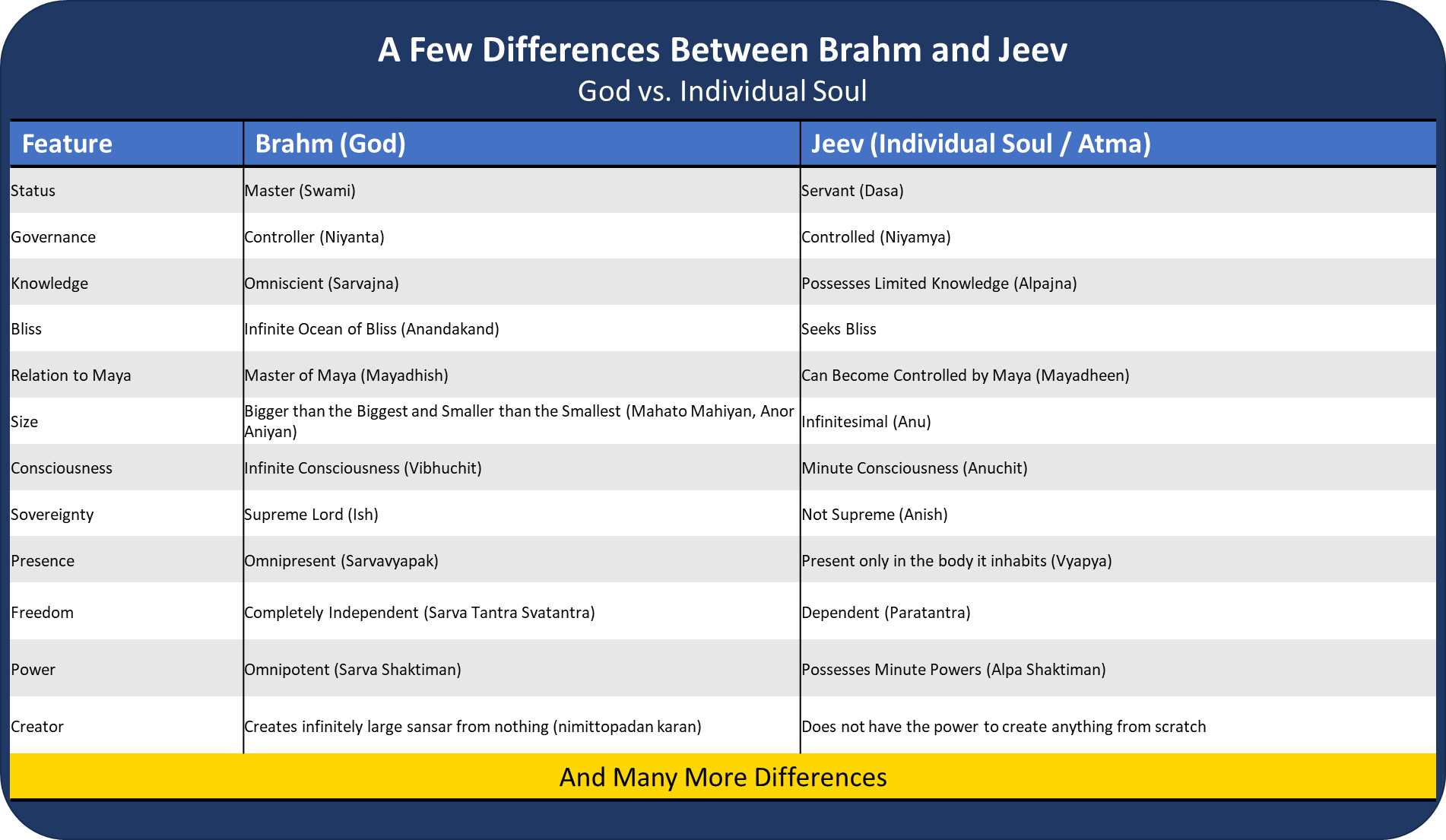
Additional Roles God Plays for the Maya-Baddha Soul
While the soul remains bound by Maya, God also performs certain additional functions.
God Empowers; the Soul Acts
God is Prayojak Karta (प्रयोजक कर्ता | prayojaka kartā) or Prerak (प्रेरक | preraka)—the giver of the power to act.
The soul is Prayojya Karta (प्रयोज्य कर्ता | prayojya kartā) or Prerya (प्रेर्य | preraya)—the one who acts using that God-given power.
God supplies the power.
The soul exercises free will in using that power.
Therefore, the soul remains responsible for its actions and their consequences.
God Witnesses; the Soul Performs Actions
God is Drashta (द्रष्टा | draṣṭā) and Sakshi (साक्षी | sākṣī)—the eternal witness.
The soul is Karmakarta (कर्मकर्ता | karmakartā)—the performer of actions.
God observes all actions performed by the soul.
God Judges; the Soul Experiences the Results
God is Nyayakarta (न्यायकर्ता | nyāyakartā) and Karmaphal-Data (कर्मफलदाता | karmaphaladātā)—the dispenser of justice and karmic results.
The soul is Karmabhokta (कर्मभोक्ता | karmabhoktā)—the experiencer of those results.
The soul chooses its actions.
God administers their consequences.
Why This Distinction Matters
Many philosophical errors arise when the soul and God are treated as identical.
The soul is spiritual, but it is not God.
The soul is conscious, but it is not all-conscious.
The soul seeks bliss, while God is the infinite source of bliss.
The soul may become liberated, but God is eternally beyond Maya.
For this reason, realization of the soul and realization of God are not the same attainment.
Understanding the distinction between Brahm and Jeev is therefore essential for understanding Bhakti, Grace, surrender, and liberation.
The Essential Conclusion
The scriptures teach that Brahm and Jeev are eternally distinct entities.
God is infinite, independent, omniscient, omnipotent, and eternally beyond Maya.
The soul is infinitesimal, dependent, limited in knowledge and power, and capable of becoming bound by Maya.
The soul may attain God-realization and liberation through Divine Grace.
However, it never becomes God.
Understanding these distinctions is essential for understanding Bhakti, surrender, Grace, and the soul's eternal relationship with God.
Go Deeper
 JKP Literature
 JKP Literature
 JKP Literature
 JKP Literature
 JKP Literature
 JKP Literature
 JKP Literature
Reference
Paid Subscription: Mein Kaun? Mera Kaun Lecture? Lecture 39 — 38:18