Additional Benefits of Doing Bhakti
Beyond its primary fruit of divine love, Bhakti automatically grants spiritual knowledge, detachment, yogic powers, and freedom from the five sheaths—even though the devotee seeks none of these.

The primary fruit of Bhakti is not worldly happiness, liberation, or supernatural powers. It is the opportunity to serve Shri Krishna eternally with divine love.
Through Sadhana Bhakti, the devotee gradually relinquishes material attachments. Upon complete surrender, the Guru bestows divine love, enabling the devotee to serve Shri Krishna and experience the unsurpassed bliss of His loving service.
Yet, when a devotee receives this supreme treasure, many other benefits come automatically, even though the devotee has never sought them.
These are called ancillary fruits (आनुषंगिक फल) of Bhakti.
Consider a beggar who wins a billion-dollar lottery. By becoming a billionaire, he automatically possesses millions and thousands of dollars. He does not need to acquire those smaller amounts separately; they are already included in his billion-dollar fortune.
Similarly, when God's supreme divine power is bestowed upon a jeev, all lesser attainments become available to that soul. These are not the devotee's goal. They are additional benefits received without asking.
Let us understand some of these extraordinary fruits of Bhakti.
Bhakti Makes Yogic Siddhis Serve the Devotee
Through yogic practices, a yogi may attain eight sattvik siddhis, or supernatural powers, to a limited extent.
However, after attaining Siddha Bhakti (perfected devotion), these siddhis and other miraculous powers serve the devotee automatically.
And they do so secretly.
Why?
Because a true devotee has no desire to acquire or display supernatural powers. The devotee desires only the loving service of Shri Krishna.
A beautiful incident involving Sant Namdev and Sant Gyaneshwar illustrates this truth.
The Yogi and the Devotee at the Well

Once, Sant Namdev and Sant Gyaneshwar were traveling together on foot through a desert.
After walking for a long time, both became thirsty. They continued searching for water until they finally discovered a well.
Unfortunately, the water level was very low, and there was neither a bucket nor a rope to draw water.
Sant Gyaneshwar was a yogi. Using his anima siddhi, he assumed a tiny form, descended into the well, drank water, and returned to the surface. He then resumed his original form.
Turning to Namdev, he began teasing him.
"See! I am a yogi. By using my siddhi, I could become tiny, descend into the well, and drink water.
"But you do nothing except chant 'Radhey Shyam, Radhey Shyam.' You have never practiced yoga or acquired any siddhi. How will you quench your thirst?"
Before Gyaneshwar could finish his taunting remarks, something astonishing happened.
The water in the well began rising.
It continued rising until it reached the very brim!
Seeing the extraordinary graciousness of his beloved Lord, Sant Namdev's eyes filled with tears. His voice choked with emotion.
He lamented:
"O my Prabhu! You Yourself came to serve Your insignificant servant!
"O my Lord! Could I not have survived just one day without water?
"Alas! You took so much trouble for such an insignificant jeev!"
Sant Gyaneshwar witnessed this extraordinary demonstration of God's graciousness toward His devotee.
He realized the folly of pursuing yogic powers instead of devotion to Shri Krishna. From that day onward, he abandoned the path of yoga and became a devotee of Shri Krishna.
Shri Krishna is the Master of all twenty-three siddhis.
When Shri Krishna Himself serves His devotees like a bonded servant, is it surprising that the siddhis also seek to please their Master by serving His devotees?
The devotee does not pursue supernatural powers. Yet those powers become available through the grace of the Lord whom the devotee loves.
Bhakti Grants the Fruits of Other Spiritual Paths
The Vedas describe other paths of spiritual upliftment, including Karma, Gyan, and Yoga.
Using the tests of Nyay Darshan to determine which path can independently bestow its promised fruit, scriptural evidence establishes that these paths cannot independently grant their ultimate fruits. It is Bhakti that grants the attainments associated with these paths.
These include the four commonly recognized human pursuits:
- Dharm: Duties prescribed by the Vedas.
- Arth: Wealth and material prosperity.
- Kaam: Fulfillment of desires.
- Moksha: Liberation from Maya.
Yet none of these is the ultimate aim of life, which is to attain the sweetest form of divine bliss through loving service to Shri Krishna.
Shrimad Bhagavatam declares:
यत्कर्मभिर्यत्तपसा ज्ञानवैराग्यतश्च यत् ।
योगेन दानधर्मेण श्रेयोभिरितरैरपि ॥
सर्वं मद्भक्तियोगेन मद्भक्तो लभतेऽञ्जसा ।
स्वर्गापवर्गं मद्धाम कथञ्चिद्यदि वाञ्छति ॥
Yat karmabhiryattapasā jñānavairāgyataśca yat ।
Yogena dānadharmeṇa śreyobhiritarairapi ॥
Sarvaṃ madbhaktiyogena madbhakto labhate'ñjasā ।
Svargāpavargaṃ maddhāma kathañcidyadi vāñchati ॥
— Shrimad Bhagavatam 11.20.32–33
Meaning: Everything attainable through fruitive activities, austerities, knowledge, detachment, mystic yoga, charity, religious duties, and other spiritual practices is easily attained by My devotee through Bhakti. If My devotee happens to desire heaven, liberation, or residence in My divine abode, these too are easily attained.
And the remarkable point is that the devotee receives these attainments without even asking for them.
The devotee seeks Shri Krishna alone. All lesser attainments are included in the supreme treasure of His devotion.
Bhakti Produces Knowledge and Detachment
Many people believe that they must first acquire spiritual knowledge and develop complete Vairagya (detachment) from the world before they can practice Bhakti.
But the scriptures explain the relationship differently.
Bhakti itself produces knowledge and detachment.
Shrimad Bhagavatam declares:
वासुदेवे भगवति भक्तियोगः प्रयोजितः ।
जनयत्याशु वैराग्यं ज्ञानं च यदहैतुकम् ॥
Vāsudeve bhagavati bhaktiyogaḥ prayojitaḥ ।
Janayatyāśu vairāgyaṃ jñānaṃ ca yadahaitukam ॥
— Shrimad Bhagavatam 1.2.7
Meaning: By practicing Bhakti to Bhagavan Vasudev, knowledge and detachment arise automatically, without the devotee having to make separate efforts to attain them.
In reality, Bhakti is the mother of both Gyan and Vairagya.
Ved Vyas explains this further in Shrimad Bhagavatam:
भक्तिः परेशानुभवो विरक्तिरन्यत्र चैष त्रिक एककालः ।
प्रपद्यमानस्य यथाश्नतः स्युस्तुष्टिः पुष्टिः क्षुदपायोऽनुघासम् ॥
Bhaktiḥ pareśānubhavo viraktiranyatra caiṣa trika ekakālaḥ ।
Prapadyamānasya yathāśnataḥ syustuṣṭiḥ puṣṭiḥ kṣudapāyo'nughāsam ॥
— Shrimad Bhagavatam 11.2.42
Meaning: Three things occur simultaneously for one who has taken shelter of the Supreme Lord: devotion, experience of the Supreme Lord, and detachment from the material world.
Consider someone who is hungry.
With every morsel of food, three things happen simultaneously:
- The person experiences satisfaction.
- The body receives nourishment.
- Hunger gradually subsides.
The person does not need to make three separate efforts to achieve these results. Simply eating produces all three.
Similarly, as devotion deepens, spiritual knowledge arises and material attachment diminishes.
Adhyatma Ramayan also declares:
अतो मद्भक्तियुक्तस्य ज्ञानं विज्ञानमेव च ।
वैराग्यं च भवेच्छीघ्रं ततो मुक्तिमवाप्नुयात् ॥
Ato madbhaktiyuktasya jñānaṃ vijñānameva ca ।
Vairāgyaṃ ca bhavecchīghraṃ tato muktimavāpnuyāt ॥
— Adhyatma Ramayan 4.78.51
Meaning: One who is devoted to Me quickly attains knowledge, realization, and detachment, and thereafter becomes liberated from Maya.
Thus, knowledge and detachment are not independent prerequisites that must first be perfected through separate spiritual practices.
They arise naturally through Bhakti.
Bhakti Incinerates the Five Sheaths
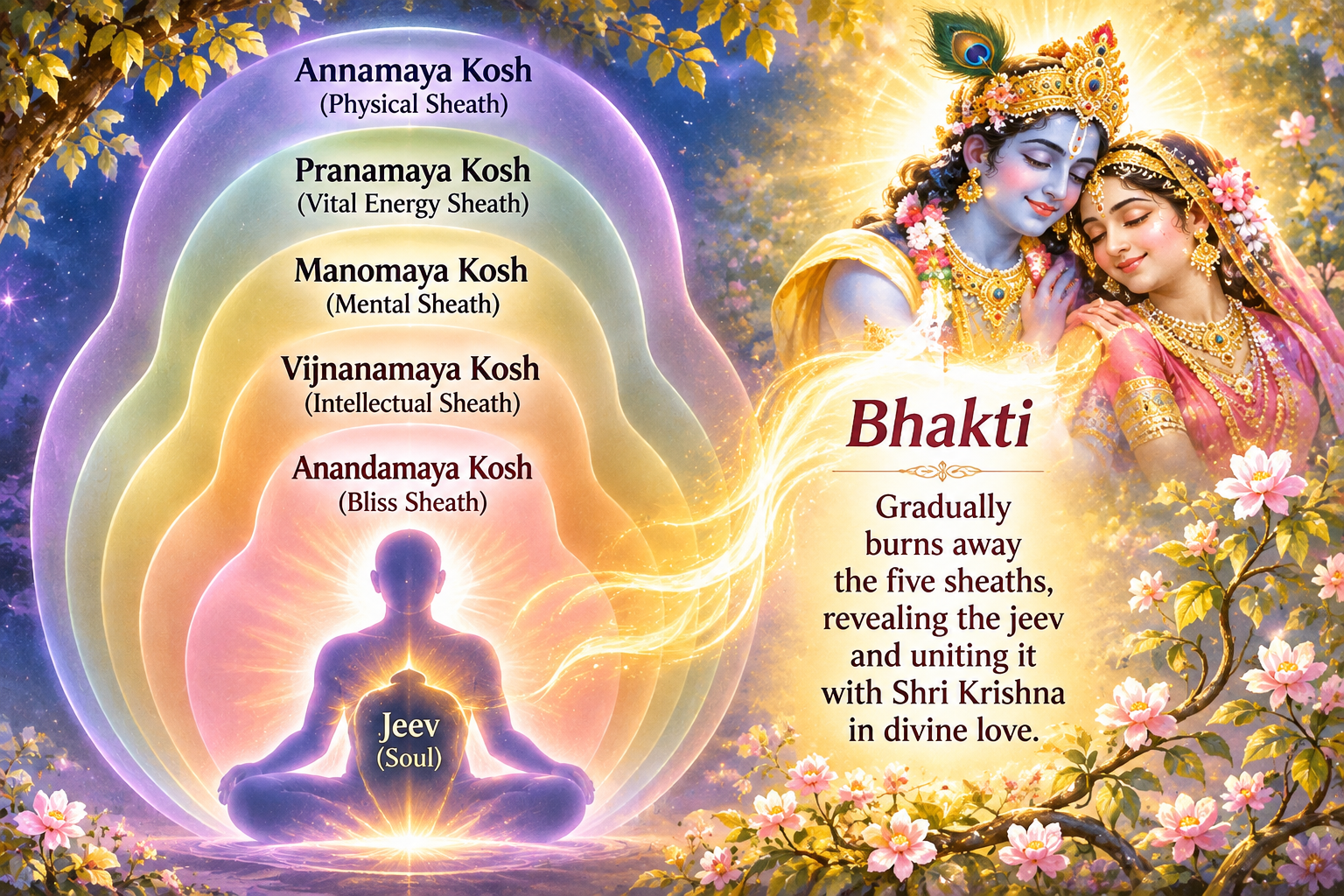
Some believe that God can be attained only after separately destroying the five sheaths, known as Panchkosh, which cover the jeev.
However, Shrimad Bhagavatam reveals that Bhakti itself accomplishes this.
अनिमित्ता भागवती भक्तिः सिद्धेर्गरीयसी । ...
जरयत्याशु या कोशं निगीर्णमनलो यथा ॥
Animittā bhāgavatī bhaktiḥ siddhergarīyasī ।
Jarayatyāśu yā kośaṃ nigīrṇamanalo yathā ॥
— Shrimad Bhagavatam 3.25.32 -33
Meaning: Selfless devotion to Bhagavan is superior even to liberation. Just as digestive fire digests the food that has been swallowed, Bhakti consumes the sheaths covering the jeev.
The devotee does not need to make a separate effort to destroy these coverings or desire for it to happen.
Consider the process of digestion.
After eating food, we do not consciously direct the body to convert it into its constituent elements. The digestive fire performs its work automatically.
According to the traditional description, food is transformed into seven bodily constituents: rasa (plasma), rakta (blood), mansa (muscle), meda (fat), majja (marrow), haddi (bone), and virya/raja (reproductive elements).
We do not need to understand or control every stage of digestion to receive nourishment.
We simply eat appropriate food, and the digestive process does the rest.
Similarly, the devotee needs to practice Bhakti and increase the longing to meet Shri Krishna.
Through Roopdhyan, the devotee contemplates the beloved Lord, experiencing both the pangs of separation (virah) and the sweetness of meeting Him (milan).
As this longing intensifies, Bhakti itself gradually burns away the five sheaths.
The devotee need not undertake a separate practice to destroy them.
The Supreme Treasure Includes All Lesser Attainments
The devotee does not practice Bhakti to obtain yogic powers, worldly prosperity, knowledge, detachment, liberation, or the destruction of the five sheaths.
The devotee seeks only the loving service of Shri Krishna.
Yet the power of Bhakti accomplishes all these things without requiring separate effort.
Just as the beggar who receives a billion dollars automatically possesses every smaller denomination contained within that fortune, the soul that receives God's supreme divine treasure has no need to pursue lesser attainments independently.
The devotee seeks Shri Krishna alone. Everything else comes as an ancillary fruit of His devotion.
Go Deeper
- What Bhakti Does Behind the Scenes — Further ancillary benefits of devotion.
- Bhakti Produces Knowledge and Detachment — How knowledge and detachment arise through Bhakti.
- Siddhi — Mystical Powers and Their Spiritual Dangers — Why supernatural powers are not the goal of spiritual practice.
- Why Impose the Condition of Selflessness in Bhakti? — Why devotion must be free from selfish desire.
- Is Serving God a Burden? — Why eternal service to God is the soul's highest privilege.
- Eternity in Golok — What Awaits the Devotee? — What divine service means after God-realization.
- Does God Play Favorites? — Understanding God's graciousness toward His devotees.
- Akaran Karun Shri Krishna — The causeless compassion of Shri Krishna.
- I Long for God—So Why Don't I Follow Through? — Why spiritual aspiration does not always translate into practice.
- Not This, Not That—Only This Will Ever Satisfy You — Why worldly attainments cannot satisfy the soul.