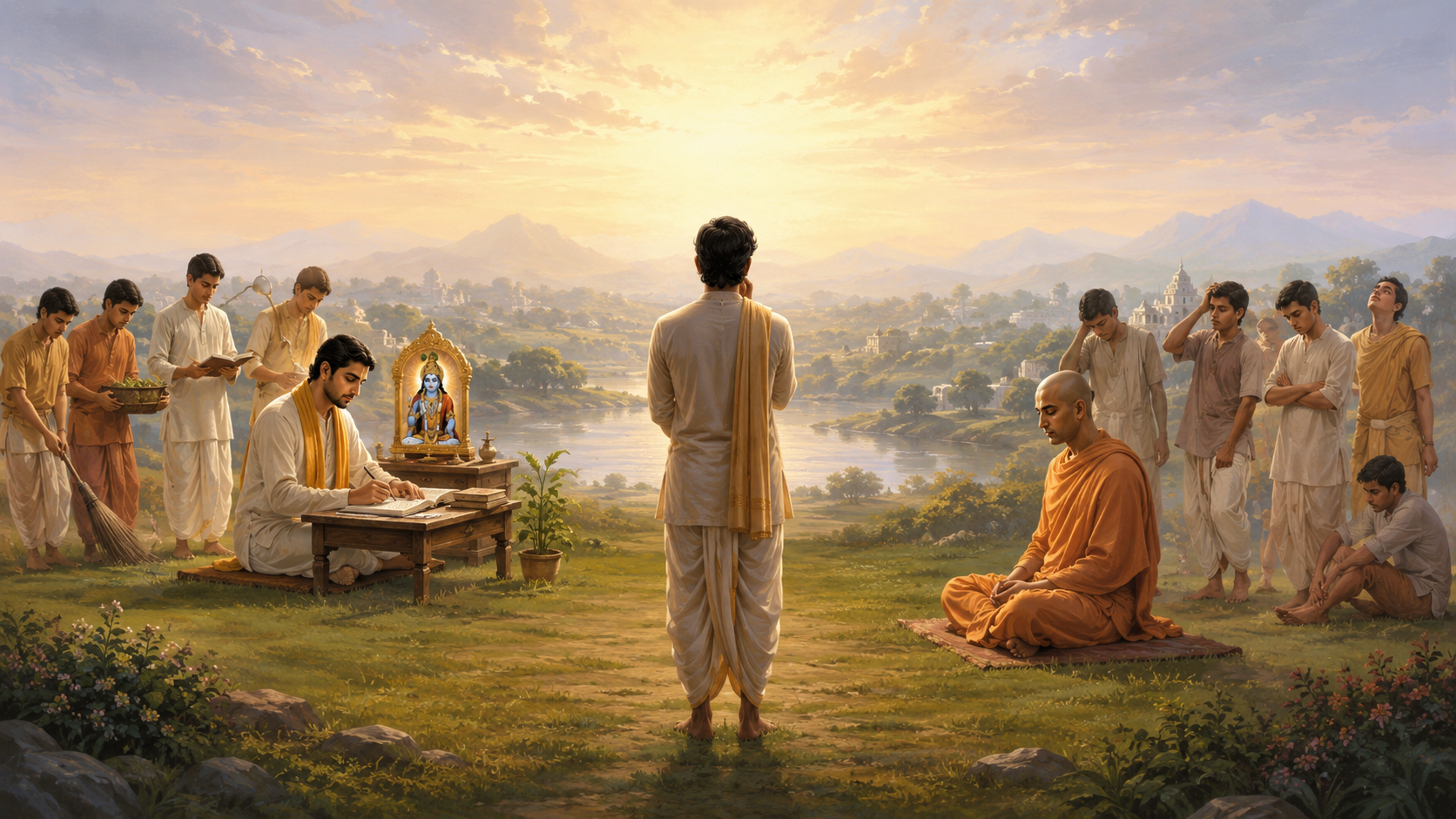
Why Karma Cannot Purify the Mind by Itself
The Vedas prescribe karma and atonement to address specific sins, yet the deeper problem remains. Without purification of the mind through Bhakti, karmic bondage continues and liberation remains impossible.

📍 Where You Are in the Inquiry
In the previous article, we examined the relationship between Varnashram Dharma and spiritual progress.
We saw that Varnashram Dharma has value. It can generate punya, produce favorable future circumstances, and even prescribe forms of prayashchitta (atonement) through which certain sins may be reduced or neutralized.
This raises an important question.
If Vedic actions can generate merit and even remove certain sins, why do the scriptures still declare that karma alone cannot liberate the soul?
Why is Bhakti still necessary?
To answer this, we must look beyond the actions themselves and examine the condition of the mind that performs them.
Karma Can Remove Certain Sins
The Vedas prescribe numerous forms of prayashchitta for various sinful actions.
When performed properly, these practices can reduce or neutralize the consequences of certain sins.
Thus, the scriptures do acknowledge a real benefit in Vedic atonement.
This is why Varnashram Dharma includes rituals, austerities, fasting, charity, and other prescribed acts.
However, Shri Maharaj Ji explains that removing a particular sin is not the same as purifying the mind.
The deeper problem still remains.
The Problem Is Not Merely the Sin
Suppose a person commits a sinful act.
The scriptures prescribe an appropriate prayashchitta.
The person performs that atonement, and the specific sin is reduced or neutralized.
Yet something important remains unchanged.
The tendency that produced the sin is still present.
The desires, attachments, and habits of the mind remain intact.
As a result, the person may commit the same sin again.
He will then require another atonement.
And after that, perhaps another.
In this way, the cycle continues indefinitely.
The specific consequence may be removed, but the source of the problem remains untouched.
The Mind Continues Creating New Karma
The mind carries countless desires accumulated over innumerable lifetimes.
These desires give rise to actions.
Actions produce consequences.
Those consequences generate further attachments and desires.
Thus the cycle perpetuates itself.
If the mentality behind sinful action remains unchanged, then new karma will continually arise.
For this reason, Shri Maharaj Ji explains that external atonement alone cannot solve the soul's problem.
The mind itself must be transformed.
Infinite Karma Cannot Be Exhausted
There is another difficulty.
Even if one imagines that all presently visible sins could somehow be removed, the accumulated karmas of countless previous births still remain.
The scriptures describe these stored karmic impressions as sanchit karma.
These accumulated actions are beyond counting.
Some are virtuous.
Some are sinful.
Both continue to generate future consequences.
Thus the soul is not dealing with a small number of actions.
It is carrying the accumulated burden of innumerable births.
For this reason, liberation cannot be achieved merely by attempting to exhaust karmic reactions one by one.
New Karma Accumulates Faster Than Old Karma Is Removed
The problem becomes even greater.
A sinful action may be committed in a moment.
The prescribed atonement may require days, months, or even years.
While one consequence is being addressed, new actions continue to generate new consequences.
Thus the accumulation never truly ends.
Even sincere effort cannot solve this problem through karma alone.
The process is endless because the source of the problem remains active.
Why Mind Purification Is Essential
The scriptures repeatedly emphasize that liberation requires purification of the mind.
Without purification, desires continue.
Without purification, attachment continues.
Without purification, new karma continues.
For this reason, the great teachers repeatedly declare that karma alone is insufficient.
Shankaracharya writes:
"Without devotion to Krishn, purification of the mind cannot take place."
The problem is therefore not merely the existence of sin.
The problem is the condition of the mind that continually produces it.
External Actions Cannot Purify the Mind by Themselves
Many people assume that physical religious actions automatically produce spiritual transformation.
The scriptures challenge this assumption.
A person may perform rituals.
A person may undertake austerities.
A person may visit sacred places.
A person may perform acts of atonement.
Yet if the mind remains unchanged, the fundamental problem remains unchanged.
Spiritual progress does not depend solely upon what the body does.
It depends upon the transformation of the heart and mind.
The Ganga Analogy
Consider a sealed bottle filled with impurity.
If that bottle is immersed in the waters of the Ganga, the water inside the bottle remains unchanged.
Why?
Because no real contact has taken place.
In the same way, sin resides in the mind.
If only the body performs a sacred action while the mind remains untouched, true purification cannot occur.
The body may enter a sacred place.
The mind may remain exactly where it was before.
Without inner transformation, the deeper problem persists.
Why Bhakti Is Necessary
Bhakti addresses the problem that karma cannot solve.
Karma can influence external circumstances.
Karma can generate merit.
Karma can reduce certain sins.
But karma alone cannot remove attachment to the world.
It cannot awaken Divine Love.
It cannot purify the mind completely.
Bhakti gradually redirects the mind toward God.
Through Bhakti, the seeker becomes eligible for Divine Grace.
Through Divine Grace, the covering of Maya is removed.
Only then does the soul become free from the cycle of bondage.
What This Resolves
The limitation of karma is not that it produces no results.
Its limitation is that those results remain within Maya.
Karma can generate punya.
Karma can produce heavenly rewards.
Karma can reduce certain sins.
Yet karma alone cannot purify the mind, eliminate attachment, or exhaust the infinite store of accumulated karmas.
For this reason, liberation cannot be attained through karma alone.
Bhakti remains indispensable because only Bhakti leads to the purification of the mind and ultimately to Divine Grace.
Where This Inquiry Leads
If karma can generate merit and even reduce certain sins, yet still cannot liberate the soul, a final question remains.
What role should karma play in the life of a seeker who desires God realization?
The next article examines how Karm Yog should be practiced in daily life and how worldly responsibilities can become part of one's spiritual journey.
🔍 Go Deeper
Related Concepts
Understanding Karma More Deeply
- God Is Kind — So Why Does He Send Us to Hell?
- Destiny vs Deeds — Who Really Runs the Show?
- Who Really Shapes My Fate?
Applying This Understanding
Continue the Inquiry
(Part 7 of 8 — Karma — The Path of Vedic Action)
- ⬅️ Previous: Where Varnashram Dharma Fits on the Spiritual Path
- ➡️ Next: Karm Yog in Daily Life
- 🔙 Back to Hub: Karma — The Path of Vedic Action