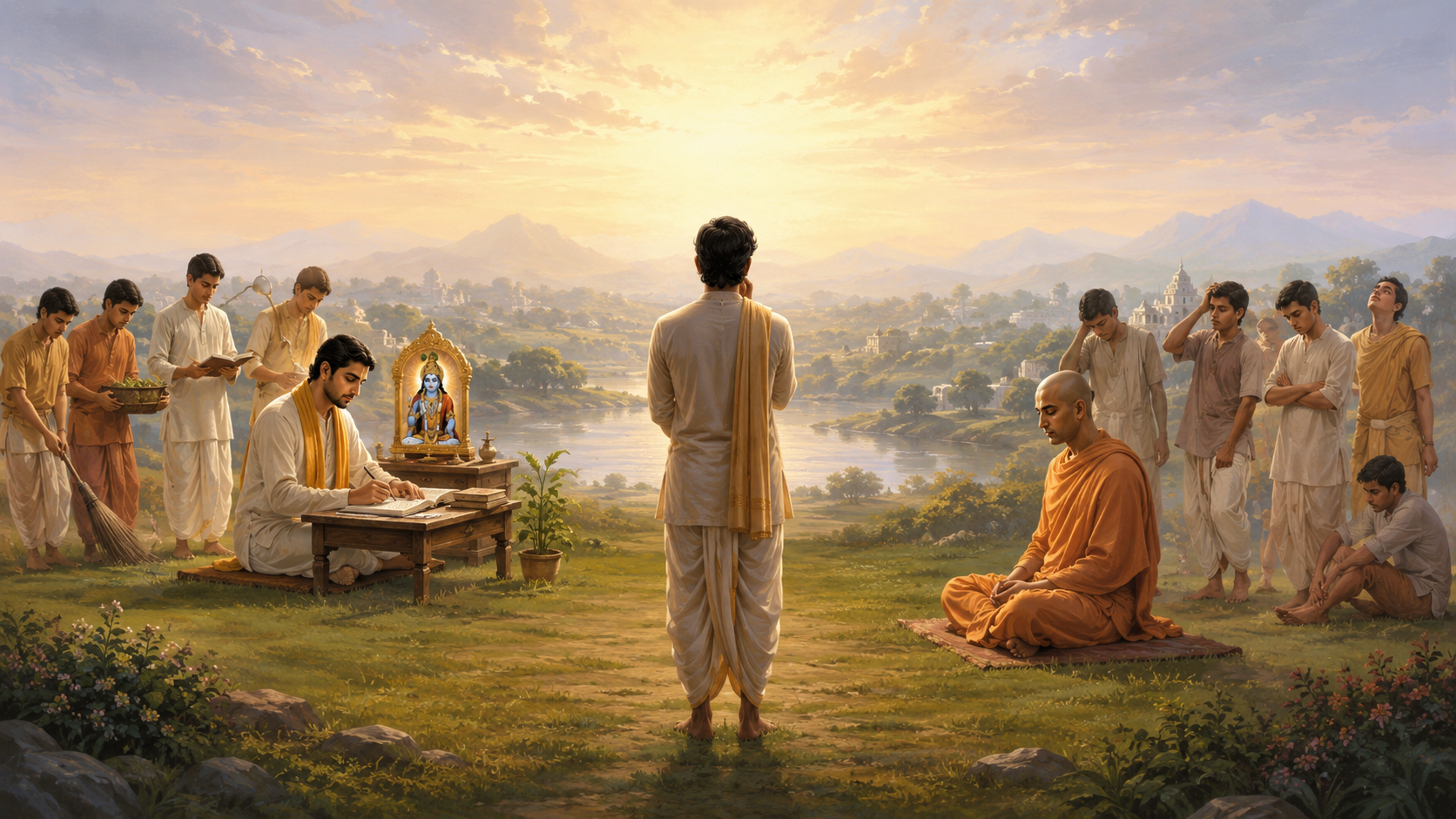
What Gives Spiritual Value to Karma?
Bhakti gives spiritual value to karma. Without devotion, actions create bondage; with devotion, they lead toward God.

📍 Where You Are in the Inquiry
In the previous article, we saw that both Karm Yog and Karm Sannyas can lead to God realization because both include bhakti of God.
We also saw that Shri Krishn praises Karm Yog because its example benefits those who follow it.
This raises an important question.
What makes Karm Yog and Karm Sannyas spiritually effective in the first place?
Is it the action itself?
Or is it something else?
Shri Maharaj Ji explains that karm and vikarm both create bondage. The difference lies not in the action alone, but in whether bhakti of God accompanies that action.
Karma Creates Bondage
Ordinary karm and vikarm both produce consequences.
One may generate pleasant results.
The other may generate painful results.
Yet both bind the soul to the cycle of birth and death.
This is why karm alone cannot fulfill the soul's ultimate goal.
Even the most virtuous actions remain within the realm of Māyā if they are performed without devotion to God.
The soul may attain favorable circumstances, but it does not attain liberation.
Bhakti Makes Karm of Karm Yogi Different
A karmi receives the consequences of his actions because his mind remains attached to the world.
A Karm Yogi is different.
His actions are accompanied by mental attachment to God.
For this reason, the question of karmic bondage does not arise in the same way.
Bhakti supersedes the results of karma.
The action may appear externally similar, but the result becomes entirely different.
This is why Karm Yog and Karm Sannyas are praised while ordinary karm is denounced.
What the Scriptures Actually Reject
Many seekers misunderstand the scriptural criticism of karm-dharm.
They assume that the scriptures reject action itself.
Shri Maharaj Ji explains that this is not the case.
The scriptures reject performance of Vedic karma when they are devoid of bhakti of God.
Actions performed solely for worldly gain, heavenly enjoyment, prestige, or personal benefit cannot fulfill the soul's ultimate purpose.
However, actions accompanied by bhakti of God are repeatedly praised throughout the Vedas, Gita, Puranas, and Ramayan.
Thus, the criticism is directed toward karma without bhakti, not toward action itself.
Actions Performed for God's Pleasure Become Spiritual
Shri Krishn teaches:
"Whatever you do, whatever you eat, whatever charity you give, whatever austerity you perform, do it for My sake."
The external action may remain the same.
A person may work, serve family, give charity, study scripture, or perform religious duties.
What changes is the purpose.
When actions are performed with God at the forefront of the mind, those ordinary actions become bhakti.
As a result, they no longer function merely as ordinary material karm.
They become a means of spiritual progress.
The Highest Example of Karm Yog
The Gopis of Braj provide the highest example of this principle.
After the Maharaas, Shri Krishn instructed them to return to their homes and perform their duties.
Externally, they resumed ordinary household activities.
Yet inwardly, their minds remained absorbed in Shri Krishn.
While carrying out daily responsibilities, they sang His glories with tears of love in their eyes.
The value of their actions did not arise from the household duties themselves.
The value arose from the bhakti that permeated those duties.
This is the true spirit of Karm Yog.
Bhakti Prevents Karmic Bondage
When actions are performed for God's pleasure, bhakti transforms their result.
Actions performed without devotion create new bondage.
Actions performed with loving attachment to God do not increase karmic bondage.
For this reason, Karm Yog is called Akarm.
Not because action disappears.
But because binding consequences cease to accumulate.
The mind gradually moves toward God rather than deeper into the cycle of action and reaction.
The Essential Principle
The scriptures repeatedly arrive at the same conclusion.
Karma that do not awaken love for God ultimately fail to fulfill the soul's purpose because they keep one within Maya.
They produce heavenly luxuries.
They produce punishment in narak.
But they cannot produce God realization.
Only actions connected to bhakti of God can fulfill the soul's ultimate aim.
Therefore, the issue is not whether action is performed.
The issue is whether God remains the object of the heart's attachment.
Where This Inquiry Leads
If bhakti is the true power behind spiritual progress, another question naturally arises.
Why do the scriptures devote so much attention to Varnashram Dharma and religious duties?
What role do these practices serve if bhakti alone leads to God realization?
The next article examines where Varnashram Dharma fits on the spiritual path.
🔍 Go Deeper
Related Concepts
Understanding Bhakti More Deeply
- Arop Siddha Bhakti in Bhakti Yog
- Sang Siddha Bhakti in Bhakti Yog
- Swaroop Siddha Bhakti in Bhakti Yog
- Why Pursue Pure Bhakti?
Applying This Understanding
Continue the Inquiry
(Part 5 of 8 — Karma — The Path of Vedic Action)
- ⬅️ Previous: Karm Yog and Karm Sannyas Compared
- ➡️ Next: Where Varnashram Dharma Fits on the Spiritual Path
- 🔙 Back to Hub: Karma — The Path of Vedic Action