
🌺 The Siddhānt (Doctrine)
Siddhānt means "Verified Truth," not theory. Explore Prem Ras Siddhānt: the unified Vedic map of the soul’s journey from ignorance to Divine Bliss.
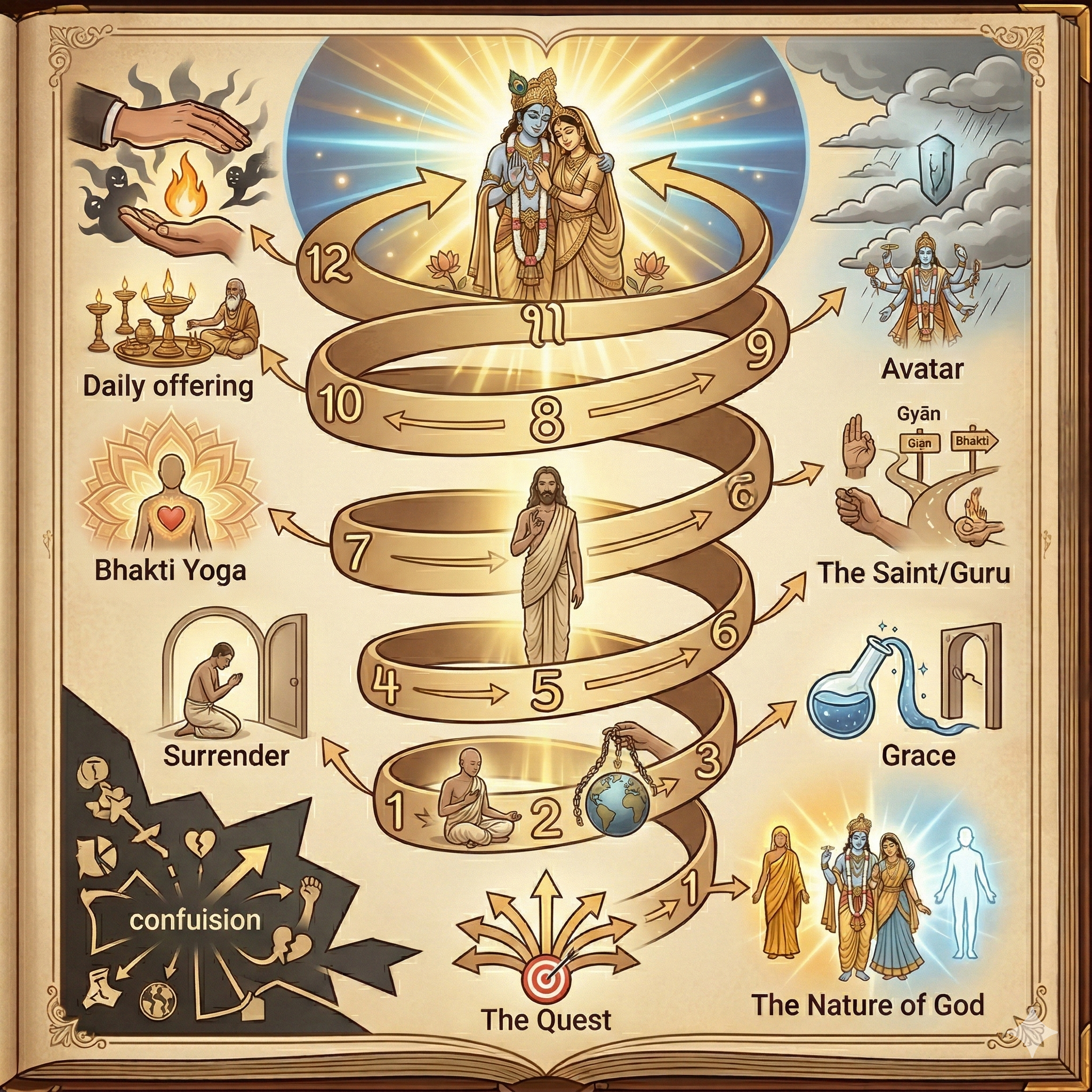
If you are new to these teachings, begin here:
Every human being seeks happiness.
Yet despite wealth, education, success, and even religion, dissatisfaction remains universal.
Today, what is called “Hindu philosophy” often appears fragmented. One voice declares everything is one. Another insists karma alone governs destiny. Another reduces bhakti to sentiment.
The result is confusion — not clarity.
The Vedas do not teach confusion. They teach coherence.
In Sanskrit, this is called Siddhānt — Concluded Truth established through scripture, logic, and realized knowledge.
Jagadguru Shri Kripalu Ji Maharaj reconciled the Vedas and over 2,500 years of spiritual thought into a unified and internally consistent framework: Prem Ras Siddhānt — The Doctrine of Divine Love.
This hub presents that framework in its natural order.
Not as beliefs to accept.
But as a structured journey that paves the way to reach from ignorance to Divine Bliss.
The Structured Journey
Each section builds upon the previous one.
Read in sequence.
1. Ultimate Goal of Every Living Being — The Quest
What are we truly seeking? Why does dissatisfaction persist?
Establishes the universal search for happiness and reveals the soul’s eternal goal.
2. The True Nature of God — The Orientation
What is the nature of the Supreme Reality the soul seeks?
Clarifies who God is — His nature, attributes, and completeness.
3. The Grace of God — The Divine Medicine
Can the soul reach God by effort alone?
Establishes why realization is impossible without divine grace.
4. The Meaning of Surrender — The Necessity
How does the soul become eligible for grace?
Defines true surrender as an internal transformation, not external action.
5. The Soul — The Self
Who am I? What is my condition?
Explains the nature of the soul, its dependence, and its current bondage.
6. The Nature of the Material World — The Trap
Why does the soul remain trapped despite seeking happiness?
Explains how the material world interacts with the mind to sustain illusion.
7. Detachment from Worldly Attractions — The Shift
Can the problem be removed, or must it be redirected?
Clarifies that attachment must be transformed—not eliminated.
8. The Saint (Guru) — The Guide
If I cannot free myself, who will guide me?
Establishes the necessity of a realized Guru in spiritual progress.
9. Paths for Spiritual Progress — The Map
What are the available paths, and where do they lead?
Examines karma, gyān, and bhakti — their scope and limitations.
10. Bhakti Yoga — The Path
Which path leads to the ultimate goal?
Establishes bhakti as the highest and complete path to Divine Love.
11. Impersonal and Personal Aspects of Brahm — The Clarity
Is God formless or personal?
Resolves the apparent contradiction between impersonal and personal aspects.
12. Avatār Tattva — The Descent
Why does God descend?
Explains divine descension and its role in making realization accessible.
14. The Supreme Object of Devotion — Shri Radha Krishna
Where should love ultimately be directed?
Reveals the highest object of devotion and the culmination of bhakti.
13. Practical Sādhana — Living the Path
What can destroy spiritual progress?
Identifies subtle obstacles and protects the seeker from downfall.
15. KuSaṅga — The Danger
What obstructs spiritual growth? This section identifies and protects against subtle forms of degradation.
Begin Section →From Map to Journey
You have now seen the entire structure.
The goal is clarified.
The path is ordered.
The framework is coherent.
But a map is not the destination.
Knowing the formula of water does not quench thirst.
Prem Ras Siddhānt was not written to create scholars.
It was written to create Saints.
You now have the philosophy.
The practice must follow.
👉 Begin at Section 1 →
Doctrinal Source
The philosophical structure presented in this encyclopedia is drawn from Prem Ras Siddhānt, the systematic exposition of Vedic truth illuminated by Jagadguruttam Swami Shri Kripalu Ji Maharaj, who was honored by the Kashi Vidvat Parishat for his unparalleled interpretation of the Vedic scriptures and reconciling all the prevalent philosophies.