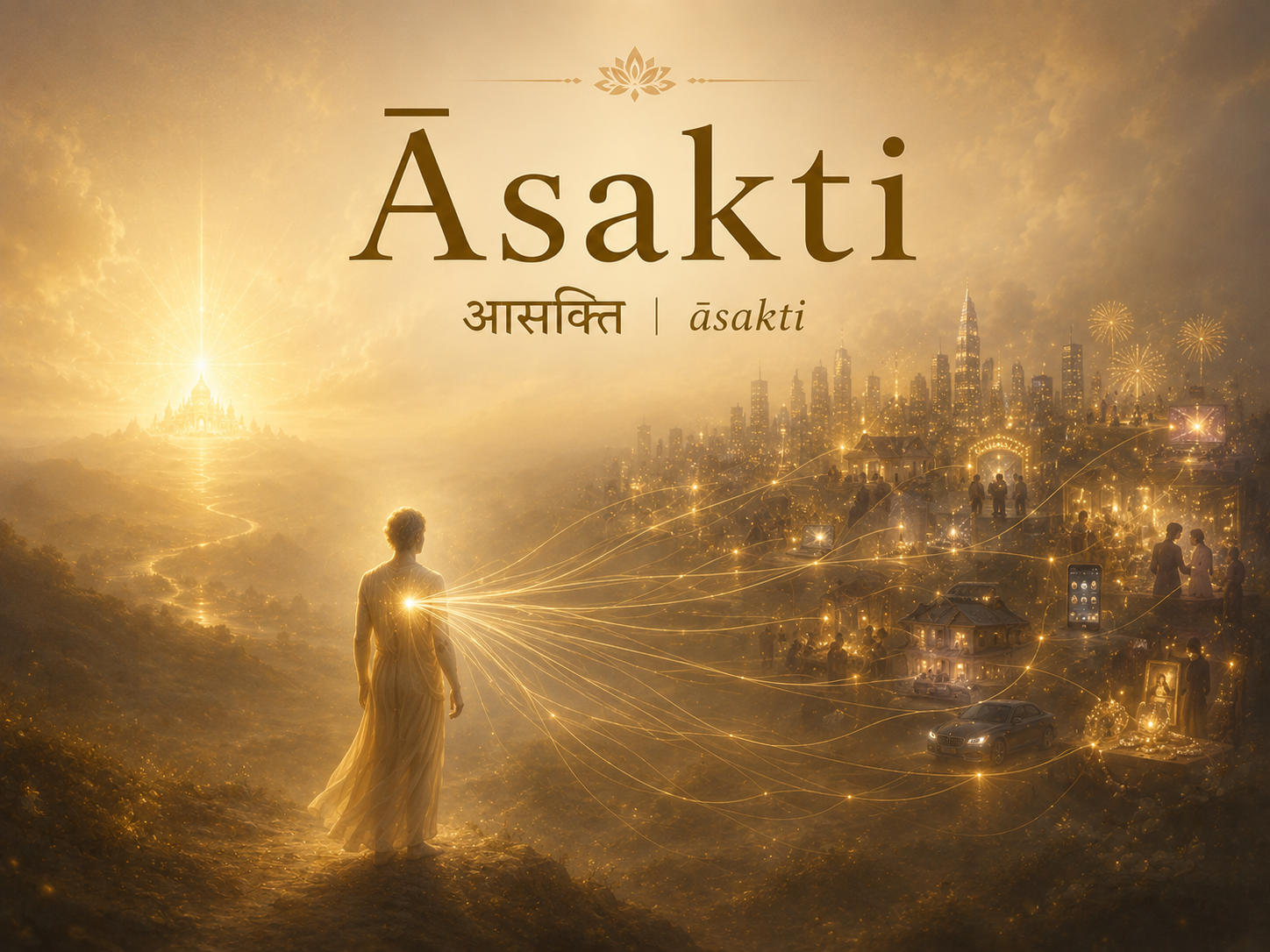
Āsakti (आसक्ति | āsakti)
Āsakti refers to worldly attachment through which the jīva becomes emotionally bound to temporary objects, relationships, desires, and experiences, strengthening bondage under Māyā.

Āsakti refers to worldly attachment through which the jīva becomes emotionally bound to temporary objects, relationships, desires, and experiences, strengthening bondage under Māyā.

Akash (आकाश | ākāśa) is commonly understood as sky or space, but in Vedic terminology it carries deeper meanings depending on context. At the material level, Ākāśa is one of the panch mahabhoot (five gross elements). It represents space—the subtlest of the material elements—and is the first gross

Anshavatara (अंशावतार | aṁśāvatāra ) means avatar of God where only a few powers are revealed. God is perfect and unchanging. All of His avatars are also God and have all of His powers. Yet, the need of the hour determines how many powers are exhibited by the avatar.

Akarm means action performed without egoistic attachment to doership or desire for personal reward. Such action does not bind the soul in karmic reaction.

Asampragyat Samadhi (असंप्रज्ञात समाधि | asaṁprajñāta samādhi ) is a state of God-realization of the yogis . The impressions from past lives called sanskars along with the seeds of sanskars burn eternally and they become free from Maya . Those who pursue the jnanayog do so with the

Ahaituki (अहैतुकी | ahaitukī) means causeless or without motive. The term is used in two related contexts: * Kripa (Grace): Grace bestowed without requiring any qualifying criterion in the recipient. * Bhakti: Loving God solely for His happiness, without seeking one's own happiness in return. In the context of

Apratihata (अप्रतिहता | apratihatā) means unhindered or uninterrupted. In Bhakti, apratihata describes devotion that is not allowed to be interrupted by any obstacle. The devotee's remembrance of God and Guru continues without a break. The scriptures compare this continuity to a steady stream of oil. Unlike water,

akarta (अकर्ता | akartā ) means the non-doer. Every jiva is akarta but it has been given an eternal servant called mind. Jeev wants limitless, everlasting, ever-increasing ananda . So, mind keeps striving to find ananda . Since, mind is material it performs tamasik , rajasik , sattvik karma and keeps getting entangled

Sampragyat samadhi (संप्रज्ञात समाधि | saṁprajñāta samādhi) is a state of meditation of yogis where mind experiences the bliss of divine soul (jiva). This is quite blissful state but not a permanent one. The impressions of past lives are still there in the mind. So, the

aham chetana (अहं चेतना | ahaṁ cetanā) means the false ego. It is also called dehabhiman (देहाभिमान | dehābhimāna ) means false pride generated since the jeev considers itself to be a material body. The cause of this disillusion is Svarupavarika Maya aspect of Maya. This is a

aja kripaniya nyay (अजा कृपाणीयन्याय | ajā kr̥pāṇiyanyāya ) is another rule in the book of rules called Nyay Shastra. Word by word these are the synonyms aja = goat | kripaniya = sword | nyay = rule It simply means being in the wrong place at the wrong time. In

Anarth Nivritti refers to the dissipation of unwanted tendencies and impurities that obstruct devotion. * anartha — that which is not meaningful or beneficial for the soul * nivṛtti — removal or cessation It is the stage in Bhakti where inner obstacles begin to weaken and fall away. What It Is Anarth Nivritti is