Jeevatma (जीवात्मा)
Jeevatma is the eternal individual soul residing in the heart, whose consciousness enlivens and illumines the entire body.
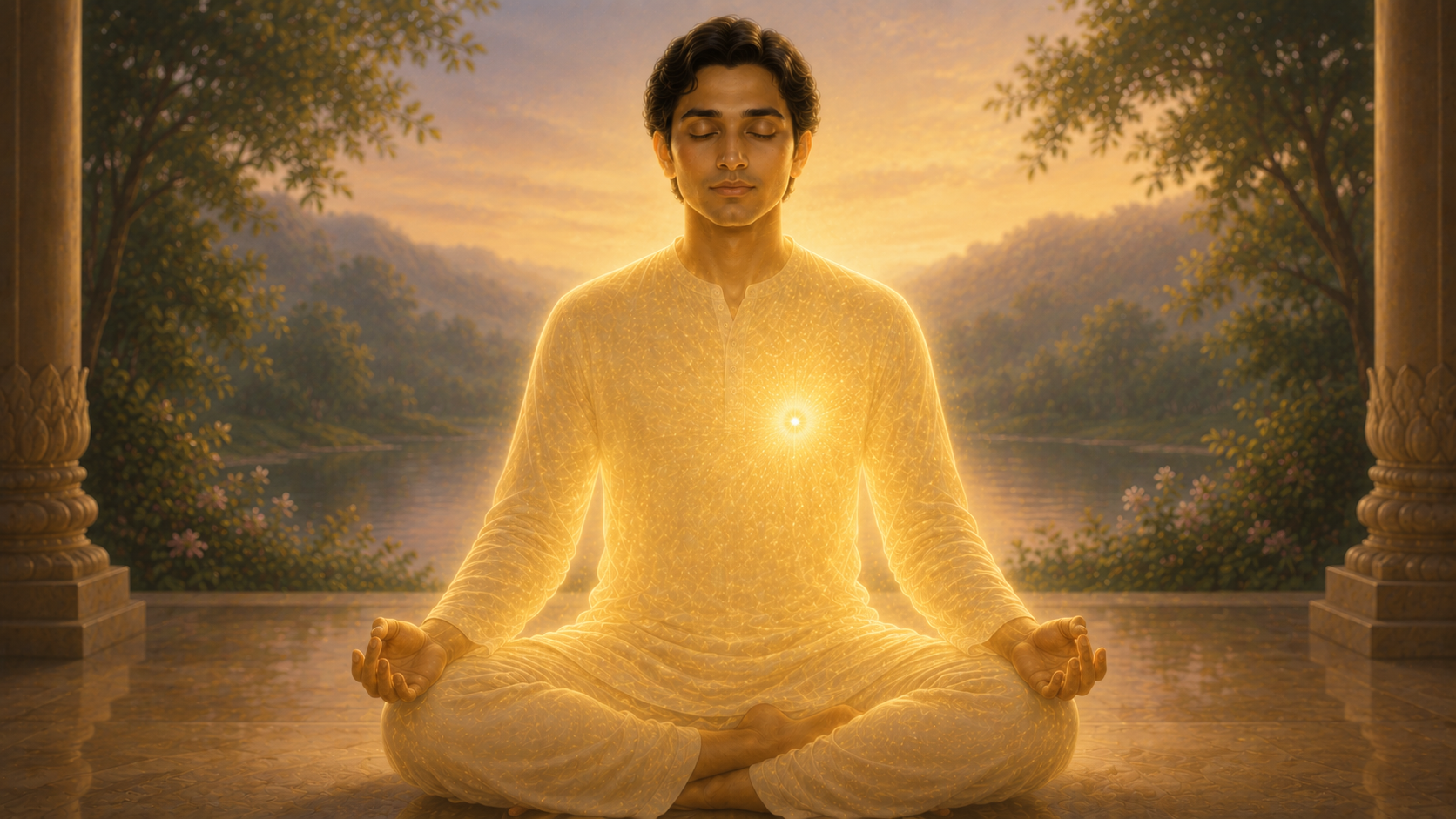
Jeevatma (जीवात्मा | jīvātmā) refers to the individual soul residing within every living being. It is eternal, conscious, and distinct from the physical body. Although minute (aṇu) in size, its consciousness pervades the body, making it alive and capable of perception.
The terms Atma (आत्मा | ātmā), Jeev (जीव | jīva), and Jeevatma are often used interchangeably to refer to the individual soul. However, Jeevatma specifically emphasizes the soul residing within and enlivening a living body.
Does Every Living Being Have a Jeevatma?
Every living body is inhabited by its own distinct Jeevatma. No two Jeevatmas are the same, nor can one Jeevatma become another. Although all Jeevs belong to God's Jeev Shakti, each possesses its own eternal identity.
A Jeevatma may inhabit the body of a human being, animal, bird, fish, insect, tree, plant, grass, bacterium, virus, or any other living organism according to its Karmas. Although the bodies differ in form, size, and abilities, every living body is enlivened by its own individual Jeevatma.
Is the Jeevatma the Size of the Body?
No. The Jeevatma is aṇu (atomic or infinitesimal) in size. It does not become larger in the body of an elephant or smaller in the body of an ant. The soul remains the same minute size regardless of the body it inhabits.
This explains how the same Jeevatma can inhabit different bodies throughout the cycle of birth and death.
Where Does the Jeevatma Reside?
The Vedas explain that the Jeevatma resides in the region of the heart. Although it remains situated there, the Jeevatma does not physically spread throughout the body.
How Does the Jeevatma Enliven the Entire Body?
Although the Jeevatma remains in the heart, its consciousness pervades the entire body.
The Vedant explains this subtle truth through simple illustrations.
Just as a lamp placed in one part of a dark room illuminates the entire room, the Jeevatma remains in one place while its consciousness illumines the whole body.
Similarly, just as sandalwood paste applied to one part of the body gradually spreads its cooling effect throughout the body, the consciousness of the Jeevatma is experienced throughout the body even though the soul itself remains in one place.
Thus, every part of the body becomes capable of awareness because of the consciousness of the Jeevatma.
What Happens at Death?
The physical body is inert by its very nature. It appears alive only because of the presence of the Jeevatma. When the Jeevatma departs, the body loses consciousness and returns to its original inert state.
The Jeevatma then continues its eternal journey according to its Karmas.