Bhakti Alone Unites With God
Each of us can relate to our desire of being “happy forever”. In fact, all jeev want to be happy and have been searching for happiness forever, yet even after expending numerous efforts over uncountable lifetimes, they have not achieved that happiness and their search continues. Possibly a thought may cross their mind that since happiness has not been attained through the attainment of material wealth, perhaps there may be another path to attain that happiness. Jagadguruttam Shri Kripalu Ji Maharaj says, our scriptures show us the path for attaining that happiness.
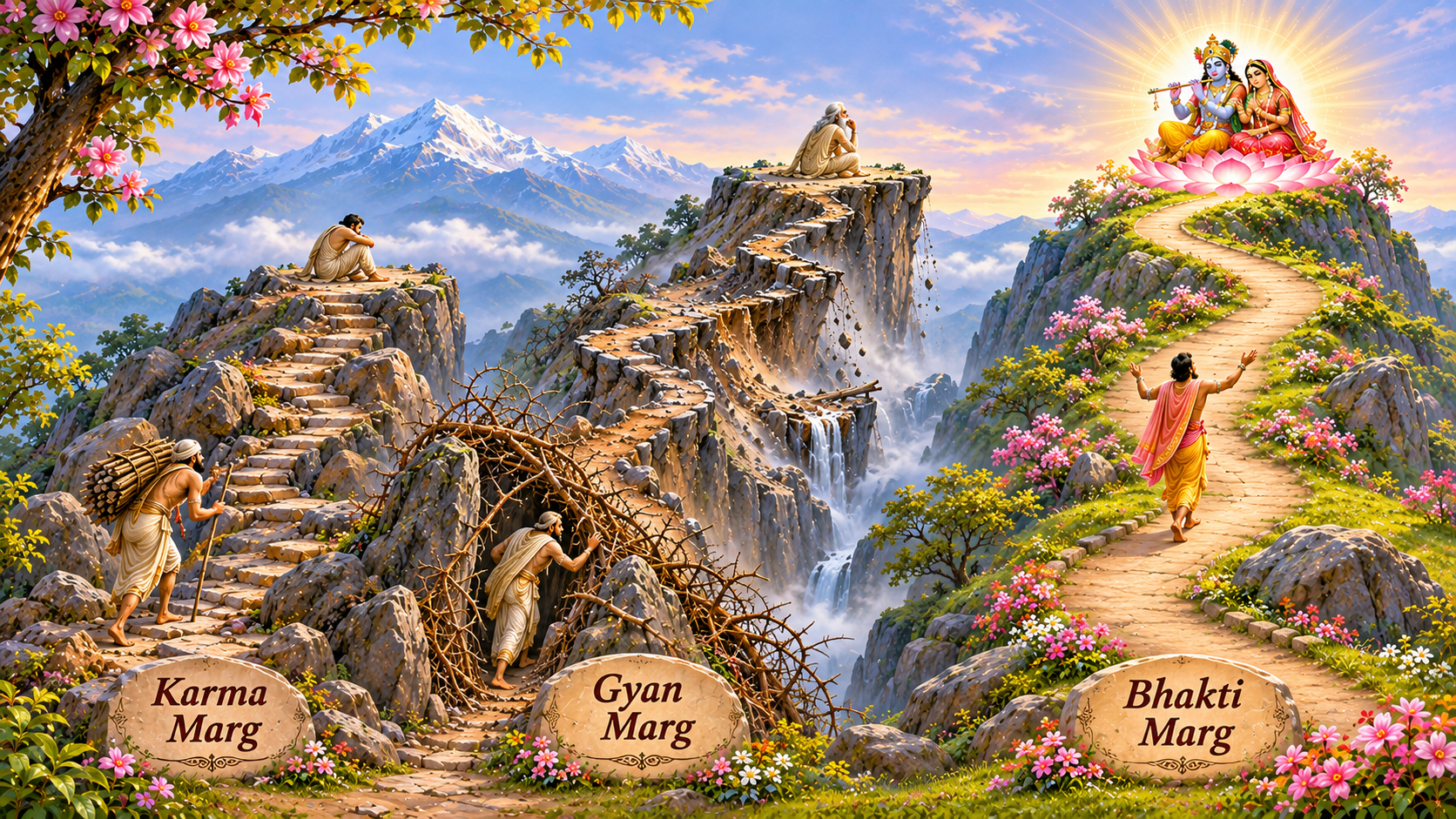
For spiritual-upliftment, and attainment of our ultimate goal of unending divine bliss, Vedas prescribe 3 paths - karma, gyan and bhakti. Let us put karma, gyan and bhakti to test to determine which path is capable of granting us the bliss we seek.
The first criteria for evaluating whether our chosen path is right or not is called anvaya. The word anvaya means that “the goal should be achievable through this path”.
First, let us evaluate the path of karma.
If one observes to perfection, each of the prohibitively strict rules of karmakand prescribed by the Vedas, then one will earn temporary residence in heaven (swarg). After enjoying the luxuries of swarg for a finite duration, the jeev is again sent back into the lower forms of life.Also, while enjoying the luxuries in swarg, one constantly suffers from agonies of material afflictions such as lust, anger, greed, and attachment still plague the jeev. You might recall the incident when King Dilip was performing his hundredth ashvamedha yagya. Successful completion of 100 ashvamedha yagya entitles one to become the king of swarg. At that time, Indra, the king of swarg, assumed that Dilip wanted to be king of swarg and take his position. Consequently, he felt jealous and scared of King Dilip. So, to stop his ashvamedha yagya, Indra stole the ceremonial horse.
Yet another incident relates to Indra being anxious seeing a 5-year-old child Dhruv praying to God, fearful that he might take his position. Such was his level of anxiety that he sent celestial nymphs to disturb Dhruv’s meditative state. When the king of swarg is plagued with the vices of Maya (e.g. jealousy, greed, fear, passion), one can only imagine the mental state of his subjects in swarg?
Veda says -
इष्टापूर्तं मन्यमाना वरिष्ठं, नान्यच्छ्रेयो वेदयन्ते प्रमूढाः।
नाकस्य पृष्ठे ते सुकृतेनुभूत्वेमं, लोकं हीनतरं वा विशन्ति॥
iṣṭāpūrtaṃ manyamānā variṣṭhaṃ, nānyacchreyo vedayante pramūḍhāḥ।
nākasya pṛṣṭhe te sukṛtenubhūtvemaṃ, lokaṃ hīnataraṃ vā viśanti॥
“Those who follow the path of karma are extremely foolish, for after toiling so hard they attain luxuries for a brief period, thereafter the jeev might be banished into the lower life forms”. And even when enjoying the fruits of karma also, the jeev is not blissful. Thus the goal of attaining unlimited, everlasting bliss cannot be achieved by karma as it bestows the bliss of sansaar and does not take the jeev to aim of life. So the karma does not live up to this criterion.
Now, let us put gyan to test on this criterion.
The final stage of the path of gyan is self-knowledge (not knowledge of Nirakar Brahm). As long as the soul does not attain Brahmanand, there will be no mukti from Maya, so there is no question of attaining bliss. You might counter this by saying gyan yoga does grant mukti from Maya. Only if gyan is mixed with bhakti, then it is called gyan yoga. And yes, gyan yog can grant freedom from Maya. But gyan alone can destroy the ignorance that “I am this body” and enable self-realization (the knowledge that “I am soul”). Beyond taking the Jeev to the state of self-realization, Gyan cannot help any further. The attainment of the Nirakar Brahma (impersonal form of God) is not achievable by the path of Gyan. Without having Brahma Gyan, one cannot get rid of Maya and therefore one cannot dream of attaining that everlasting divine bliss.
Lord Shri Krishna has said in Gita -ज्ञानयज्ञेन चाप्यन्ये यजन्तो मामुपासते।
एकत्वेन पृथक्त्वेन बहुधा विश्वतो मुखम् ॥
गीता ९. १५jñānayajñena cāpyanye yajanto māmupāsate।
ekatvena pṛthaktvena bahudhā viśvato mukham ॥
gītā 9. 15"
Whether one follows the path of gyan or any other path, he will have to worship Me”. Because -
भक्त्यात्मामभिजानाति यावान् यश्चास्मि तत्वतः। ततो मां तत्त्वतो ज्ञात्वा विशते तदनन्तरम् ॥
गीता १८.५५
bhaktyātmāmabhijānāti yāvān yaścāsmi tatvataḥ। tato māṃ tattvato jñātvā viśate tadanantaram ॥
gītā 18.55
“Only through bhakti, can one gain complete knowledge of My infinite glory and only then will one attain mukti". So the path of gyan also does not live up to this criterion.
All Vedic scriptures proclaim that God can be attained ONLY through the path of devotion or bhakti.
Shri Krishna revealed this secret to Arjuna in the Gita.
भक्त्या त्वनन्यया शक्य अहमेवंविधोऽर्जुन । ज्ञातुं द्रष्टुं च तत्त्वेन प्रवेष्टुं च परन्तप ॥
गीता 11.54॥
bhaktyā tvananyayā śakya ahamevaṃvidho'rjuna । jñātuṃ draṣṭuṃ ca tattvena praveṣṭuṃ ca parantapa ॥
gītā 11.54॥
“Only by devotion can I be known or seen. One can be absorbed in Me only by bhakti.”
Shri Krishna did not say one can see Me, know Me by gyan or by karma !
Therefore, out of the three paths, only the path of bhakti meets the criterion of anvaya.
Bhakti alone can unite the jeev with Brahma-Supreme God.