Archival Record: Invited Saints and Scholars — Chitrakoot Convention (1955)
A historical record of the distinguished saints, scholars, and spiritual leaders invited to the 1955 Chitrakoot Convention organized by Shri Kripalu Ji Maharaj.
The spiritual leaders, philosophers, and scholars named in the historical invitation
The 1955 Chitrakoot convention drew invitations to some of India's respected spiritual leaders, heads of established religious traditions, Sanskrit scholars, philosophers, and educators.
Among those named were Jagadgurus representing different Vaishnava traditions, senior monastic leaders, accomplished Sanskrit scholars, university professors, and recipients of advanced academic degrees.
Who were these distinguished figures? The historical invitation preserves their names and titles. Independent records help us appreciate the religious responsibilities, scholarship, and accomplishments of many of them.
Their backgrounds provide valuable context for the gathering described in the 1955 Chitrakoot convention.
The Historical Invitation
The following names are drawn from the surviving invitation to the 1955 Chitrakoot convention. A reproduction of the historical document is provided below, followed by a readable list of the invited saints and scholars.
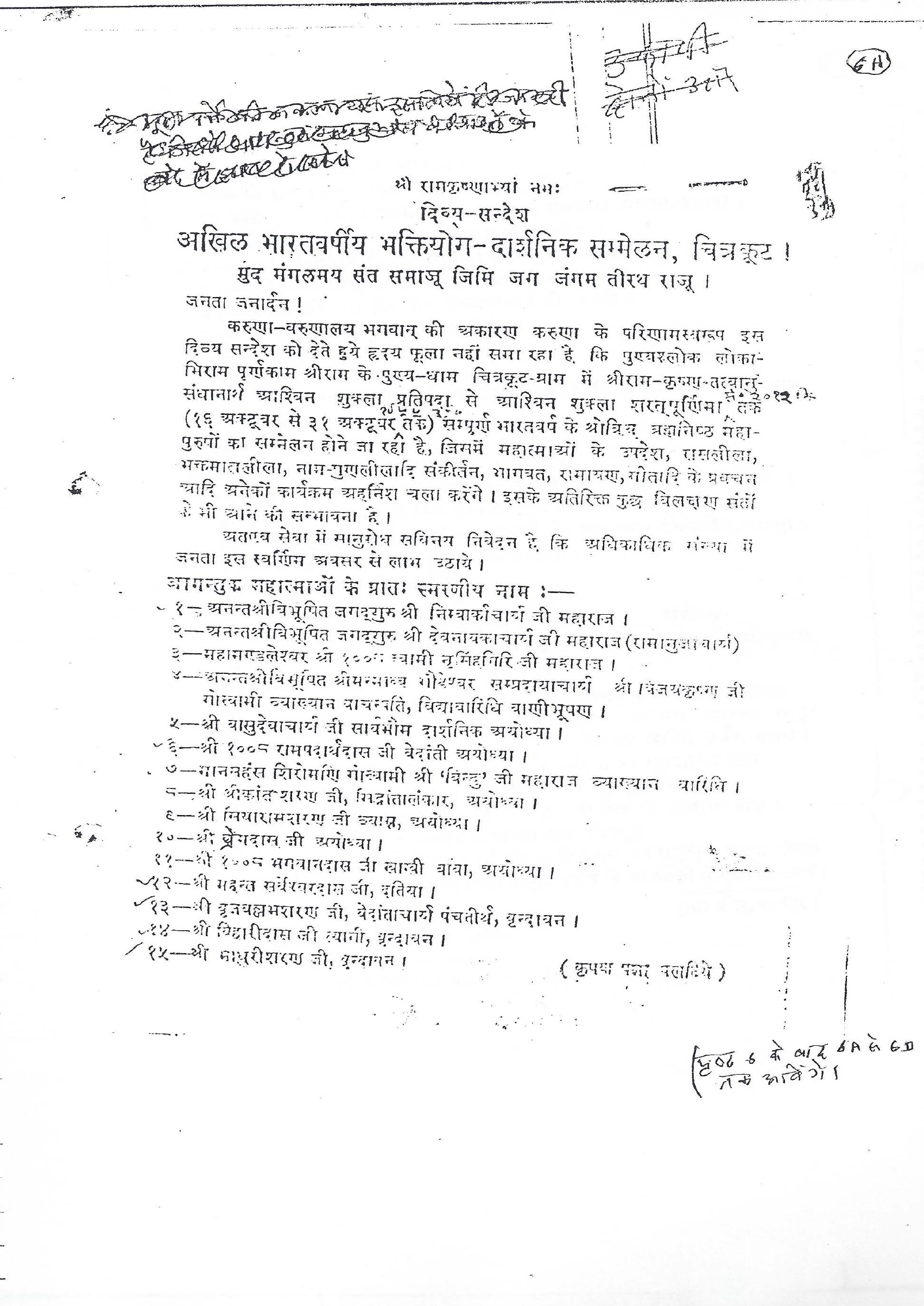
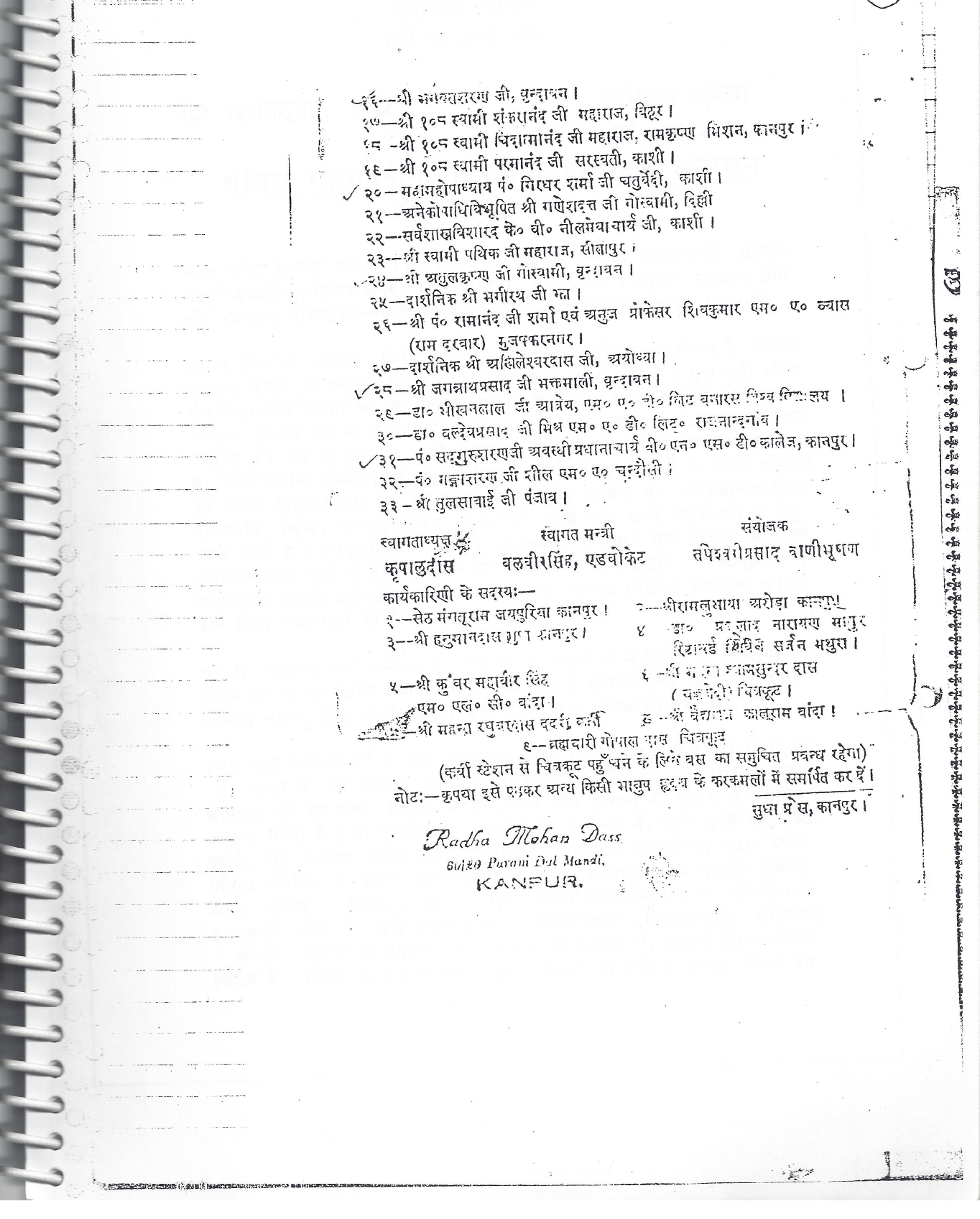
Historical invitation to the 1955 Chitrakoot religious convention. Reproduced from an imperfect surviving copy; the original Hindi text may be difficult to read.
The Invited Saints and Scholars
1. Anant Shree Vibhushit Jagadguru Shree Nimbarkacharya ji Maharaj
The invitation names the revered head of the Nimbarka Sampradaya, an established Vaishnava tradition teaching Dvaitadvaita philosophy. In 1955, this distinguished spiritual seat was held by Jagadguru Shri Radha Sarveshvar Sharan Devacharya, the 48th Nimbarkacharya, who had assumed the office at Salemabad in 1943.
Sources: Nimbarkacharya Peeth succession history
2. Anant Shri Vibhushit Jagadguru Shri Devnayakacharyaji Maharaj (Ramanujacharya)
The invitation names a Jagadguru Ramanujacharya, representing the respected philosophical and devotional tradition of Shri Ramanuja. A lineage account identifies a Devnayakacharya as the seventh head of Shripati Peeth; he may be the leader named here. The revered Jagadguru designation reflects the standing of this spiritual office.
Sources: Tridandi Swami lineage account · Inventory of Sanskrit Scholars
3. Mahamandaleshwar Shree 1008 Swami Nrsinghagiri Ji Maharaj
The distinguished title Mahamandaleshwar denotes senior leadership in a Hindu monastic tradition. A historical study records Mahamandaleshwar Narsingh Giri as the founder of Pandit Sevamurti Sanskrit Pathshala, Varanasi, in 1957. The similarity of name, title, and period suggests that he may be the scholar named in the invitation.
Sources: Cultural-heritage research report
4. Anant Shri Vibhushit Shrimanmadhva Gaudeshwar Sampraday Shri Vijayakrishna Goswami
Shri Vijayakrishna Goswami was invited under the designation Madhva Gaudeshwar Sampraday, a designation associated with a Vaishnava religious tradition.
5. Shri Vasudevacharyaji sarvabhaum darshnik, Ayodhya
Shri Vasudevacharya Ji was introduced as Sarvabhauma and darshnik (philosopher)—designations emphasizing his standing in philosophical learning. The 1957 Sanskrit Commission independently records Pt. Vasudevacharya Sarvabhauma of Ayodhya, placing a scholar of the same name and distinction in the city at the time.
Sources: Sanskrit Commission report
6. Shri 1008 Rampadarathadas Ji (Ayodhya)
Shri Ram Padaratha Das Ji was invited from Ayodhya, a major center of the Ram bhakti tradition. The 1957 Sanskrit Commission also records him in connection with Saddharma Vivardhini Sanskrit Pathasala, linking his name to the preservation and teaching of Sanskrit learning.
Sources: Sanskrit Commission report
7. Mansahans Shiromani Goswami Shribinduji Maharaj
Goswami Binduji Maharaj was honored with the distinctive title Manas-hans Shiromani, reflecting esteem for his association with the Ramcharitmanas tradition. Bindu Sewa Sansthan remembers him as a teacher and writer devoted to the Ramayana and Bhagavata. His contributions place him within the living tradition of scriptural exposition.
Sources: Bindu Sewa Sansthan biography
8. Shri Kantsharan Ji Maharaj, Sidhantalankar, Ayodhya
Shri Kantsharan Ji of Ayodhya was introduced with the scholarly designation Sidhantalankar, a respected designation associated with doctrinal learning.
9. Shri Siyaram Sharan Ji Vyas, Ayodhya
Shri Siyaram Sharan Ji was invited from Ayodhya with the designation Vyas, a name often associated with the exposition and narration of sacred texts.
10. Shri Premdas ji, Ayodhya
Shri Premdas Ji was among the saints invited from Ayodhya, a historic center of devotion to Shri Ram.
11. Shri 1008 Bhagwandas Ji Khakhi Baba, Ayodhya
Shri Bhagwandas Ji was invited from Ayodhya with the distinctive designation Khakhi Baba. A historical account in Navbharat Times remembers Mahant Bhagwan Das of the Khaki Akhara for supporting India's independence movement in the 1930s, including suffering imprisonment under British rule. The matching name and affiliation suggest that he may be the saint named in the invitation.
Sources: Navbharat Times historical account (Published: 31 December 2018)
12. Mahant Sarveshwardas ji, Datia
Mahant Sarveshwardas Ji was among the religious leaders invited from Datia. The respected title Mahant traditionally denotes the head of a Hindu monastery or religious institution, a position entrusted with spiritual leadership and the preservation of its traditions.
13. Shri Brijvallabhsharan ji, Vedantaacharya Panchtirtha, Vrindavan
Shri Brijvallabhsharan Ji of Vrindavan was introduced with the distinguished scholarly title Vedantacharya, identifying him with the teaching and study of Vedanta.
14. Shri Bihari Dasji Tyagi, Vrindavan
Shri Bihari Dasji Tyagi was invited from Vrindavan. A Live Hindustan account remembers Sant Bihari Das Tyagi as the founder of Shri Gautam Rishi Ashram and associates him with the Nimbarka Sampradaya. The matching name and location suggest that this may be the invited saint.
Sources: Live Hindustan report (Published: 31 January 2026)
15. Shri Madhurisharan ji, Vrindavan
Shri Madhurisharan Ji was among the saints invited from Vrindavan, the sacred land of Shri Radha Krishna's pastimes.
16. Shri Bhagwatsharanji, Vrindavan
Shri Bhagwatsharan Ji was invited from Vrindavan.
17. Shri 1008 Shankaranand Ji Maharaj, Bithoor
Shri Shankaranand Ji Maharaj was invited from Bithoor and honored in the invitation with the traditional reverential designation Shri 1008.
18. Shri 108 Chidattamanand Ji Maharaj, Ramakrishna Mission, Kanpur
Swami Chidatmananda was associated with the Ramakrishna Mission in Kanpur, part of the respected monastic and service tradition inspired by Shri Ramakrishna and Swami Vivekananda. The Mission's own historical records identify Swami Chidatmananda (1910–1975) and document his work with the Kanpur center. He later served as its secretary, beginning in 1960.
Sources: Ramakrishna Mission Kanpur centenary history · Ramakrishna Mission Kanpur secretaries
19. Shri 108 Parmanand Ji Maharaj, Kashi
Shri Parmanand Ji Maharaj was among the saints invited from Kashi, a renowned center of Sanskrit learning. An ashram biography describes a Swami Parmanand Ji Maharaj who studied Vedic scriptures and Sanskrit in Banaras and later taught there. His name and association with Kashi suggest a possible identification with the invited saint.
Sources: Swami Parmanand Ashram biography
20. Mahamahopadhyay Pt. Giridhar Sharma 'Chaturvedi', Kashi
Pandit Giridhar Sharma Chaturvedi was introduced with the prestigious scholarly title Mahamahopadhyay, traditionally bestowed in recognition of exceptional learning. His standing in Sanskrit scholarship is independently documented in the 1957 Sanskrit Commission report. He was among the distinguished scholars invited from Kashi.
Sources: Sanskrit Commission report
21. Anekopadhibhushat Shri Ganeshduttji Goswami, Delhi
Shri Ganesh Dutt Goswami was invited from Delhi with the honorific Anekopadhibhushat, indicating that he was known by multiple distinctions. The Nehru Archive independently identifies Goswami Ganesh Dutt (1889–1959) and preserves correspondence involving him from 1955, offering a contemporary record of his public life.
Sources: Nehru Archive biography
22. Sarvashastra Visharad K.V. Shri Neelmeghacharyaji
Shri K. V. Neelmeghacharya was introduced as Sarvashastra Visharad, a distinguished designation suggesting mastery of multiple branches of traditional learning. Independent scholarly records identify K. V. Nilameghacharya with Purana scholarship and Sanskrit higher education.
Sources: Purana Bulletin scholarly record
23. Swamiji Pathik Ji Maharaj, Sitapur
Swami Pathik Ji of Sitapur was an acclaimed spiritual teacher and author, identified in biographical material as Gaya Prasad Trivedi. According to the historical account of the convention, after several days of unresolved philosophical discussions, Swami Pathik Ji led a delegation requesting that Shri Maharaj Ji address the questions before the assembly. Read the episode in the main Chitrakoot account.
Sources: Swami Pathik Ji biographical site · Swami Pathik Ji archival material
24. Shri Atul Krishna Goswami, Vrindavan
Shri Atul Krishna Goswami was invited from Vrindavan. A family history associated with the Shri Radha Raman tradition records an Atul Krishna Goswami in its lineage. This may be the same individual named in the invitation, although the identification has not been conclusively established.
Sources: Radha Raman lineage account · Radha Raman tradition materials
25. Philosopher Shri Bhagirathji Jha
Shri Bhagirath Jha was introduced as a philosopher. Scholarly and bibliographic sources document a Bhagirath Jha associated with Sanskrit philosophical writings, including an edition connected with Nyaya, the Indian tradition of logic and reasoning. This may be the scholar named in the invitation.
Sources: Scholarly discussion of Nyaya · Bhagirath Jha bibliographic edition
26. Pt Shri Ramanand Ji Sharma and Anuj Professor Shivkumar Vyas (Ram Darbar), Muzaffarnagar
The invitation names two brothers together: Pt. Shri Ramanand Ji Sharma and his younger brother (anuj), Professor Shivkumar Vyas, associated with Ram Darbar, Muzaffarnagar. Their titles identify one as a pandit and the other as a professor.
27. Philosopher Shri Akhleshwar Das ji, Ayodhya
Shri Akhleshwar Das Ji was among the philosophers invited from Ayodhya. Later biographical accounts mention an Akhileshwar Das associated with Shri Ram Kunj Katha Mandap in Ayodhya. The similarity of name and location suggests a possible identification, although the available evidence does not establish that they were the same person.
Sources: Ayodhya biographical account · Shri Ramanand institutional site
28. Shri Jagannathprasad ji, Bhaktimali, Vrindavan
Shri Jagannathprasad Ji of Vrindavan was introduced as Bhaktimali, associated with the tradition of honoring and recounting the lives of devotees. Research on Bhaktamal manuscripts mentions a Bhaktamali Jagannath Prasad who preserved manuscripts connected with this devotional literature. The matching name and designation suggest that he may be the invited scholar.
Sources: Bhaktamal manuscript research · Devotional historical account
29. Dr. Bheekhan lal ji Atrey, M.A. D. Lit. Banaras University
Dr. Bheekhan Lal Atrey (B. L. Atreya) was an accomplished scholar of Indian philosophy associated with Banaras Hindu University. He received the university's first D.Litt. degree in 1931 and published The Philosophy of Yoga-Vasistha in 1936. These documented achievements speak directly to his standing as a philosopher well before the Chitrakoot convention.
Sources: B. L. Atreya bibliographic record · History of Banaras Hindu University
30. Dr. Baldev Prasad G. Mishra, M.A. D.Lit. Rajnandgaon
Dr. Baldev Prasad Mishra was a scholar and writer from Rajnandgaon, introduced with the advanced academic qualification D.Litt. An official biography from the Rajnandgaon district administration records his literary contributions, including work on Tulsidas and devotional literature.
Sources: Rajnandgaon district government biography
31. Shri Sadgurusharanji Awasthi, Principal B.N.S.D. College Kanpur
Shri Sadguru Sharan Awasthi was invited as Principal of B.N.S.D. College, Kanpur, a substantial educational responsibility rather than an honorary designation. Local institutional records also remember him as a former principal and connect him with the administration of a temple trust.
Sources: Temple trust institutional record · Local historical account
32. Pt. Gangasharan Ji Sheel, M.A. Chandausi
Pt. Gangasharan Sharma ‘Sheel’ was a Hindi scholar, teacher, and devotional writer associated with S. M. College, Chandausi. His academic work and literary contributions are remembered in independent publications. The invitation records his M.A. qualification and his association with Chandausi.
Sources: Sivananda publication · Live Hindustan report
33. Shri Tulsibai Ji Punjab
Shri Tulsibai Ji of Punjab was also named among the invitees.
About This Historical Record
The original invitation is the source for the names and titles in this list. Independent references, where available, add information about the individuals and their contributions. Some identifications remain provisional; an invitation alone does not establish that every person attended or spoke.
The invitation reveals the range of spiritual leadership and scholarship represented among those invited to Chitrakoot. To learn what happened at the convention and how Shri Maharaj Ji addressed the philosophical questions before the gathering, read the 1955 Chitrakoot account.