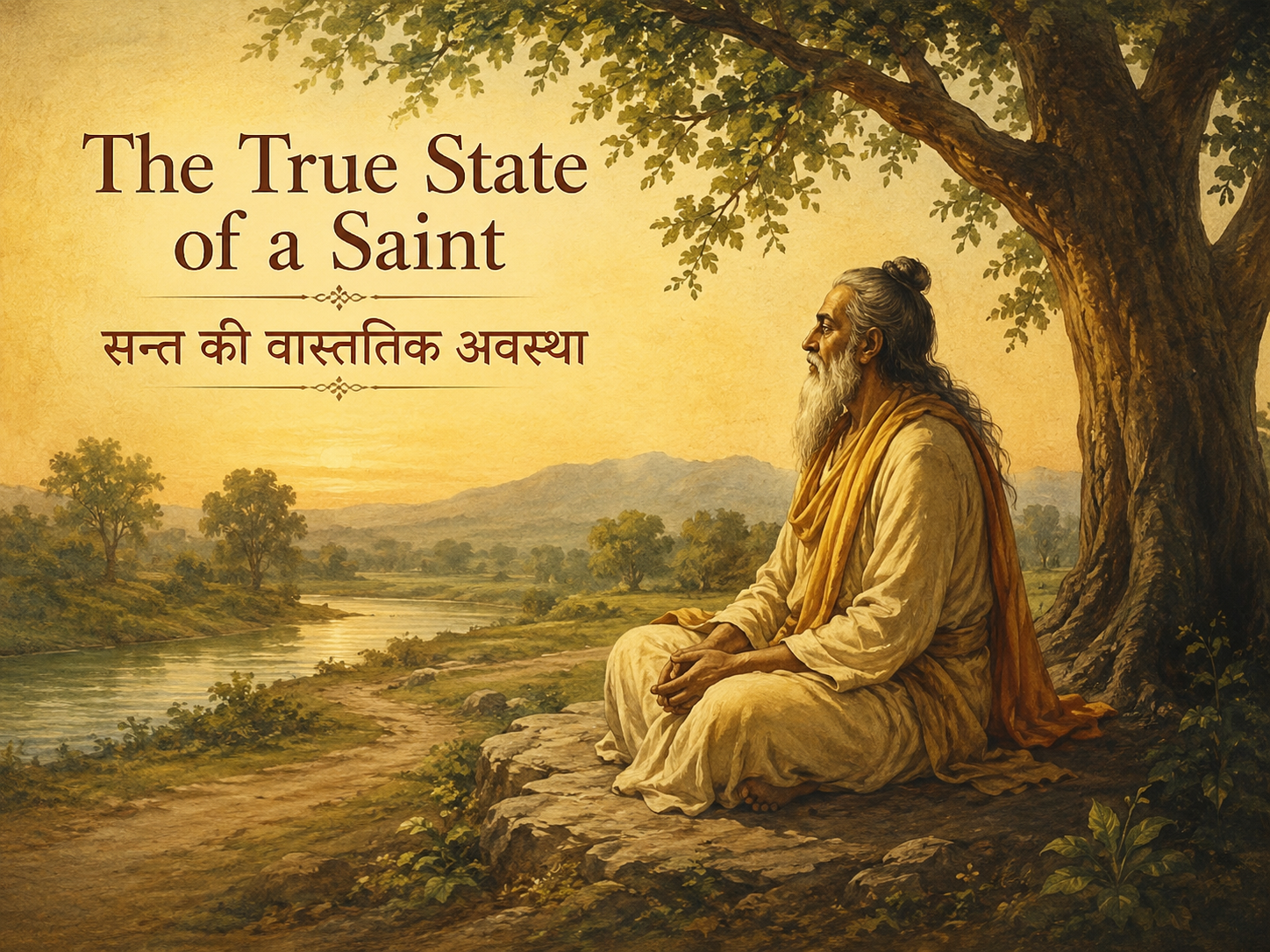
The True State of a Saint
A God-realized Saint is beyond Maya, established in Divine Bliss, and serves as a channel of Divine Grace for the welfare of souls.
📍 Where You Are in the Inquiry
Previously, we examined the proper attitude a spiritual aspirant should have toward a God-realized Saint.
Humility, inquiry, service, faith, and surrender enable the seeker to receive the greatest benefit from saintly association.
Yet another question naturally arises.
What is actually occurring within such a Saint?
What distinguishes a God-realized Saint from an ordinary person?
What changes when a soul attains God?
Many people imagine that a Saint is simply a person who possesses greater knowledge, stronger self-control, deeper devotion, or superior moral character.
The scriptures describe something far greater.
A true Saint is not merely a religious person.
A Saint is a soul whose entire state has been transformed through God-realization.
A Saint Has Attained God
The defining characteristic of a Saint is not scholarship.
It is not renunciation.
It is not eloquence.
It is not popularity.
It is not religious position.
A Saint is one who has attained God.
Such a person no longer speaks merely from belief, philosophical understanding, or scriptural study.
He speaks from realization.
This is why the scriptures describe a true Saint as Brahmanishtha — one who is firmly established in God through direct experience.
A seeker studies the destination.
A Saint has reached it.
A Saint Has Attained the Goal of Life
Every living being seeks happiness.
Whether knowingly or unknowingly, every action is ultimately motivated by the search for fulfillment.
The soul seeks infinite happiness because its true object of love is God.
Until God is attained, the mind continues searching for satisfaction in the material world.
The Saint's search has ended.
For this reason, the Saint no longer seeks happiness in worldly objects.
He has already attained that for which every soul is searching.
A Saint Is Established in Divine Bliss
The happiness experienced through the material world is temporary and limited.
The happiness experienced through God is infinite and eternal.
A true Saint has attained God, is beyond the bondage of Maya, enjoys Divine Bliss, and will remain in the service of God forevermore.
Worldly gains no longer intoxicate him.
Worldly pleasure no longer attracts him.
Worldly loss no longer disturbs him.
His happiness is no longer dependent upon:
- possessions,
- relationships,
- praise,
- status,
- success,
- comfort,
- or worldly circumstances.
The source of his joy is no longer external.
It is God Himself.
Maya Can No Longer Bind the Saint
Ordinary souls remain under the influence of Maya.
As a result, the mind experiences:
- attachment,
- desire,
- fear,
- anger,
- pride,
- jealousy,
- and countless other disturbances.
The Saint has crossed beyond this bondage.
Maya continues to exist.
The world continues to exist.
The body continues to exist.
Yet the power of Maya to enslave that soul has been permanently destroyed.
The Saint therefore lives in the world while remaining untouched by it.
Just as a lotus grows in water without becoming wet, a Saint may appear to live amidst worldly circumstances while remaining inwardly established in God.
The Saint Sees Reality Differently
The ordinary soul views reality through the material mind and intellect.
The Saint does not.
Having attained God, the Saint perceives reality from an entirely different level of consciousness.
This is one reason spiritual aspirants sometimes struggle to understand Saints.
The Saint's perspective is no longer limited by the same ignorance that governs ordinary perception.
Many aspects of Divine reality that remain hidden from seekers are directly experienced by the Saint.
For this reason, the guidance of a Saint often transcends the conclusions of ordinary logic.
A Saint Does Not Merely Know About God
Many people possess scriptural knowledge.
Many can explain philosophy.
Many can speak eloquently about spiritual subjects.
A Saint is different.
A Saint does not merely know about God.
A Saint knows God.
This distinction is fundamental.
The difference is similar to that between reading about a distant country and living there.
One is information.
The other is experience.
The Saint's words carry unique authority because they arise from realization rather than theory.
A Saint Lives for the Welfare of Souls
After attaining God, nothing remains to be gained.
The Saint has already attained the highest possible fulfillment.
This raises an important question.
Why do Saints continue to teach?
Why do they guide seekers?
Why do they endure criticism, misunderstanding, hardship, and opposition?
The scriptures answer:
Divine Grace and compassion.
The Saint no longer acts for personal gain.
Having attained God, nothing remains to be gained for oneself. Yet the Saint continues to work tirelessly for the welfare of souls. This does not arise from personal desire, need, incompleteness, or self-interest.
This compassion is not limited to relieving temporary suffering.
The Saint seeks the soul's eternal welfare. For this reason, Saints tirelessly guide souls toward God-realization, even when doing so brings criticism, misunderstanding, hardship, or persecution.
The Saint Becomes a Channel of Divine Grace
The Saint is not merely a teacher of spiritual principles.
The Saint becomes a medium through which Divine Grace reaches the soul.
This is why the scriptures place such importance upon saintly association.
Through the Saint, the seeker receives:
- guidance,
- correction,
- inspiration,
- spiritual knowledge,
- and Divine Grace.
The Saint therefore becomes an indispensable link between the bound soul and God.
Why This Understanding Matters
Many people think of Saints as exceptionally good human beings.
The scriptures describe something much greater.
A true Saint has attained God, crossed beyond the bondage of Maya, enjoys Divine Bliss, and lovingly serves God forevermore.
By the will of God, some God-realized Saints appear among humanity for the spiritual welfare of souls.
Understanding this helps explain why Saints occupy such a central place in spiritual life.
The importance of a Saint does not arise from social status or religious authority.
It arises from realization.
The Saint has attained the destination that the seeker longs to reach.
Where This Inquiry Leads
We have now examined the necessity of a Saint, the nature of saintliness, how Saints are recognized, the proper attitude toward a Saint, and the inner state of a God-realized Saint.
Yet one final danger remains.
Not everyone who appears spiritual has attained God.
Some possess scholarship.
Some possess charisma.
Some possess mystical powers.
Some cultivate spiritual appearances.
How can seekers distinguish genuine realization from imitation and deception?
To answer this, we must now examine false Saints, siddhis, and spiritual deception.
🔍 Go Deeper
Foundations of This Doctrine
Related Topics
Related Clarifications
- Does the Desireless God Actually Desire?
- Is Bhakti Eternal or Not?
- Why True Divine Love Can Never Be Faked
- Bhakti Cannot Be Achieved by Effort
Related Teachings
- Guru as the Personification of Divine Grace
- Saints Perform Grace, Not Miracles
- Why Are Saints Compared to Birch Trees?
Continue the Inquiry
(Part 6 of 7 — The Saint (Guru): The Guide)
- ⬅️ Previous: How to Associate With a Saint
- ➡️ Next: Spiritual Appearances and Spiritual Reality
- 🔙 Back to Hub: The Saint (Guru) — The Guide