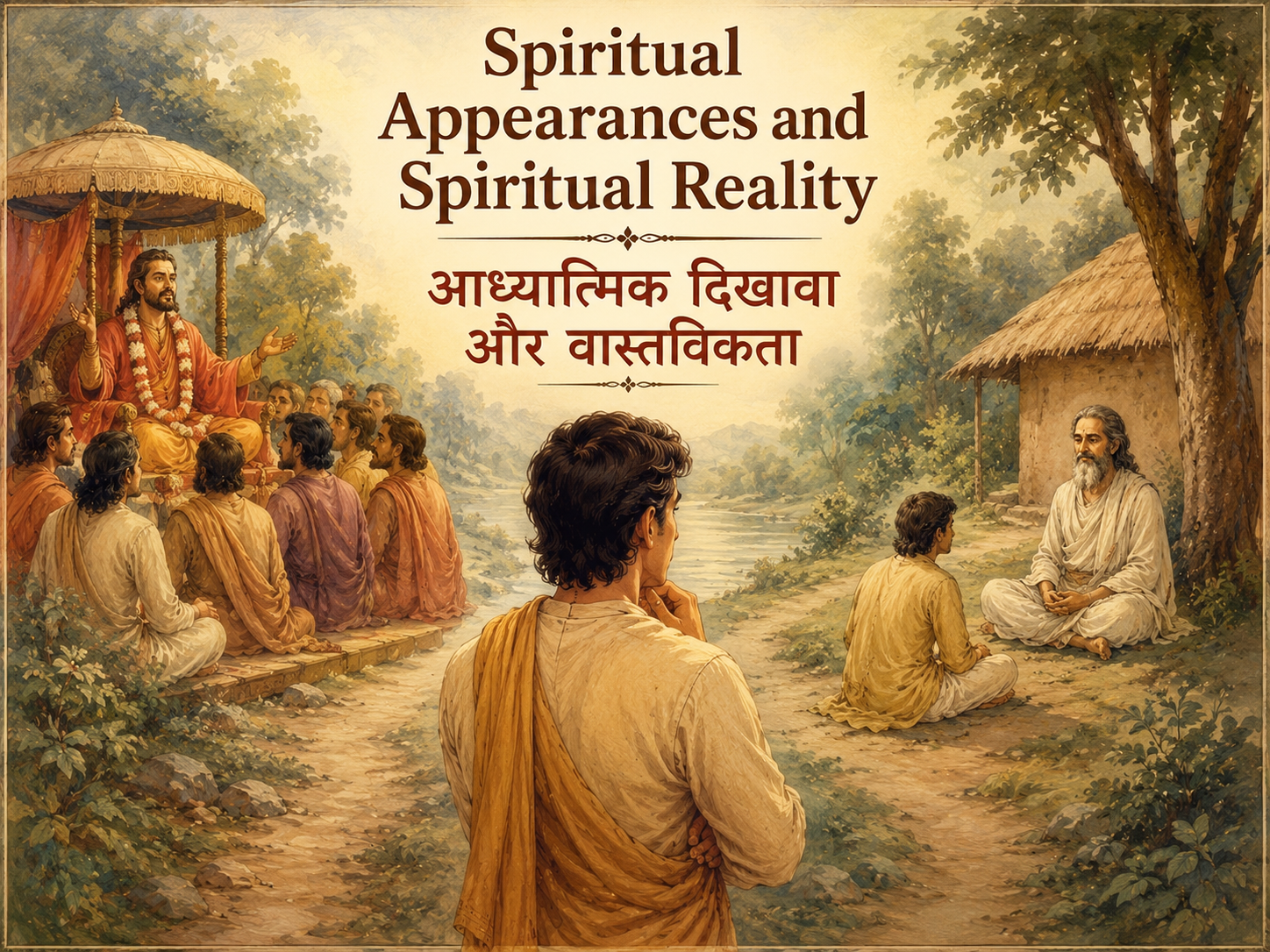
Spiritual Appearances and Spiritual Reality
Can miracles, mystical powers, scholarship, popularity, or spiritual appearances prove God-realization? Learn why external signs can be misleading and what truly distinguishes a God-realized Saint.
📍 Where You Are in the Inquiry
Previously, we examined the true state of a God-realized Saint.
A true Saint has attained God, crossed beyond the bondage of Maya, relishes Divine Bliss, and serves as a channel of Divine Grace for the welfare of souls.
Yet one final danger remains.
Not everyone who appears spiritual has attained God.
Throughout history, seekers have been misled by external appearances, mystical powers, scholarship, charisma, reputation, and religious status.
How can genuine saintliness be distinguished from imitation?
How can a seeker avoid spiritual deception?
To answer this, we must examine some of the most common misunderstandings about spiritual attainment.
External Appearances Can Be Misleading
Many people assume saintliness can be recognized through visible signs.
They look for:
- special clothing,
- extreme austerities,
- living underground,
- living beneath the open sky,
- surviving on leaves, fruits, or very little food,
- public renunciation,
- large followings,
- popularity,
- reputation,
- scholarship.
The scriptures repeatedly caution against this approach.
Most genuine Saints appear completely ordinary from the outside.
Some ordinary people cultivate extraordinary appearances.
God-realization is an internal state of consciousness. It cannot be determined by clothing, appearance, social position, reputation, or external lifestyle.
Mystical Powers Do Not Prove God-Realization
One of the most common misunderstandings concerns siddhis (super-natural or mystical powers).
Mystical powers may include:
- predicting future events,
- reading thoughts,
- knowing hidden information,
- healing illnesses,
- procuring things from elsewhere,
- remaining without food for long periods,
- extraordinary control over the body,
- other yogic powers described in the scriptures.
Many seekers assume such abilities prove saintliness.
The scriptures do not.
Siddhis may arise through austerity, yoga, past karmas, or other causes.
A person may possess siddhis while remaining under Maya.
For this reason, seekers should not mistake mystical powers for God-realization.
Shri Maharaj Ji repeatedly cautions:
"Chamatkar ko dur se namaskar karo."
The seeker of Bhakti should seek God, not miracles.
Miracles Distract the Seeker
Human beings are naturally attracted to the extraordinary.
A miracle captures attention.
A spectacle creates excitement.
Yet none of these are God-realization.
None of these remove ignorance.
None of these awaken Divine Love.
More often, fascination with such things distracts seekers from the true goal of spiritual life.
The purpose of spiritual life is not to witness miracles.
The purpose of spiritual life is to attain God.
For this reason, genuine Saints do not seek to impress crowds through displays of power.
Their purpose is to awaken Divine Love, not astonishment.
What a True Saint Actually Gives
Many seekers approach spiritual teachers seeking worldly benefits.
Some seek relief from suffering.
Some seek wealth, health, success, protection, mystical experiences, or miracles.
A true Saint has come to give something far greater.
The primary purpose of a God-realized Saint is not to distribute material boons but to guide souls toward God-realization.
Nor does a Saint seek to gather followers through fear, displays of power, or promises of worldly success.
A true Saint teaches the science of God-realization.
He teaches the nature of God, the nature of the soul, the bondage of Maya, the path of Bhakti, and the means by which Divine Grace is received.
The true gift of a Saint is not a material blessing.
It is the path to God.
Scholarship Does Not Prove Realization
A person may possess vast scriptural knowledge.
He may explain philosophy brilliantly.
He may win debates.
He may quote scripture flawlessly.
Yet scriptural knowledge and God-realization are not identical.
A Saint does not merely know about God.
A Saint knows God.
This distinction is fundamental.
The difference is similar to that between reading about a distant country and living there.
One is information.
The other is experience.
The Saint's words carry unique authority because they arise from realization rather than theory.
Popularity Does Not Prove Saintliness
Many people assume large followings indicate spiritual attainment.
The scriptures do not establish such a rule.
Truth has often been rejected by the majority.
Likewise, large numbers may gather around charisma, personality, entertainment, material benefit, or social influence.
Popularity therefore cannot determine realization.
Nor can criticism disprove it.
Saintliness is not measured by public opinion.
Why Seekers Become Deceived
Most spiritual deception arises because seekers value the wrong evidence.
They become impressed by:
- powers,
- appearances,
- charisma,
- fame,
- emotion,
- reputation,
- external displays.
Meanwhile, they overlook the evidence that truly matters.
The scriptures repeatedly direct attention toward transformation.
Does association with this person increase:
- attraction toward God?
- faith?
- surrender?
- devotion?
- humility?
- inner purification?
These questions reveal far more than outward appearances.
The Greatest Sign of Saintliness
The greatest sign of a true Saint is not power.
It is not scholarship.
It is not popularity.
It is not miracle.
It is not charisma.
It is the ability to turn the soul toward God.
A genuine Saint gradually awakens Divine Love within the seeker's heart.
Everything else is secondary.
The greatest miracle performed by a Saint is not the suspension of natural laws.
It is the transformation of the human heart.
When attraction toward the world gradually becomes attraction toward God, when doubt gives way to faith, and when devotion begins to awaken, the seeker has witnessed a miracle far greater than any display of mystical power.
Why This Understanding Matters
The purpose of these teachings is not to make seekers suspicious of everyone.
Nor is it to encourage criticism of spiritual teachers.
The purpose is discernment.
The scriptures teach these principles so that seekers do not mistake appearance for realization.
A genuine Saint exists.
Divine Grace continues to flow through such Saints.
The seeker's task is therefore neither blind acceptance nor cynical rejection.
It is sincere inquiry, careful association, humility, and faith guided by scriptural understanding.
Where This Inquiry Leads
We have now examined:
- why a Saint is necessary,
- what a Saint is,
- why Saints may appear worldly,
- how they are recognized,
- how seekers should relate to them,
- the true state of a God-realized Saint,
- and how spiritual deception can be avoided.
A true Saint is the guide to God-realization.
This naturally raises the next question.
If a God-realized Saint guides souls toward God, then what path does such a Saint teach?
To answer this, we must now examine the principal spiritual paths described in the Vedic tradition.
🔍 Go Deeper
Foundations of This Doctrine
Related Topics
Related Clarifications
- Siddhi (Mystical Powers)
- Distinguishing Saintliness from Appearance
- How Does One Find a True Guru?
- Why True Divine Love Can Never Be Faked
Related Teachings
- Saints Perform Grace, Not Miracles
- Don't Be Fooled by Malefic Performers
- Guru as the Personification of Divine Grace
- Eternity in Golok — What Awaits the Devotee
Continue the Inquiry
(Part 7 of 7 — The Saint (Guru): The Guide)
- ⬅️ Previous: The True State of a Saint
- ➡️ Next: Karm, Vikarm, Akarm, and Karm Sannyas
- 🔙 Back to Hub: The Saint (Guru) — The Guide