What Is Divine Bhakti?
If Divine Bhakti cannot be produced by spiritual practice, what can a seeker actually do to attain it?
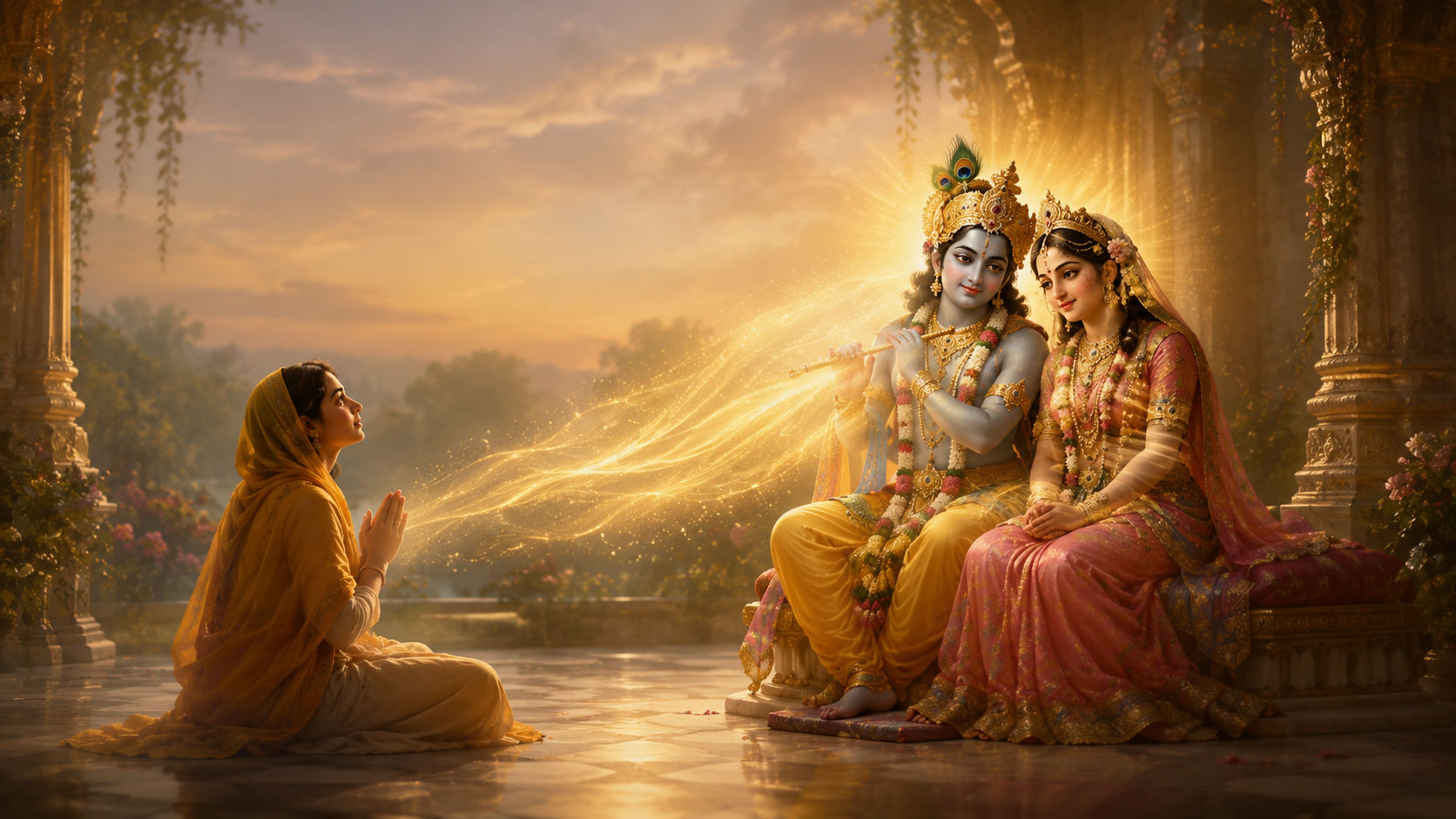
📍 Where You Are in the Inquiry
The scriptures unanimously establish selfless devotion, or Bhakti (भक्ति | bhakti), to Krishn as supreme. Ved Vyas declares that after examining all the scriptures repeatedly, the conclusion is that Narayan Hari alone should be meditated upon:
आलोड्य सर्वशास्त्राणि विचार्यं च पुनः पुनः ।
इदमेकं सुनिष्पन्नं ध्येयो नारायणो हरिः ॥
āloḍya sarvaśāstrāṇi vicāryaṁ ca punaḥ punaḥ |
idam ekaṁ suniṣpannaṁ dhyeyo nārāyaṇo hariḥ ||
(Ved Vyas)
The Ramayan similarly establishes love for the lotus feet of Ram as the conclusion of all teachings and devotion to Hari as the fruit of all spiritual practices described by the Vedas:
सब कर मत खगनायक एहा । करिय राम पद पंकज नेहा ॥
sab kara mata khaganāyaka ehā | kariya rāma pada paṅkaja nehā ||
जहँ लगि साधन वेद बखानी । सब कर फल हरि भगति भवानी ॥
jahaṁ lagi sādhana veda bakhānī | saba kara phala hari bhagati bhavānī ||
(Ramayan)
If Bhakti is supreme, the natural question is: how do we attain it?
Here Shri Maharaj Ji introduces a distinction that is essential to the entire path of devotion. The Divine Bhakti that overwhelms even great paramhansas cannot be produced through our own effort, nor does it simply arise by itself. Divine Bhakti is the supreme personal power of God and resides in Him alone.
As Shri Maharaj Ji illustrates, a priceless object cannot be attained for any price. The Ramayan describes even great yogis searching for this Divine love:
अविरल भगति विशुद्ध तव, श्रुति पुराण जेहि गाव ।
जेहि खोजत योगीश मुनि, प्रभु प्रसाद कोउ पाव ॥
avirala bhagati viśuddha tava, śruti purāṇa jehi gāva |
jehi khojata yogīśa muni, prabhu prasāda kou pāva ||
(Tulsidas)
“Great yogis search for Divine love, but only a few fortunate ones actually attain it, and it is received only with the Grace of God.”
To understand how such Bhakti can be attained, we must first understand what Divine Bhakti actually is.
Krishn Has Uncountable Divine Powers
The Chaitanya Charitamrit, the biography of Shree Chaitanya Mahaprabhu, explains that the Divine powers of Krishn are uncountable. Of these, three are principal:
कृष्णेर अनन्तशक्ति ताते तिन प्रधान । चिच्छक्ति मायाशक्ति जीवशक्ति नाम ॥
kṛṣṇera anantaśakti tāte tina pradhāna | cicchakti māyāśakti jīvaśakti nāma ||
अन्तरंगा बहिरंगा तटस्था कहि जारे । अन्तरंगा स्वरूप-शक्ति स्वार उपरे ॥
antaraṅgā bahiraṅgā taṭasthā kahi jāre | antaraṅgā svarūpa-śakti svāra upare ||
(Chaitanya Charitamrit)
The three principal powers are:
- Chit Shakti (चित् शक्ति | cit śakti) — God's personal Blissful power.
- Maya Shakti (माया शक्ति | māyā śakti) — the material power.
- Jeev Shakti (जीव शक्ति | jīva śakti) — all the souls.
These are respectively described as Antarang (अन्तरंग | antaraṅga), the personal power; Bahirang (बहिरंग | bahiraṅga), the external power; and Tatasth (तटस्थ | taṭastha), the neutral power.
Of these three, Chit Shakti—Krishn's personal power—is foremost.
The same threefold distinction is expressed in the Vishnu Puran:
विष्णुशक्तिः परा प्रोक्ता क्षेत्रज्ञाख्या तथापरा ।
अविद्याकर्मसंज्ञान्या तृतीया शक्तिरिष्यते ॥
viṣṇuśaktiḥ parā proktā kṣetrajñākhyā tathāparā |
avidyākarmasaṁjñānyā tṛtīyā śaktir iṣyate ||
(Bhagavat 6/7/61)
The source further gives:
ह्लादिनी संधिनी संवित्त्वय्येका सर्वसंश्रये ।
ह्लादतापकरी मिश्रा त्वयि नो गुणवर्जिते ॥
hlādinī sandhinī saṁvit tvayy ekā sarvasaṁśraye |
hlādatāpakarī miśrā tvayi no guṇavarjite ||
(Bhagavat 1/12/69)
This establishes the first step in understanding Divine Bhakti: it must be understood within Krishn's own personal Divine power.
The Three Aspects of Krishn's Personal Power
The Chaitanya Charitamrit further explains the nature of Krishn's personal power, Swaroop Shakti (स्वरूप शक्ति | svarūpa śakti), also called Chit Shakti:
सत् चित्-आनन्दमय कृष्णेर स्वरूप । अतएव स्वरूप शक्ति होय तिन रूप ॥
sat cit-ānandamaya kṛṣṇera svarūpa | ataeva svarūpa śakti haya tina rūpa ||
आनन्दांशे ह्लादिनी सदंशे संधिनी । चिदंशे संवित्, जारे ज्ञान करि मानि ॥
ānandāṁśe hlādinī sadaṁśe sandhinī | cidaṁśe saṁvit, jāre jñāna kari māni ||
(Chaitanya Charitamrit)
Swaroop Shakti has three aspects: Sat (सत् | sat), Chit (चित् | cit), and Anand (आनन्द | ānanda). Therefore, God is called Sachchidanand (सच्चिदानन्द | saccidānanda).
Each aspect corresponds to a Divine power:
- the Anand aspect becomes Hladini Shakti (ह्लादिनी शक्ति | hlādinī śakti), the power of Divine love;
- the Chit aspect becomes Samvit (संवित् | saṁvit), or Gyan Shakti (ज्ञान शक्ति | jñāna śakti), the power of knowledge;
- the Sat aspect becomes Sandhini Shakti (संधिनी शक्ति | sandhinī śakti), the power of almightiness.
Of these three, Hladini Shakti is the sweetest and most potent.
Through this power, God remains ever-Blissful even while creating uncountable brahmands and keeping account of the uncountable actions of uncountable souls.
Shri Maharaj Ji brings the magnitude of this into ordinary human experience. In a family containing only a few people, there is always some reason for disturbance. Even a husband and wife may become upset with each other many times in a single day.
Consider, then, God's responsibility: He keeps the record of the uncountable actions of every soul, across uncountable lifetimes, in uncountable brahmandas, and gives the outcome of all those actions. Yet He is never disturbed.
Through Hladini Shakti, He remains ever-Blissful.
The Essence of Hladini Shakti Is Divine Love
The Chaitanya Charitamrit now takes the teaching one step further:
ह्लादिनी सार अंश तार प्रेम नाम ।
hlādinī sāra aṁśa tāra prema nāma |
(Chaitanya Charitamrit)
The essence of Hladini Shakti is Prem (प्रेम | prema), Divine love—Bhakti.
The complete progression can now be seen.
God possesses uncountable powers. Three are principal: Swaroop Shakti, Jeev Shakti, and Maya Shakti. Of these, Krishn's personal power, Swaroop Shakti, is foremost.
Swaroop Shakti consists of Sat, Chit, and Anand. Of these, Anand Shakti is main. Its essence is Hladini Shakti, and the essence of Hladini Shakti is Divine love, or Bhakti.
Bhakti, therefore, is not merely something the soul manufactures through devotional effort. It is God's most personal and sweetest power.
Indeed, God Himself remains under its control.
This is why, when God appears, the rasik Saints ask Him for this very power and nothing else. They ask for Divine love under names such as aviral bhakti, anapayini bhakti, nirbhara bhakti, and para bhakti.
God is reluctant to give this power, yet He is bound to give it to His devotees.
If Divine Bhakti Cannot Be Produced, What Can We Do?
We have now reached an apparent difficulty.
If Bhakti is Divine and belongs to God, it cannot be the consequence of our spiritual practice. But what follows from that?
Shri Maharaj Ji identifies two opposite errors.
Some people attempt to attain Divine Bhakti through the strength of their own spiritual practice.
Others reason in the opposite direction: if Bhakti can only be given by God, there is nothing for them to do. They simply wait for it to happen by itself.
Both are wrong.
The Ved establishes the relationship between our practice, God's Grace, and Divine Bhakti:
तपः प्रभावाद् देवप्रसादाच्च ।
यमेवैष वृणुते तेन लभ्यस्तस्यैष आत्मा विवृणुते तनूँ स्वाम् ॥
tapaḥ prabhāvād devaprasādāc ca |
yam evaiṣa vṛṇute tena labhyas tasyaiṣa ātmā vivṛṇute tanūṁ svām ||
The distinction is therefore crucial.
There is Sadhana Bhakti (साधना भक्ति | sādhanā bhakti)—devotional Bhakti that we have to practice.
And there is Divine Bhakti—the Divine love given by God when the heart has been completely purified.
The relationship between them is not:
practice → production of Divine Bhakti
Nor is it:
no practice → wait for Divine Bhakti
Rather, Shri Maharaj Ji establishes the progression:
Sadhana Bhakti → Grace of God → Divine Bhakti
The Ramayan describes the devotional practice through which God's Grace is received:
मन क्रम वचन छाँड़ि चतुराई ।
भजतहिं कृपा करत रघुराई ॥
mana krama vacana chāṁḍi caturāī |
bhajatahiṁ kṛpā karata raghurāī ||
(Ramayan)
Wholehearted, selfless devotion with sincere feelings of love and dedication brings God's Grace. Then Divine love—the essence of Hladini Shakti—is attained.
Where This Inquiry Leads
We began with the scriptural conclusion that selfless devotion to Krishn is supreme. But this immediately raised a deeper question: if Bhakti is supreme, what exactly is the Bhakti we are trying to attain?
Shri Maharaj Ji establishes that Divine Bhakti is not an achievement produced by the strength of our practice. It is the essence of Hladini Shakti—God's most personal and sweetest Divine power—and is attained through His Grace.
Yet this does not make spiritual practice unnecessary.
It reveals the precise role of practice.
We perform Sadhana Bhakti. Through Sadhana Bhakti we receive God's Grace. Through God's Grace we attain Divine Bhakti.
This distinction resolves one question but immediately gives rise to the next.
If Sadhana Bhakti is what we must do, how should Sadhana Bhakti actually be practiced?
That is where the inquiry now turns.
Go Deeper
Continue the Inquiry
Part 1 of 6 — Bhakti Yoga — The Path
Divine Bhakti is God's own personal power and cannot be produced by spiritual practice. Yet Shri Maharaj Ji establishes that we must perform Sadhana Bhakti to receive God's Grace, through which Divine Bhakti is attained. This leads to the first condition of that practice: what does it actually mean for devotion to be selfless?
- ⬅️ Previous: Why Did Shankaracharya Himself Worship Shri Krishna?
- ➡️ Next: What Does Selfless Devotion Really Mean?
- 🔙 Back to Hub: Bhakti Yoga — The Path