Does God Have to Be Formless to Be Omnipresent?
If God possesses a Divine personal form, how can He still be present everywhere?
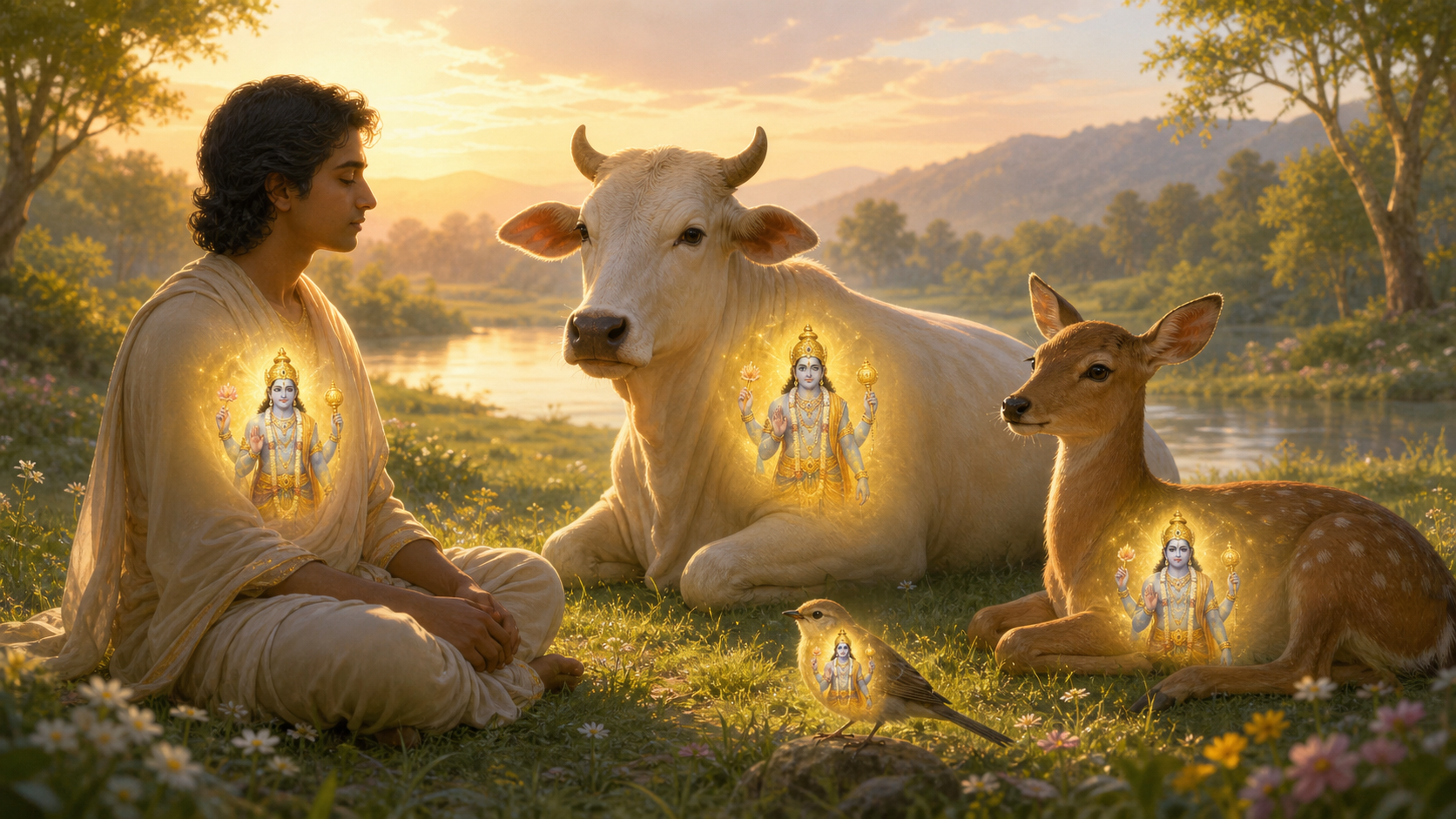
A common assumption is that God must pervade creation in a Nirakar form.
After all, how can something with a particular shape fit within every other shape and size? And how could something possessing a form be present even within formless space?
It can therefore seem that God must become formless in order to pervade everything.
Based on this reasoning, one might conclude that Nirakar Brahm must be the omnipresent aspect of God, while God's Sakar Roop cannot itself be omnipresent.
But the scriptures provide contrary evidence. God is not limited by His Sakar form.
God's Divine Form Is Not Limited Like a Material Form
The difficulty arises because we naturally understand form through our experience of material objects.
A material body occupies limited space. If our body is in one place, that same body cannot simultaneously be somewhere else. A particular material shape cannot fit within objects of every other shape and size.
But God's Sakar Roop is not material.
His form is Divine.
The limitations that apply to material forms therefore cannot be imposed upon God's Divine form.
Scripture gives us direct examples of this.
Paramatma Is Sakar Yet All-Pervading
Paramatma Swaroop is a Sakar Roop of God.
Yet the Shvetashvatara Upanishad describes God as all-pervading and present within all beings:
एको देवः सर्वभूतेषु गूढः सर्वव्यापी सर्वभूतान्तरात्मा।
eko devaḥ sarvabhūteṣu gūḍhaḥ sarvavyāpī sarvabhūtāntarātmā
— Shvetashvatara Upanishad 6.11
God is hidden within all beings, is all-pervading, and dwells within all beings.
Thus, being Sakar does not prevent God from being all-pervading.
The assumption that a form must necessarily be confined to one place comes from our experience of material forms. Paramatma demonstrates that God's Divine Sakar Roop is not subject to that limitation.
Shri Krishna's Sakar Form Is Not Limited to One Place
The same truth becomes even more striking in Shri Krishna's Divine personal form.
During Maharas, the Bhagavatam describes Shri Krishna manifesting simultaneously between every two Gopis:
रासोत्सवः सम्प्रवृत्तो गोपीमण्डलमण्डितः ।
योगेश्वरेण कृष्णेण तासां मध्ये द्वयोर्द्वयोः ॥
प्रविष्टेन गृहीतानां कण्ठे स्वानिकटं स्त्रियः ।
यं मन्येरन्नभस्तत्स्थैर्विमानावलिसङ्कुलम् ॥
Each Gopi experienced Shri Krishna beside her.
Shri Krishna remained Sakar while being simultaneously present with them all. His Divine personal form was simply not bound by the limitations that govern a material body.
Shri Maharaj Ji explains an even deeper truth: Shri Krishna's Divine Sakar form is eternally present in every particle of creation.
During Maharas, Shri Krishna did not have to travel from one place to another or create Divine bodies in places where He had previously been absent.
His Divine Forms were already present there. He simply revealed them through His Yogmaya Shakti.
Thus, God's Sakar form does not prevent Him from being omnipresent.
Nirakar Does Not Mean Nirakar Brahm
One distinction remains.
Nirakar means formless. Nirakar Brahm is God's formless, impersonal aspect. The two should not be treated as interchangeable.
Paramatma provides a clear example.
Paramatma is Sakar, yet Paramatma also pervades creation in nirakar form.
This does not mean that Paramatma's nirakar pervasion is Nirakar Brahm. Nirakar Brahm, Paramatma, and Bhagavan are eternal aspects of the same God and coexist eternally.
Therefore:
Paramatma is Sakar.
Paramatma pervades in nirakar form.
That nirakar pervasion is not Nirakar Brahm.
God does not have to be formless in order to be omnipresent.
Nor does Sakar mean limited to one place. God's Divine Sakar Roop is not subject to the spatial limitations of material form.
Nirakar Brahm is not God's omnipresent aspect.
God is omnipresent in His Divine Sakar Roop.
Go Deeper
- How Can God Be Both Formless and Have a Personal Form? — Understand how Brahm can simultaneously be Nirakar and possess a Divine personal form.
- If God Is Everywhere, Why Can't I See Him? — If God's Divine form is already present everywhere, understand why it cannot be perceived through material senses.
- Are Krishna's Multiple Forms the Same as a Yogi's Kayavyuh Deh? — Understand why Shri Krishna's eternal Divine Forms are fundamentally different from bodies created through yogic power.
- Brahm — The Supreme God — Explore Nirakar Brahm, Paramatma, and Bhagavan and the Divine powers manifested in these forms.