Gyan and Bhakti
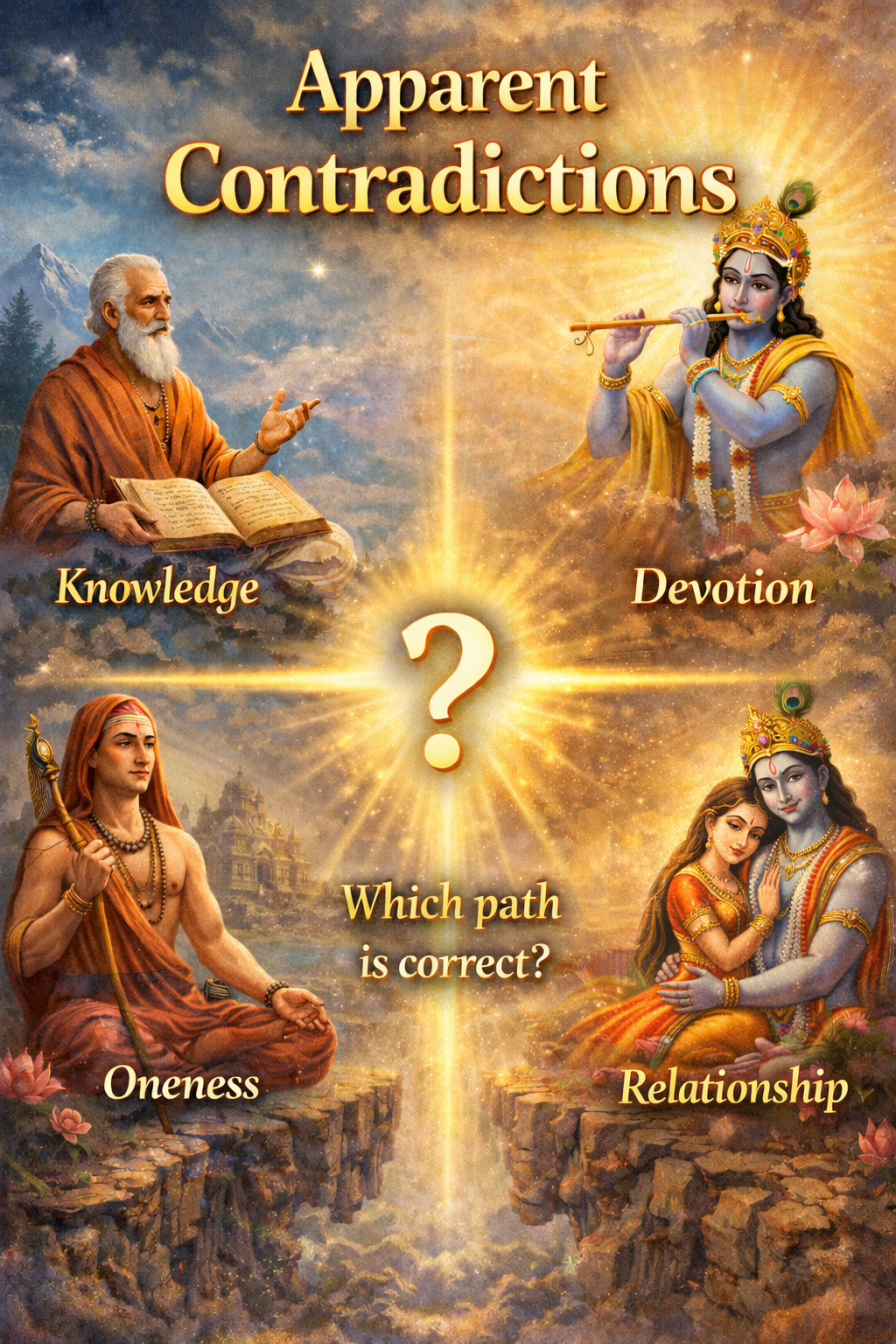
Apparent Contradictions
The teachings of different acharyas and saints
often appear to contradict each other.
They differ in many ways:
- the nature of the soul
- the nature of maya
- the form of God they worship
- the path they prescribe
- the practices they emphasize
- the sentiments toward God
- even the way they describe the goal
Some worship:
- a formless God
Others worship:
- a personal form of God
Some emphasize:
- knowledge
Others emphasize:
- devotion
Some speak of:
- oneness
Others speak of:
- eternal relationship
To a seeker, this creates confusion:
Which path is correct?
Which God should I follow?
The Source of the Confusion
This diversity appears as contradiction
only when seen at the surface.
These differences arise due to:
- differences in perspective
- differences in context
- differences in the condition of the soul
Differences in Perspective
Some teachings emphasize unity.
Others emphasize relationship.
Both refer to the same Divine Reality,
but describe it differently.
Differences in Context
At different times,
different teachings were necessary.
For example,
Jagadguru Shankaracharya strongly emphasized non-duality
to counter Buddhist philosophy prevalent at his time.
Yet, in his personal life,
he practiced devotion to Shri Krishna
and guided even his Mother towards bhakti of Shri Krishna.
This shows:
The expression may differ,
but the intent remains the same.
Differences in Qualification
Souls come with impressions from past lives.
These impressions create natural inclinations:
- toward action
- toward knowledge
- toward devotion
Because of this,
different approaches resonate with different people.
One may feel drawn toward karma-marg.
Another toward gyan-marg.
But this inclination is only a starting point.
It does not determine the final path.
A true Guru does not simply confirm
what the soul already prefers.
He understands the condition of the soul
and guides it forward—
even beyond its current inclination.
So the paths may appear different at the beginning.
But they are not meant to remain separate.
They lead the soul progressively
toward the same conclusion.
The Deeper Unity
When seen correctly,
these teachings are not in conflict.
They are guiding souls
from different starting points
toward the same Divine Goal.
The Brahm realized by the gyani
and the Bhagwan loved by the bhakt
are not different.
They are two ways of experiencing
the same God.
The Decisive Insight
If they were truly different—
then those who attained the highest knowledge
would never move toward bhakti.
But this is not what we see.
The Final Evidence
The greatest Brahmgyanis (knowers of Brahm) —
Creator Lord Brahma, Lord Shiv, the Kumar Brothers, King Janak, Uddhav,
Sage Ved Vyas, and Shukdev—
all attained the state of impersonal realization.
Yet, upon experiencing the personal form of their Brahm,
they were naturally drawn toward loving Him.
This was not taught to them,
nor was it the result of deliberate practice.
It happened naturally.
This reveals a deeper truth—
realization finds completion in love.
👉 Further Reading Why do even the greatest realized souls become drawn toward Bhakti?
What This Reveals
This shows that:
The Brahm realized by the gyani
and the Bhagwan loved by the bhakt
are not two different Supreme Beings —
But the experience of Divine love
has a unique sweetness
that even greatest gyanis are drawn toward.
A Simple Way to Understand
Knowing something
is not the same as experiencing it fully.
Seeing, smelling, and tasting
are not the same experience—
even though they relate to the same object.
In the same way:
Realizing the impersonal aspect of God
and loving the personal form of God
are not contradictory—
but the latter carries a unique intimacy.
The Final Understanding
The teachings of the acharyas differ in expression,
but not in their ultimate purpose.
They guide souls from where they are—
toward the complete experience of God.
The Natural Conclusion
One may begin with karma-marg.
One may begin with gyan-marg.
But neither reaches completion on its own.
Both find their fulfillment in Bhakti.
The Next Inquiry
If even the greatest realized souls are drawn toward bhakti
what is Bhakti,
and how does it lead to God?
The Next Question
The path of action has its limitation.
Even when action is refined,
it must be joined with Bhakti to become liberating.
So another question naturally arises:
What about knowledge (Gyan)?
The scriptures praise it highly.
But can knowledge alone lead to God?
What Is Gyan?
Knowledge is of two kinds:
- Theoretical knowledge — understood through words
- Realized knowledge — known through direct experience
A person may:
- speak about God
- explain scriptures
Yet not know God.
So knowing is not the same as realizing.
The Source of Confusion
The scriptures both praise and criticize Gyan.
They say:
- Nothing purifies like knowledge
- A gyani is dear to God
- Liberation comes through knowledge
But they also say:
- Knowledge without Bhakti leads to downfall
- Gyan without Bhakti is incomplete
- A gyani without Bhakti does not attain God
So what is correct?
What Is Being Criticized
The criticism is not of true knowledge.
It is of theoretical knowledge without Bhakti.
This kind of knowledge:
- remains in words
- does not transform the mind
- creates the illusion of understanding
The Danger of Theoretical Knowledge
A person with such knowledge may think:
“I understand.”
But without Bhakti,
this becomes pride.
And pride creates distance from God.
A simple person may remain humble.
But a theoretical gyani:
- tries to display knowledge
- feels no need to surrender
So instead of progressing,
he becomes stuck.
The Role of Knowledge
This does not mean knowledge should be rejected.
Correct understanding is necessary.
Without it:
- confusion arises
- the path is misunderstood
So knowledge has a role—
but only as a support.
It is meant to:
- guide practice
- remove doubt
- lead toward God
What True Knowledge Does
True knowledge does not remain intellectual.
It leads to:
- clarity
- faith
- attraction toward God
If this does not happen,
then the knowledge is incomplete.
Because true knowledge
naturally leads toward Bhakti.
Why Gyan Alone Is Not Enough
Even one who realizes the self (atma):
- becomes detached
- becomes peaceful
But this is not complete.
Because knowing the self
is not the same as knowing God.
Without Bhakti,
God cannot be known.
So knowledge alone cannot lead to God realization.
Gyan Yog
The path of Gyan Yog is:
- contemplation on the formless (nirakar) reality
- withdrawal from worldly engagement
- absorption in knowledge
This path requires:
- near-complete detachment from the world
- control over the mind
- freedom from worldly attraction
Very few qualify.
The Practical Difficulty
Most people are:
- neither fully attached
- nor fully detached
So they are not fit for this path.
Even Then, It Is Not Safe
Even for those who follow this path:
without Bhakti,
there is no protection.
So even at advanced stages,
one may fall.
Because maya is not fully overcome.
Why This Happens
Effort remains individual.
And individual effort is limited.
Without Bhakti,
there is no Divine support.
What the Scriptures Ultimately Say
After many lifetimes of effort,
a gyani finally turns toward God.
Only then does realization occur.
The Essential Insight
Knowledge can prepare the mind.
But it cannot complete the journey.
Only Bhakti leads to God.
The Limitation of Gyan
So the position becomes clear:
- Knowledge is necessary
- But not sufficient
It must be supported by Bhakti.
It must lead toward Bhakti.
It must be completed by Bhakti.
Final Realization
Knowledge without Bhakti creates pride.
Knowledge supported by Bhakti prepares the mind.
But only Bhakti leads to God.
The Next Question
If both action and knowledge
depend on Bhakti—
what is Bhakti,
and how does it lead to God?