Why Guidance Is Necessary
If infinite bliss exists but our limited mind cannot reach it alone, guidance becomes intelligence—not dependence. This is the turning point of the search.
Material pleasure fades, diminishes, and ends—yet our desire for happiness does not. Why is there such a mismatch between what we seek and what the world provides?
The Question That Arises Once a true Saint is recognized, a natural question follows: Which path should be followed to attain God? The scriptures describe multiple approaches. But they are not all equal. To understand this clearly, we must first understand what “action” really means. Understanding Action All actions fall
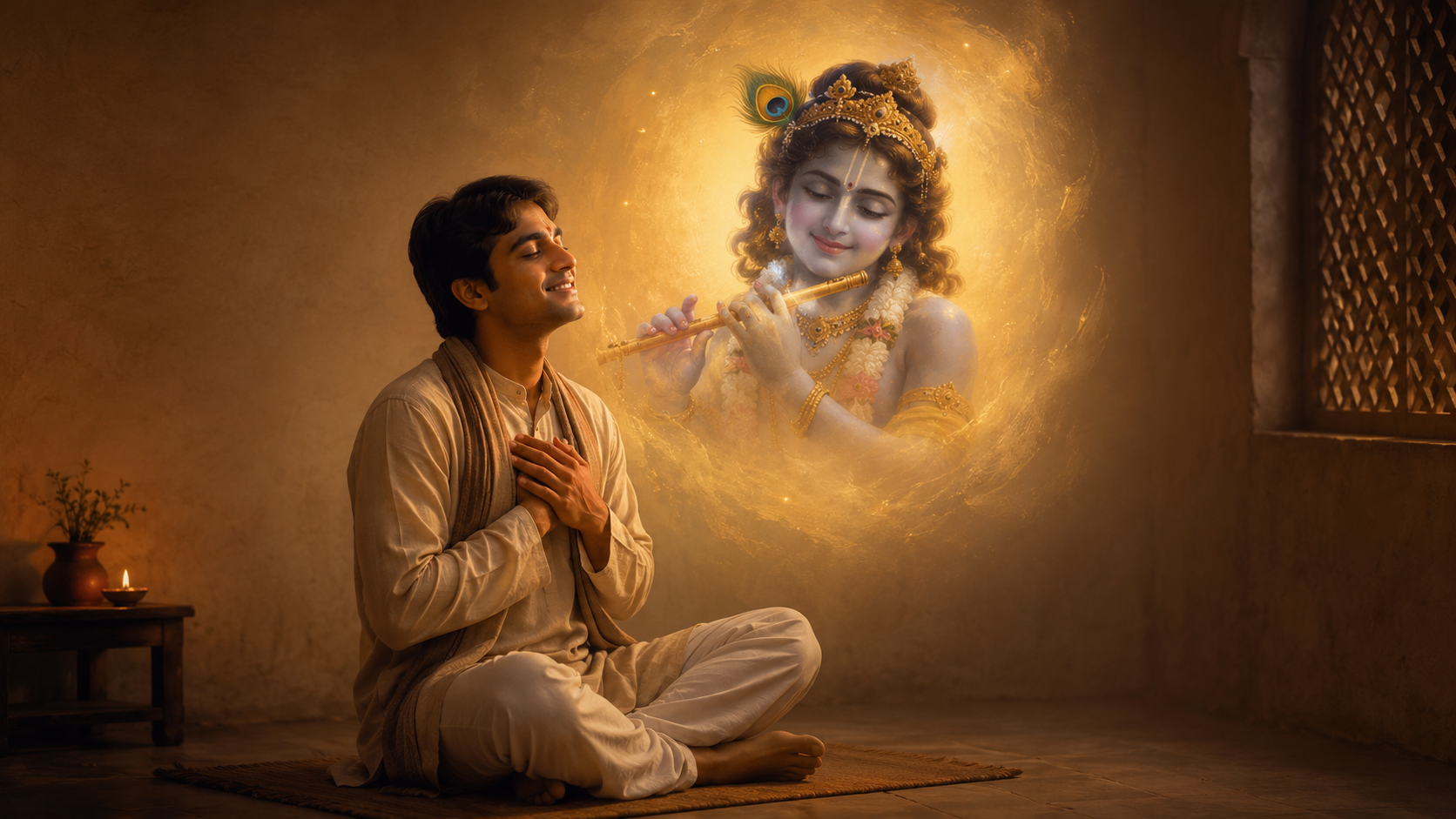
A structured one-hour routine: prayer, ārati, guru reverence, rūpadhyān with kīrtan, and bhog—designed to deepen steady devotion.
The Next Question The path of action has its limitation. Even when action is refined, it must be joined with Bhakti to become liberating. So another question naturally arises: What about knowledge (Gyan)? The scriptures praise it highly. But can knowledge alone lead to God? What Is Gyan? Knowledge is
Apparent Contradictions The teachings of different acharyas and saints often appear to contradict each other. They differ in many ways: * the nature of the soul * the nature of maya * the form of God they worship * the path they prescribe * the practices they emphasize * the sentiments toward God * even the way
Shakha (शाखा, śākhā) literally means "branch." In the context of Vedic literature, it refers to a specific concept. Further Reading and Reference * Related Concepts: Upanishad * Reference: Who am I? Who is Mine? Vol. 1, Ch. 2
Question Jagadguruttam Shri Kripalu Ji Maharaj often draws a comparison between the nature of God-realized saints and a birch tree. What is the similarity between these two? Answer: The Ramayan says भुर्ज तरु सम संत कृपाला । पर हित सह नित विपति वि
Yajurveda (यजुर्वेद, yajurveda) is one of the four Vedas. It primarily contains the mantras and detailed instructions required to perform Vedic sacrifices and rituals. Further Reading and Reference * Alternate Spelling: Yajur Veda, Yajurved * Related Concepts: Upanishad * Reference: Who am I? Who is Mine? Vol. 1, Ch. 2
The Murti (मूर्ति) is the divine form for worship. As the true Murti is God's form, the consecrated idol helps the mind achieve God-realization via Rupdhyana.
Akshaypatra (अक्षयपात्र, akṣayapātra) refers to the inexhaustible vessel or divine bowl. The term is derived from Akshaya (un-decaying/inexhaustible) and Patra (vessel). In the Mahabharata, this vessel was gifted by the Sun God (Surya) to the Pandavas during their exile. It provided an unlimited supply of food
Atharvaveda (अथर्ववेद, atharvavēda) is one of the four parts of the Vedas consisting of 50 branches (shakha), comprising verses for averting calamities and bodily afflictions, and for performing religious rites. Further Reading and References * Also written as Atharva Veda, Atharv Ved * Further Reading: rigveda, saamved, yajurveda, When and