When and How Vedas Came to Us?
Are the Vedas historical or eternal? Discover why Jagadguru Shri Kripalu Ji Maharaj reveals that the Vedas were never created anew, defying modern academic dating.

The Eternal Origin of the Vedas: Beyond Historical Dates
If you consult sources like Wikipedia, you will find that the Vedas were supposedly composed between 1500 and 1200 BC. These sources state, "The Vedas have been orally transmitted since the 2nd millennium BCE with the help of elaborate mnemonic techniques," and claim that the oldest part of the Rig Veda Samhita was orally composed in north-western India during this period.
However, it is important to understand that these dates are merely deductions made by modern researchers based on limited historical and linguistic data. As new evidence surfaces, these estimated timelines frequently change. Given this constant fluctuation, one can infer that these academic dates may not be bonafide or absolute truths.
When seeking the ultimate truth on a subject, one must seek the advice of the highest authority in that field. In the realm of spiritual knowledge, Jagadguruttam Swami Shri Kripalu Ji Maharaj is the greatest contemporary authority on the Vedic scriptures.
He was acclaimed as Pad-Vakya-Pramana-Paravarina by an assembly of the 500 most distinguished and decorated Vedic scholars of India (the Kashi Vidvat Parishat). These highly accomplished scholars declared to the world that Shri Maharaj Ji's wisdom was the very source of the knowledge contained within the scriptures.
Therefore, we look to Shri Maharaj Ji's words as the final evidence to answer this question. He reveals the scriptural verdict: The Vedas were never created anew. They are Apaurusheya—eternal, beginningless, and divine.
Vedas were never created anew.
The Eternal Cycle: How the Vedas are Revealed
At the time of Mahapralaya (The Great Dissolution), the eternal Vedas merge back into Brahm—The Supreme Lord.
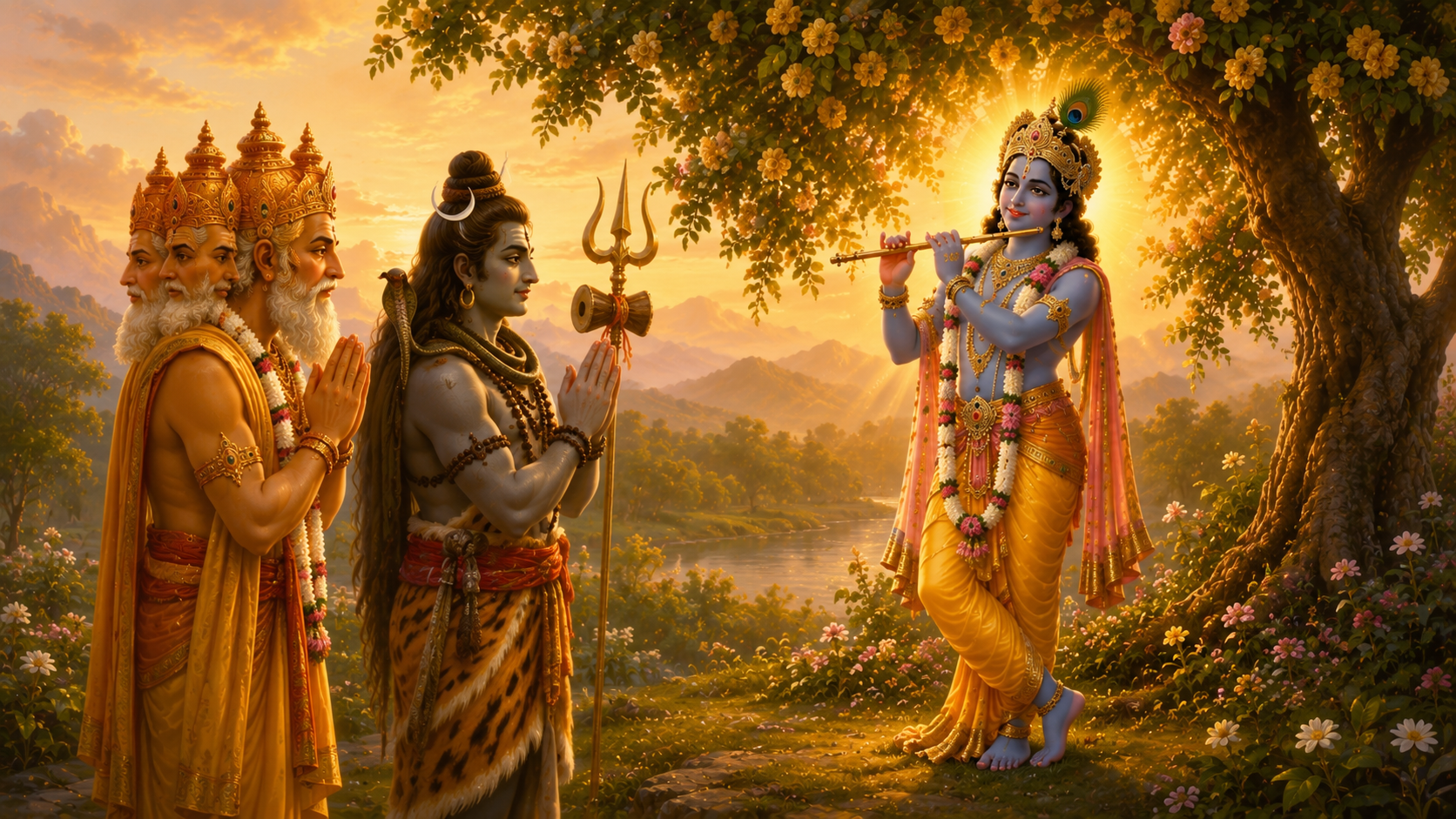
Before the onset of the next creation, while Karnarnavshayi Mahavishnu is resting in Yoganidra (divine sleep), the Vedas emerge effortlessly from His divine breath. Subsequently, Shri Krishna manifests this divine knowledge within the mind of each Creator Brahma. It is important to note that there is a distinct Brahma for each Brahmand (universe).
Our specific universe was created by Chaturmukhi Brahma (the four-headed Lord Brahma) approximately 154 trillion years ago. Therefore, in this particular Brahmand, the Vedas were introduced 154 trillion years ago.
Lord Brahma imparted this knowledge to his sons, the celestial sages. For the first three Yugas of the Chaturyuga cycle, this knowledge was transmitted strictly through the oral tradition. Later, the great Sage Veda Vyasa organized and divided the vast body of Vedic hymns into four distinct books: the Rig Veda, Yajur Veda, Sama Veda, and Atharva Veda.
Additionally, if the Vedas ever become lost in the middle of a creation cycle, God intervenes to re-introduce them. This is the eternal process by which the Vedas are reproduced in each universe.
In this context, a natural question arises: Did God orally transmit all one billion mantras of the Vedas?
The Science of Divine Transmission: How the Vedas Were Revealed
To understand how this vast knowledge was transmitted, we must understand that speech, or Vani (वाणी; vāṇī), is not limited to the spoken word. It manifests in four distinct levels:
- Para Vani (परा वाणी; parā vāṇī): This is the supreme form of sound, limited to the Atma (soul). At this level, the orator has no independence; it is pure, unmanifested.
- Pashyanti Vani (पश्यन्ती वाणी; paśyantī vāṇī): Here, the words and their meanings are perfectly in sync. However, because there is no relationship with the mind at this stage, it cannot be understood by the intellect. Like Para, the orator has no independence here.
- Madhyama Vani (मध्यमा वाणी; madhyamā vāṇī): This is the intermediate stage, related to the mind but not yet perceptible to the external senses. Unlike Pashyanti (where word and meaning are fused), at this level, the word and its meaning can deviate from each other. The orator has independence in this form of communication.
- Vaikhari Vani (वैखरी वाणी; vaikharī vāṇī): This is fully manifest, audible speech where the orator has full independence. It is further divided into two types:
- Upanshu (उपान्शु वाणी; upānśu vāṇī): Spoken at a very low volume, as if whispering into someone's ears.
- Uchayi (उच्चयी वाणी; uccayī vāṇī): Spoken loudly, such as when giving a lecture.
The Method of Transmission God did not physically speak the Vedas with a human voice. Instead, God revealed the Vedas to the Rishis (Seers) using Pashyanti Vani and Madhyama Vani.
These inspired Rishis then produced and recited the Vedas in Vaikhari Vani (audible speech) for the benefit of humanity. Finally, approximately 5,000 years ago, Veda Vyas captured this oral tradition and produced it in written print.