Daily Devotional Routine
A structured one-hour routine: prayer, ārati, guru reverence, rūpadhyān with kīrtan, and bhog—designed to deepen steady devotion.
This sequence expands the foundational discipline described earlier.
Understanding prepares the mind.
Daily sitting builds attachment.
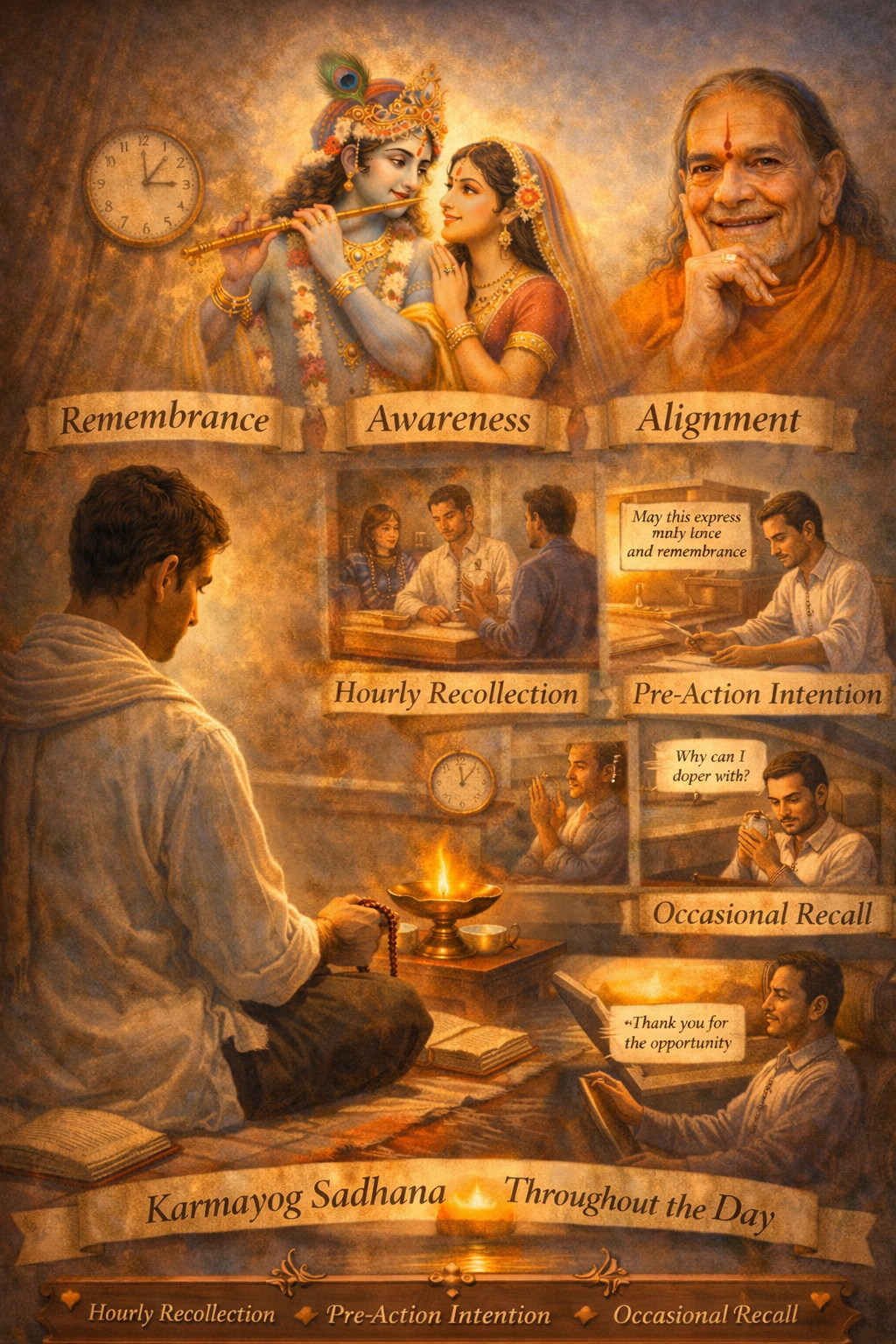
Karmayog preserves remembrance.
To deepen Bhakti steadily, Shri Maharaj Ji prescribed a structured sequence of devotional practices.
This routine protects love from becoming vague and prevents Sadhana from becoming mechanical.
The Minimum Foundation
Shri Maharaj Ji explains that one hour of daily Bhakti Sadhana is necessary for steady progress.
Less than this may maintain inspiration.
Transformation requires disciplined time.
As capacity grows, duration may increase. But one hour should be treated as foundational.
This time must be guarded.
The Prescribed Order
The sequence is deliberate. Each step prepares the next.
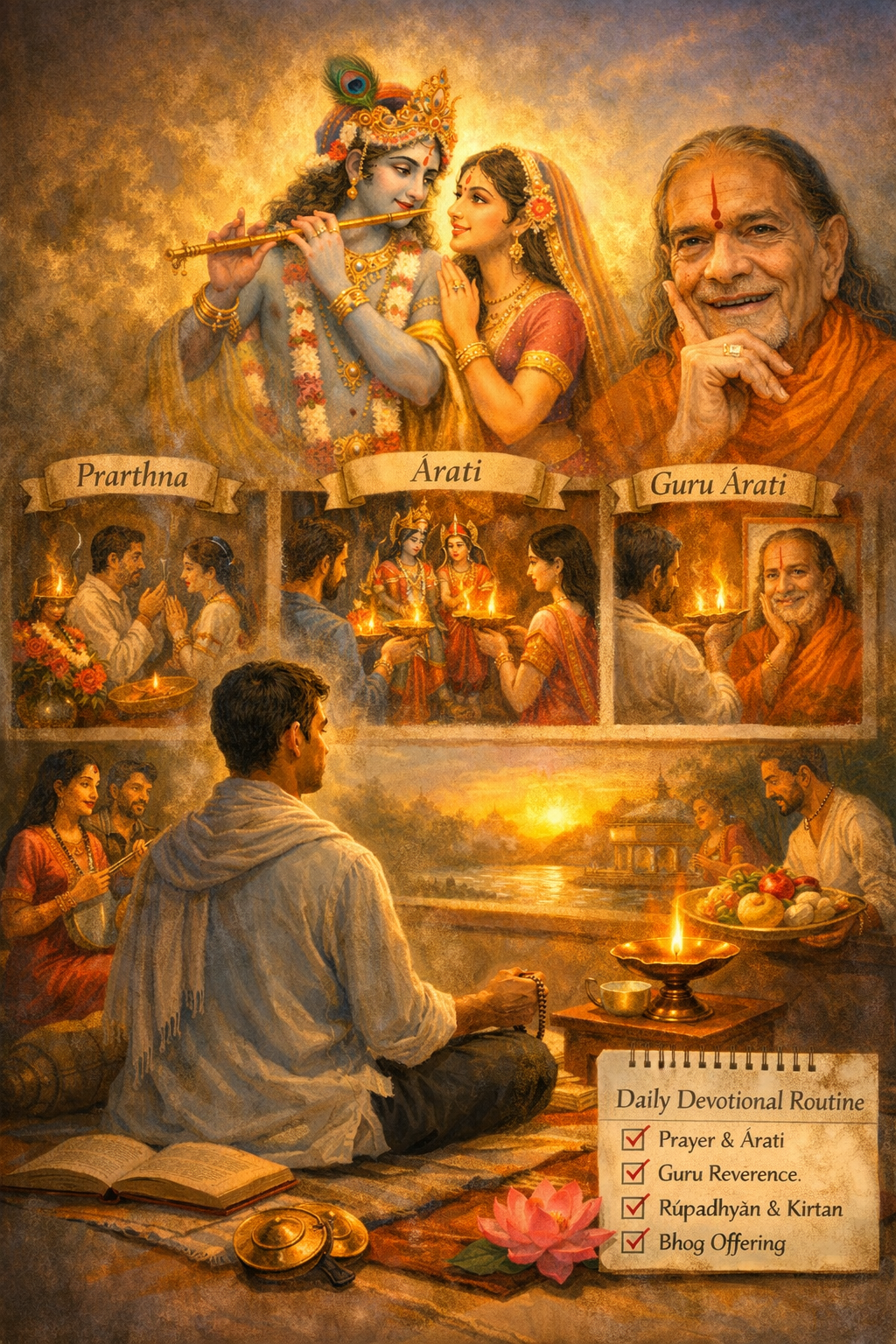
1. Prarthna (Daily Prayer)
Begin with prayer.
Prayer establishes humility and dependence. It reminds the mind:
“I cannot attain God by my own strength.”
Without humility, devotion becomes self-driven. Prayer softens the heart before deeper practice begins.
→ Read the full Prarthna guide
2. Radha-Krishna Ārati
Offer Ārati to Shri Radha-Krishna.
In this Ārati, Their divine form, beauty, and qualities are described. This establishes reverence and brings the divine personality clearly before the mind.
Ārati is glorification — not yet deep meditation. It prepares the mind for absorption.
→ Read the Yugal-Sarkar Ārati guide
3. Guru Ārati
Offer reverence to Guru.
Guru is the revealer of tattvagyan and the channel of grace. Without Guru’s guidance, Sadhana may become imagination-driven or misdirected.
Honoring Guru before deeper meditation aligns the practice with grace.
→ Read the Guru Ārati guide
4. Rūpadhyāna (Meditation on the Divine Form)
Now deepen concentration.
Engage the mind steadily in remembrance of the divine form described in Ārati.
This is not imagination for entertainment. It is focused attachment.
In the beginning:
- Attention may fluctuate.
- The mind may wander.
- Absorption may feel weak.
That is natural.
With repetition, steadiness grows. Rūpadhyāna trains the mind to remain attached.
5. Kīrtan
Kīrtan is the singing of the glories, qualities, beauty, and virtues of Hari and Guru.
It serves two purposes:
First, it engages the outward-facing senses in devotional activity. The voice, ears, and attention align, preventing distraction.
Second, singing reduces drowsiness. Where silent meditation may lead to sleep in early stages, kīrtan sustains alertness.
Kīrtan softens the heart while keeping attention active.
6. Yugal-Sarkar Bhog (Optional but Beneficial)
Offering food to Shri Radha-Krishna cultivates relational devotion.
It shifts remembrance from inward meditation to loving exchange.
Though optional, it strengthens personal connection.
→ Read the Yugal-Sarkar Bhog guide
Why This Order Matters
The sequence moves from:
Humility → Glorification → Grace Alignment → Deepening and Softening → Offering
It engages:
Mind
Intellect
Emotion
Action
When practiced consistently, this structure gradually transforms habit into devotion.
Practical Structure for One Hour
A balanced one-hour session may look like this:
- Prarthna – 5 minutes
- Radha-Krishna Ārati – 5 minutes
- Guru Ārati – 5 minutes
- Rūpadhyāna with Kīrtan – 45 minutes
- Bhog – as appropriate
During the final portion, Rūpadhyāna and Kīrtan are performed together.
Meditating on the divine form while singing Kīrtan engages both the mind and the senses. One may softly clap or use simple devotional instruments to support attention. When voice, hands, and awareness are aligned, external disturbances fade and drowsiness reduces.
Where silent meditation alone may lead to boredom or sleep in early stages, this combined engagement sustains alertness and deepens absorption.
Adjust slightly if needed, but preserve the order and combined engagement.
If One Hour Feels Difficult Initially
Begin where you can.
But build toward one hour.
Love grows through disciplined repetition.
What is practiced consistently becomes natural.
The Purpose of Structure
This routine is not ritual for display.
It is training.
Without structure, love remains inconsistent.
With structure, attachment deepens.
What is practiced consistently becomes natural.
As structure becomes steady, attention must also become sincere. Discipline alone does not produce devotion; inner orientation determines growth.
→ Continue to Inner Attitude in Practice