Karmayog Sadhana - Preserving Devotion Throughout the Day
Karmayog Sadhana—Living Bhakti in Action. Learn how to preserve remembrance throughout the day using structured recollection, aligned intention, and detachment from results—without abandoning responsibilities.
Karmayog Sadhana
Living Bhakti in Action
Bhakti is not limited to a period of sitting.
The mind must remain attached to God
while the body continues performing its duties.
This is the practical form of Bhakti.
This is Karmayog Sadhana.
Morning Sadhana ignites remembrance.
But Shri Maharaj Ji explains:
One hour of devotion to God and Guru,
followed by twenty-three hours absorbed in material thoughts,
produces limited progress.
If remembrance remains confined to a short session,
the habits of the day overpower it.
Therefore,
devotion must be preserved throughout the day.
1. Begin With Structured Remembrance
Remembrance does not remain naturally at first.
It must be structured.
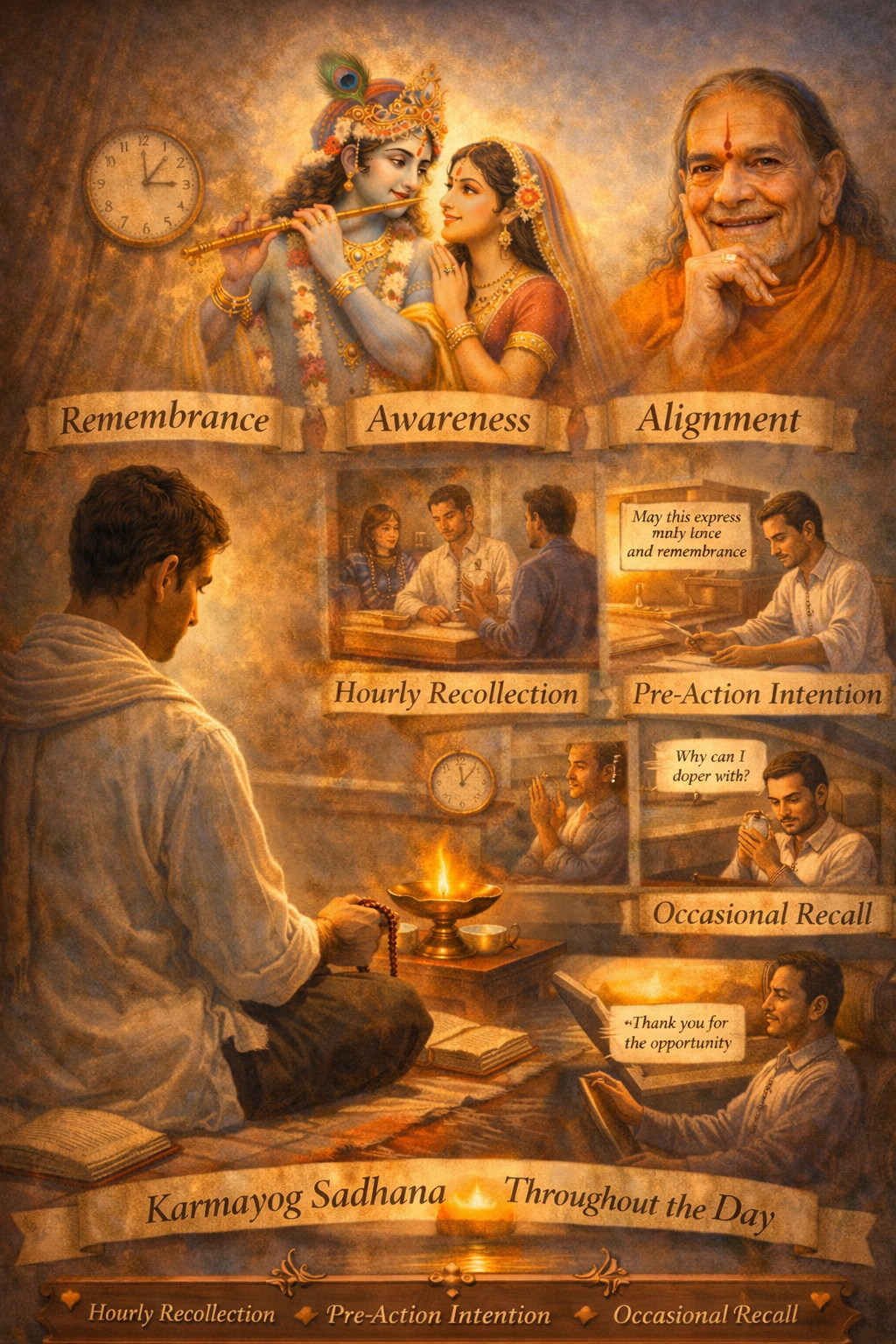
Start by reminding yourself once every hour:
“God and Guru are aware of my thoughts.”
This is not fear.
It is relational awareness.
God is not a distant authority to be feared.
He is the eternal well-wisher of the soul.
Remembrance is not surveillance —
it is connection.
This recollection interrupts unconscious habits
and weakens negative thought patterns.
When hourly remembrance becomes steady,
shorten the interval:
- every 30 minutes
- then every 15 minutes
- then every 10 minutes
Gradually,
remembrance becomes less forced
and more natural.
Over time,
forgetting reduces.
2. This Is Not Continuous Roop Dhyan
Karmayog Sadhana does not mean
performing deep meditation all day.
If the mind is fully absorbed in roop dhyan,
worldly duties cannot be performed—
especially in the beginning.
Therefore,
structured recollection is necessary.
You perform your responsibilities sincerely.
At intervals,
you recollect.
The recollection stabilizes direction
without disrupting action.
3. Align Before Action
Before beginning any task,
orient it inwardly:
“May this action express my love and remembrance.”
Not out of fear.
Not as mechanical duty.
But as alignment.
God is to be loved,
not feared.
He has accompanied the soul
through every experience.
Remembrance during action
is not anxiety about judgment—
it is awareness of relationship.
Setting intention
changes the direction of action.
4. Remain Aware During Action
While performing the task,
occasionally recall:
Why am I doing this?
The goal is not distraction from work,
but purification of motive.
Your ability,
intelligence,
and opportunity
come from God.
This awareness reduces ego
and keeps action aligned.
5. Transition Without Attachment
When the task is complete,
move forward.
Do not linger over:
- how well did I perform
- will I gain recognition
- what fruit will come
If intention was aligned before action
and awareness maintained during action,
attachment to results weakens naturally.
There is no need to fight it—
there is no room for it.
6. Replace Old Habits With Structure
Love does not appear instantly.
The mind has practiced material attachment
for countless lifetimes.
Those patterns do not dissolve through inspiration alone.
They change through repetition.
By remembering at intervals…
By aligning before action…
By releasing ownership afterward…
Old habits weaken.
New orientation strengthens.
Love grows gradually
where remembrance is protected.
7. Short Anchors Throughout the Day
You may establish small anchors:
- a brief pause before meals
- a moment of inward remembrance before meetings
- silent gratitude during transitions
- a short reflection before sleep
These anchors prevent spiritual forgetfulness.
8. Gradual Naturalization
At first,
remembrance feels deliberate.
Later,
it feels familiar.
Eventually,
it becomes background awareness.
This cannot be forced.
What is practiced consistently
becomes natural.
The Continuity of Practice
If devotion remains confined to one hour,
material habits dominate.
If remembrance is inserted repeatedly into the day,
attachment deepens.
Bhakti is not escape from life.
It is alignment within life.
Continue steadily.
→ Return to Sadhana