
Sadhana: Disciplined Practice for Steady Remembrance of God
Learn the structured path of Sadhana Bhakti: daily discipline, devotional routine, inner attitude, and Karmayog for steady remembrance of God.
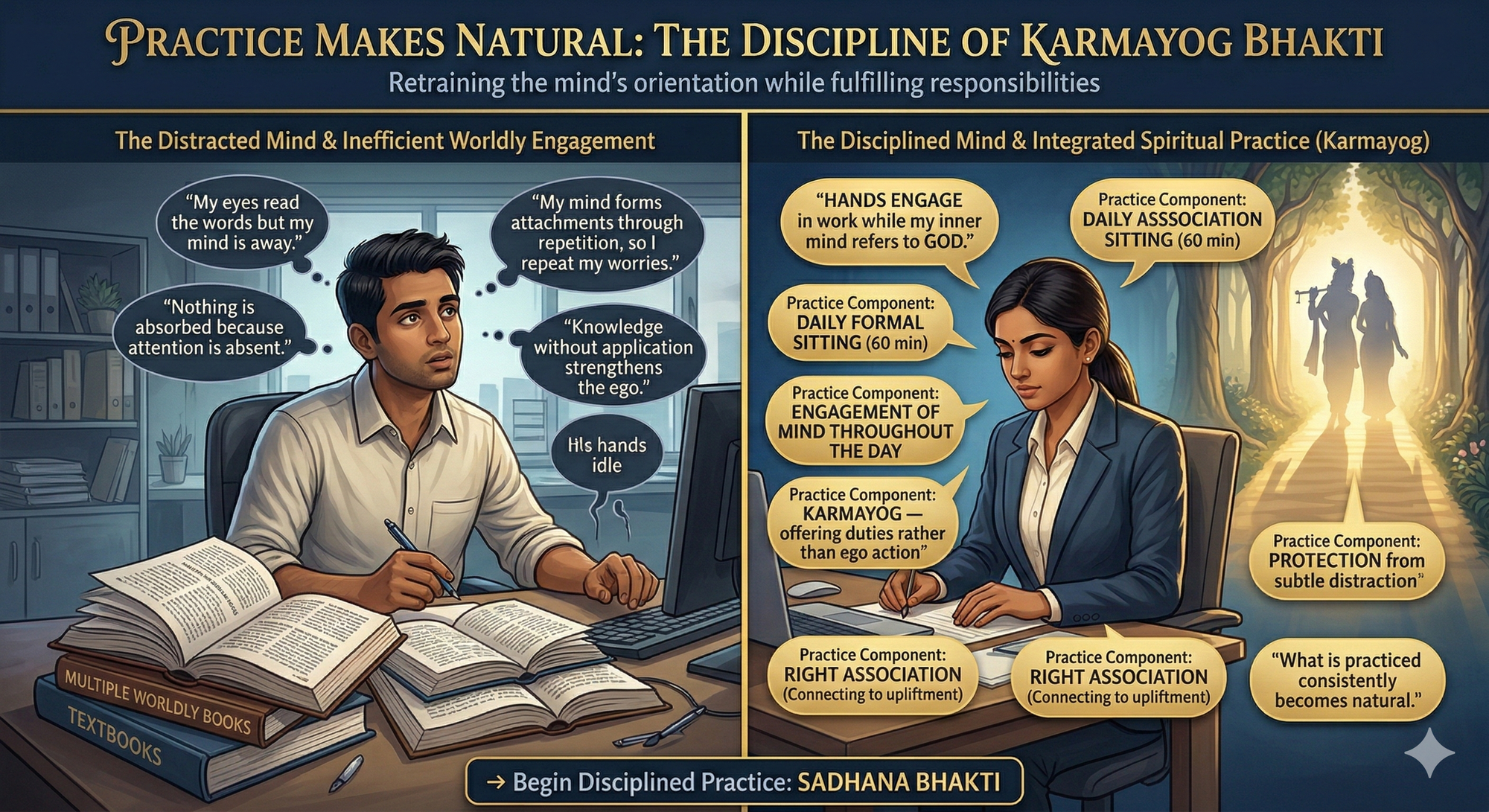
The Practical Problem
Every person has experienced:
when the mind is elsewhere,
the senses fail to perceive properly.
A book may be open before us,
yet nothing is absorbed
because attention is absent.
Action depends upon attention.
If the mind is to be absorbed in God,
then how can one fulfill responsibilities?
Does remembrance require withdrawal from life?
The Direction Given
In the Bhagavad Gita, Shri Krishna instructs:
one must remember Him at all times.
This is not poetic exaggeration.
It is the direction of spiritual discipline.
Continuous remembrance does not mean abandoning action.
It means retraining the orientation of the mind.
The hands perform their duties,
but the inner reference of the mind
is gradually shifted toward God.
Why Practice Is Necessary
Doctrine explains why this is necessary.
But the mind does not transform
through understanding alone.
Knowledge without disciplined application
can even strengthen subtle ego.
Therefore, practice is essential.
Anything of value requires sustained effort.
Mastery in any field demands repetition.
The mind forms attachment through repetition.
Therefore,
Divine remembrance becomes steady
through disciplined repetition.
The Practice Principle
What is practiced consistently becomes natural.
If the mind is repeatedly placed in remembrance,
attachment to God gradually becomes its resting state.
What Is Sadhana
Sadhana is the conscious use of free will
to place the mind where it ought to rest—
again and again—
until steadiness becomes natural.
This section does not repeat philosophy.
It explains:
- what must be done
- how it must be done
- how it may be done
without abandoning one’s responsibilities
The aim is not outward display
or emotional intensity.
It is steadiness—
gradual purification
and reorientation of the mind
toward loving absorption in God.
The Structure of Disciplined Practice
True practice rests upon a few essential components:
- Daily formal engagement
(setting aside time for focused remembrance) - Engagement of the mind throughout the day
(preventing mental drift) - Karmayog Sadhana
(performing duties while remaining inwardly aligned) - Right association
(remaining connected to uplifting guidance) - Protection from subtle distraction
(preserving steadiness)
Each of these is explained below.
Begin Disciplined Practice
If this understanding is clear,
practice must follow.
What Is Sadhana Bhakti?
Understand why repetition is required
before Divine Love becomes steady.
Daily Sadhana
Learn how to establish a daily foundation
for focused remembrance.
Daily Devotional Routine
Follow a structured sequence
to deepen engagement.
→ Follow the structured routine
The Inner Attitude in Practice
Refine how the mind engages—
without ego, mechanical repetition, or discouragement.
Karmayog Sadhana
Learn how to preserve remembrance
while fulfilling responsibilities.
→ Integrate practice into daily life