
The Kashi Recognition (1957): Conferment of Jagadguruttam
In 1957, the Kashi Vidvat Parishad — one of India’s most respected bodies of Vedic scholarship — formally conferred upon Shri Kripalu Ji Maharaj the title of Jagadguruttam after evaluating his scriptural mastery.
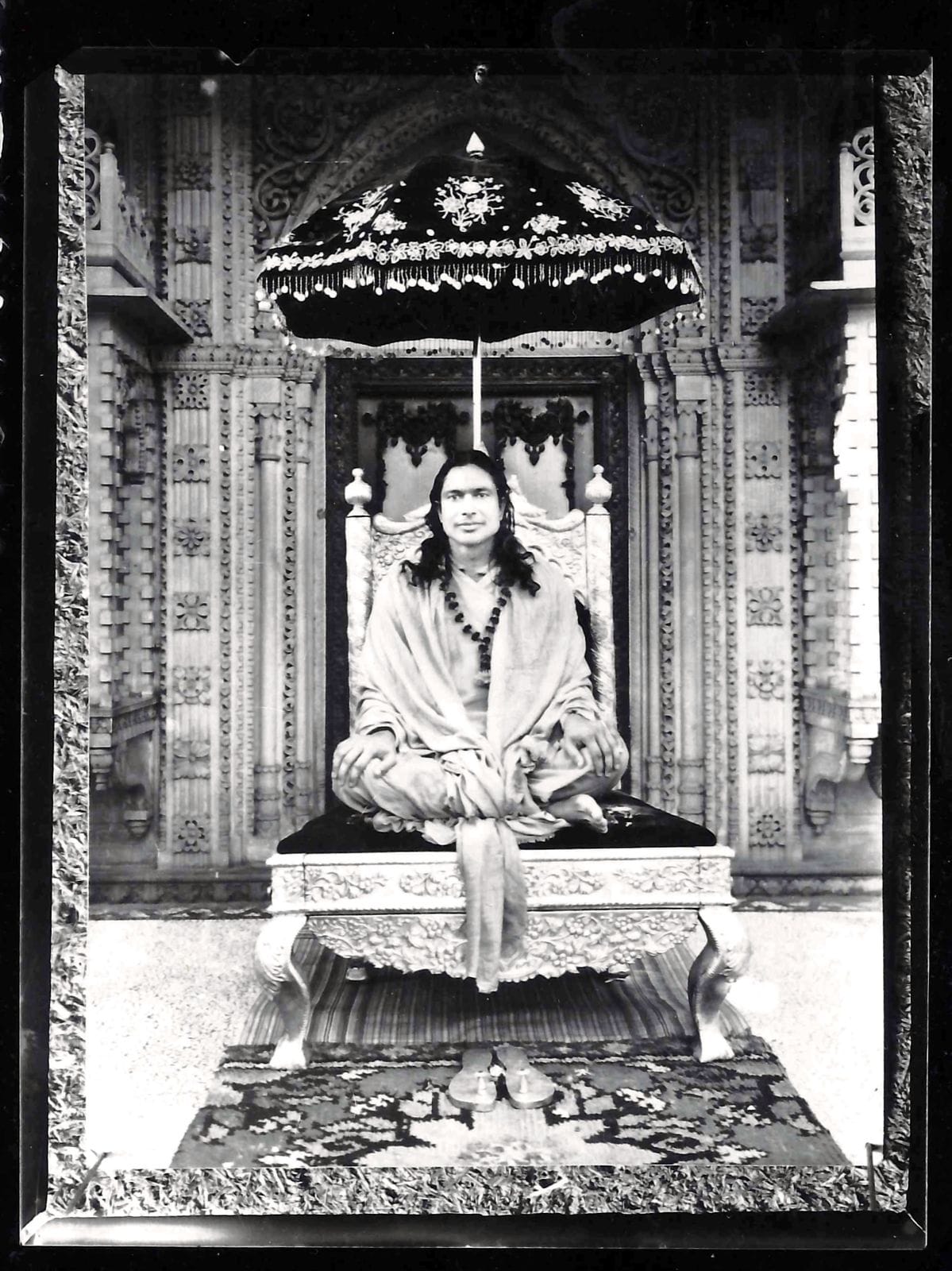
On 14 January 1957, the auspicious occasion of Makar Sankranti, the Kashi Vidvat Parishad (काशी विद्वत् परिषद्) conferred the title Jagadguruttam — Supreme among Jagadgurus upon Shri Kripalu Ji Maharaj.
The recognition followed a series of remarkable scholarly encounters beginning at Chitrakoot in 1955 and continuing at Kanpur in 1956. At Kashi, Maharaj Ji presented an extraordinary demonstration of his command of the Vedic Scriptures, challenging scholars to examine arguments drawn from the scriptures themselves.
The recognition is preserved in JKP historical records, a photograph of the ceremony, and a Sanskrit offering known as the Padya-Prasunopahar.
The Events Leading to Kashi
Chitrakoot, 1955
At the Chitrakoot Sammelan in 1955, Shri Maharaj Ji served as President of the Welcome Committee.
Scholars representing different philosophical traditions attended the gathering. Maharaj Ji placed before them foundational questions concerning apparently contradictory scriptural statements and philosophical conclusions.
When the scholars could not reconcile these positions, Maharaj Ji was requested to explain them. He demonstrated how the apparently conflicting teachings could be reconciled.
Among the scholars associated with the gathering were Mahamahopadhyay Shri Giridhar Sharma Chaturvedi and Neel Meghacharya of Kashi.
JKP historical accounts describe their favorable assessment of Maharaj Ji's scriptural knowledge.
Read: Chitrakoot Convention (1955)
Kanpur, 1956
The Second All-India Convention of the Akhil Bharatvarshiya Bhakti Yoga Darshanic Mandal took place in Kanpur from 5 to 19 October 1956.
Among the scholars who attended was Acharya Shri Rajnarayan Shukla Shatshastri, Chief Secretary of the Kashi Vidvat Parishad and a distinguished scholar of the six traditional systems of Indian philosophy.
Acharya Shukla had an established record of Sanskrit scholarship, including the editing and annotation of classical texts. He was closely associated with Kashi's tradition of shastrartha and later served as President of the Kashi Vidvat Parishad.
After hearing Maharaj Ji's exposition at Kanpur, Acharya Shukla publicly acknowledged his extraordinary scriptural mastery.
On 19 October 1956, he declared before the assembled scholars that the pandits of Kashi did not readily recognize anyone as a master of the scriptures. Such recognition followed careful examination and scriptural debate.
Having heard Maharaj Ji's exposition, he expressed his recognition of Maharaj Ji's exceptional knowledge.
His declaration preceded the formal recognition at Kashi by approximately three months.
Read: Kanpur Convention (1956)
Read: Acharya Rajnarayan Shukla's Public Declaration
The Kashi Vidvat Parishad
Kashi (Varanasi) has long been a renowned center of Sanskrit learning, Vedic scholarship, and philosophical debate.
The Kashi Vidvat Parishad (काशी विद्वत् परिषद्) was an established assembly of distinguished scholars associated with this intellectual tradition. According to JKP's published historical accounts, the Parishad comprised approximately 500 scholars at the time of Shri Kripalu Ji Maharaj's recognition in 1957.
Its scholars represented traditional disciplines including the Vedas, Vedanta, Sanskrit grammar, Nyaya (logic), and the philosophical systems of India. Their scholarly tradition emphasized shastrartha—the rigorous examination of philosophical propositions through scriptural evidence, reasoning, objections, and responses.
The scholarly standing of individuals associated with the Parishad can also be established through independent historical records. The Government of India's Report of the Sanskrit Commission, 1957 identifies Raj Narayan Shukla as Secretary of the Kashi Vidvat Parishad during the Commission's visit to Varanasi in March 1957. His Sanskrit scholarship is further documented through published editions and commentaries on classical texts.
The recognition of Shri Maharaj Ji by this scholarly body is particularly significant in light of the scriptural demonstrations preserved in JKP's historical accounts.
The Extraordinary Challenge Concerning the Vedas and Gita
JKP historical accounts describe a remarkable demonstration presented by Shri Maharaj Ji before scholars at Kashi.
He announced that he would prove, using the Vedas and Bhagavad Gita themselves, that these scriptures were worthless.
He then presented arguments drawn from the Vedas and Gita to support that proposition.
Having completed his demonstration, Maharaj Ji challenged the assembled scholars to refute his arguments the following day.
The challenge was deliberately provocative. He was not expressing his own rejection of the Vedas or Bhagavad Gita. He was demonstrating what could apparently be established by arguments constructed from scriptural passages.
The Challenge to the Scholars
Maharaj Ji invited the scholars to examine his arguments and identify any errors.
The account records that no one came forward with a successful refutation of the proposition he had presented.
He then announced that he would demonstrate the opposite conclusion.
The Reversal — No Scriptures Superior to the Vedas and Gita
Maharaj Ji declared that there had never been, were not, and would never be any scriptures superior to the Vedas and Bhagavad Gita.
Once again, he used the Vedas and Gita themselves.
He established the authority of the Vedas through the Vedas and Gita, and the authority of the Gita through the Vedas and Gita.
The contrast between the two demonstrations was extraordinary.
In the first, he had constructed arguments against the scriptures using their own statements. In the second, he used those same scriptural authorities to establish their unparalleled greatness.
The account thus records not two contradictory beliefs held by Maharaj Ji, but two opposing propositions presented in a scholarly demonstration.
The assembled scholars had been challenged to examine his reasoning, and the demonstration revealed the depth of his command of the scriptures.
The Recognition at Kashi — 14 January 1957
On Makar Sankranti, 14 January 1957 (Vikram Samvat 2013), the Kashi Vidvat Parishad formally recognized Shri Kripalu Ji Maharaj with the title Jagadguruttam.
A historical photograph preserved in the archives of Jagadguru Kripalu Parishat (JKP) records the ceremonial presentation.
The photograph was published in Adhyatma Sandesh, a JKP publication, with a caption identifying Mahamahopadhyay Shri Giridhar Sharma Chaturvedi, President of the Kashi Vidvat Parishad, as the scholar presenting the Jagadguruttam recognition to Maharaj Ji.
Giridhar Sharma Chaturvedi was a distinguished Sanskrit scholar whose standing is also documented in the 1957 Sanskrit Commission report.
His association with the Chitrakoot gathering connects the earlier scholarly encounters with the subsequent recognition at Kashi.
Historical photograph caption: Shri Kripalu Ji Maharaj receiving the Jagadguruttam recognition from Mahamahopadhyay Shri Giridhar Sharma Chaturvedi, identified as President of the Kashi Vidvat Parishad, on Makar Sankranti, 14 January 1957.
The Padya-Prasunopahar — A Sanskrit Record of the Recognition
The recognition is also preserved in the Padya-Prasunopahar (पद्यप्रसूनोपहार), a Sanskrit poetic offering consisting of seven verses.
The composition honors Maharaj Ji's scriptural mastery and spiritual exposition. Its fifth verse explicitly uses the designation Jagadguruttam.
The surviving document bears the names of two scholars:
Narayan Shastri (नारायणशास्त्री) — designated Adhyaksh.
Rajnarayan Shukla (राजनारायणशुक्लः) — designated Mantri.
Rajnarayan Shukla's appearance on this document is especially noteworthy because he had publicly acknowledged Maharaj Ji's extraordinary scriptural knowledge at Kanpur in October 1956.
The Sanskrit offering and the historical photograph provide complementary records of the recognition.
The photograph preserves the ceremonial presentation, while the composition preserves the scholarly tribute in Sanskrit.
Read: Padya-Prasunopahar (1957)
The Title Jagadguruttam
Jagadguruttam (जगद्गुरुत्तम) means Supreme among Jagadgurus.
JKP historical publications preserve additional honorifics associated with the recognition, acknowledging Maharaj Ji's mastery of the scriptures, reconciliation of philosophical systems, and exposition of Bhakti Yog.
The Sanskrit forms and meanings of these honorifics are examined separately, allowing the account of the Kashi proceedings to remain focused on the historical events.
From Chitrakoot to Kanpur to Kashi
The recognition of 14 January 1957 followed a documented progression.
At Chitrakoot in 1955, Maharaj Ji reconciled foundational philosophical questions before scholars representing different traditions.
At Kanpur in October 1956, Acharya Rajnarayan Shukla publicly acknowledged Maharaj Ji's extraordinary scriptural mastery.
At Kashi, JKP historical accounts describe his demonstration concerning the Vedas and Bhagavad Gita, while the surviving photograph and Sanskrit offering document the formal Jagadguruttam recognition.
Together, these records preserve the circumstances and significance of the title conferred upon Shri Kripalu Ji Maharaj.
Historical Sources
JKP historical records: Accounts of the scholarly encounters at Chitrakoot, Kanpur, and Kashi, including the Veda–Gita demonstration.
Historical membership and leadership: JKP's published accounts describe the Kashi Vidvat Parishad as comprising approximately 500 scholars in 1957. A 2022 Amar Ujala report independently records Rajnarayan Shukla among the Parishad's former presidents.
JKP photographic archives and Adhyatma Sandesh: The original recognition photograph is preserved in JKP's archives. Its published caption identifies Mahamahopadhyay Shri Giridhar Sharma Chaturvedi as presenting the Jagadguruttam recognition on 14 January 1957.
Padya-Prasunopahar (1957): The Sanskrit offering containing the Jagadguruttam designation and bearing the names of Narayan Shastri and Rajnarayan Shukla.
Report of the Sanskrit Commission, 1957: Independently documents the scholarly standing of Mahamahopadhyay Shri Giridhar Sharma Chaturvedi and identifies Shri Raj Narayan Shukla as Secretary of the Kashi Vidvat Parishad during the Commission's visit to Varanasi in March 1957.
Report of the Sanskrit Commission, 1957
CiNii Books — National Institute of Informatics, Japan: Its academic bibliographic catalog documents Sanskrit works edited and annotated by Acharya Rajnarayan Shukla, including publications from the 1930s and 1940s, independently establishing his scholarly work before the Kanpur convention of 1956.
CiNii Books — Rajnarayan Shukla
JKP historical publications: Preserve the recognition and associated honorific titles.
JKP — Jagadguruttam Shri Kripalu Ji Maharaj