Karm — The Path of Vedic Action
The Question That Arises
Once a true Saint is recognized,
a natural question follows:
Which path should be followed to attain God?
The scriptures describe multiple approaches.
But they are not all equal.
To understand this clearly,
we must first understand what “action” really means.
Understanding Action
All actions fall into four categories:
- Karm — good actions (as prescribed by scriptures)
- Vikarm — bad actions (against scriptures)
- Akarm (Karm Yog) — actions performed with devotion to God
- Karm Sannyas — renounced action with devotion
At first glance, this seems straightforward.
But the deeper reality is very different.
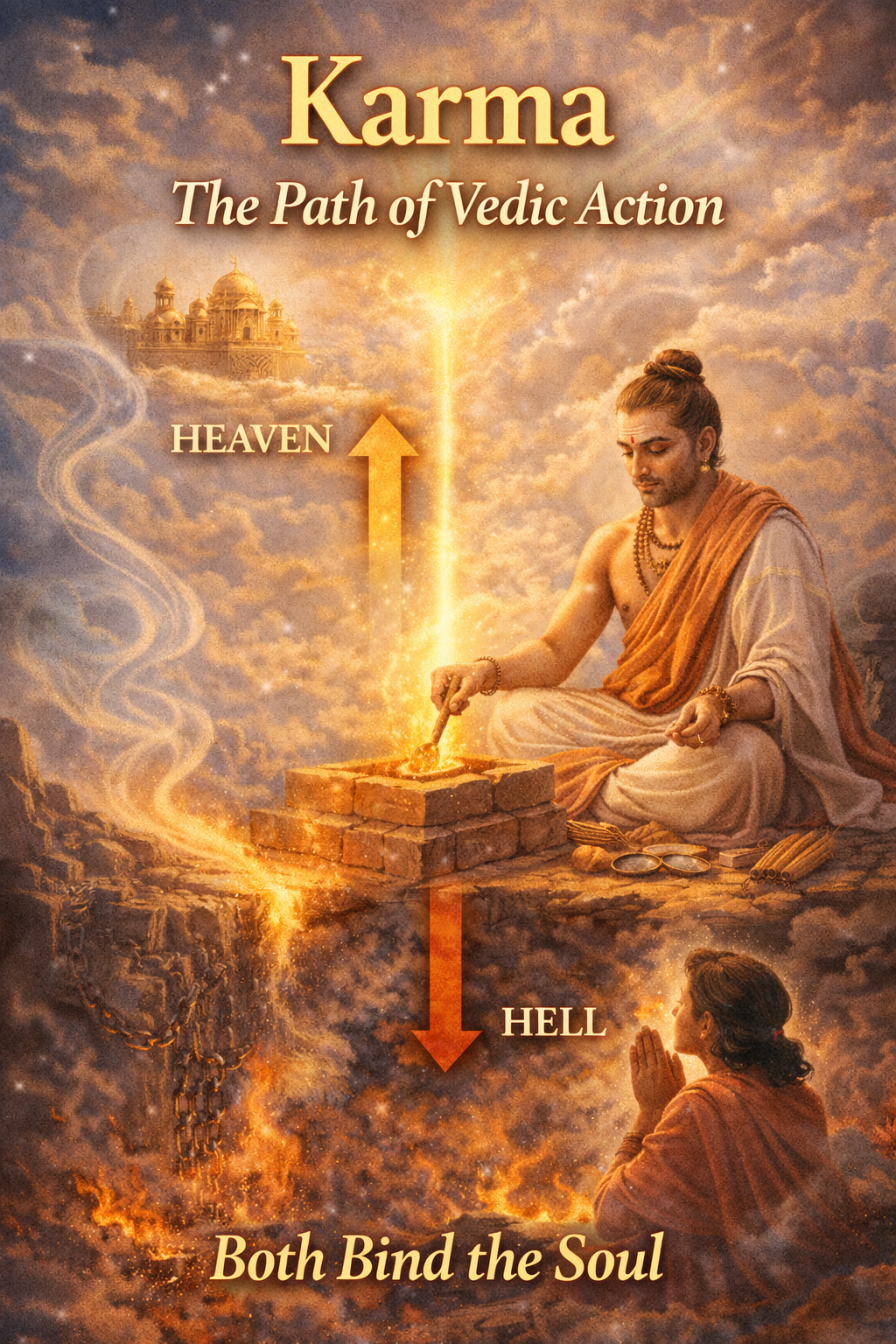
Good and Bad Both Bind
We naturally think:
- Good actions lead upward
- Bad actions lead downward
This is true—but incomplete.
Good actions lead to:
- celestial abodes
- temporary happiness
Bad actions lead to:
- suffering
- lower states
But both have one thing in common:
They bind.
After enjoying heaven,
the soul returns.
After suffering in lower states,
the soul returns.
Even a mix of good and bad actions
leads back to human life.
So the cycle continues—
not because we act,
but because we remain attached.
The Limitation of Karm
Scripturally prescribed actions must be:
- performed correctly
- with exact discipline
Even a small mistake
can change the result.
But even when performed perfectly,
the result is limited.
At best, it leads to temporary elevation.
More importantly:
Karm cannot purify the mind completely.
It can remove specific consequences.
But not the tendency behind them.
A person may:
- commit a wrong
- perform atonement
- become free of that consequence
But the inner tendency remains.
So the cycle repeats.
This is why action alone
cannot lead to liberation.
The Turning Point
The problem is not action.
The problem is attachment.
If the mind is attached to the world,
action binds.
If the mind is attached to God,
the same action frees.
This is the shift from:
Karm → Karm Yog
What Is Karm Yog
Karm Yog is:
Performing all actions
while keeping the mind attached to God.
Nothing external changes.
- duties continue
- responsibilities remain
But internally:
the direction of the mind changes.
Now:
- action happens
- attachment is not to the result
- the mind remains with God
In this state:
action no longer binds.
Why Karm Yog Frees
A person receives the consequence of action
only when the mind is attached to the world.
When the mind is absorbed in God:
- action continues
- but binding stops
So through Karm Yog:
- karmic bondage ends
- the mind becomes purified
- and the soul moves toward God
Karm Sannyas
There is another path:
Karm Sannyas — renouncing Vedic and social duties,
and performing only what is necessary to sustain the body,
while remaining devoted to God.
This also leads to God realization, because devotion is present.
So then a question arises:
If both Karm Yog and Karm Sannyas lead to the same goal,
why act at all?
Why Karm Yog Is Superior
The answer is practical.
People imitate what they see.
But imitation happens only at the external level,
not internally.
If someone imitates a Karm Yogi:
- they will at least perform good actions
- discipline is maintained
But if someone imitates a renunciate:
- they abandon duties
- without inner devotion
- they fall into disorder
So for most people:
Karm Yog is safer and superior.
The Central Principle
At this point, the teaching becomes clear:
Action itself is not the problem.
Action without God is.
- Good action without God → binding
- Bad action → binding
- Action with God → liberating
So the real transformation is not:
“What am I doing?”
But:
“Where is my mind?”
What the Scriptures Emphasize
Across all scriptures, one principle repeats:
Whatever you do—
do it for God.
- eat → for God
- work → for God
- give → for God
- perform duties → for God
When the mind is offered,
action becomes worship.
The Limitation of Ritual Alone
Without devotion:
- rituals become effort
- discipline becomes mechanical
- actions remain external
Even if sin is reduced,
the mind remains unchanged.
And as long as the mind is not purified,
the cycle continues.
So liberation cannot come from action alone.
The Role of Karm
Karm still has a place.
For those who:
- lack faith
- are deeply attached
- seek worldly or celestial rewards
It provides:
- structure
- discipline
- gradual refinement
But it is not the end.
The Higher Distinction
Scriptures describe two kinds of dharm:
Apar Dharm (lower)
- social duties
- changing rules
- temporary results
Par Dharm (higher)
- devotion to God
- eternal
- leads to Divine love
Karm belongs to the lower order.
Bhakti belongs to the higher.
The Resolution
At this point, the direction becomes clear:
- Vikarm must be rejected
- Karm is limited
- Karm Yog is praiseworthy, because action is made subservient to devotion to God
- But only devotion completes the journey
Final Realization
Action done for the world binds.
Action offered to God frees.
But only devotion leads to God.
The Next Inquiry
If action alone is not enough,
and action must be transformed through devotion,
then another question arises:
The path of knowledge (Gyan) is often praised as a means to liberation.
But can it, by itself, lead to God?