
Impersonal and Personal Aspects of Brahm — The Clarity
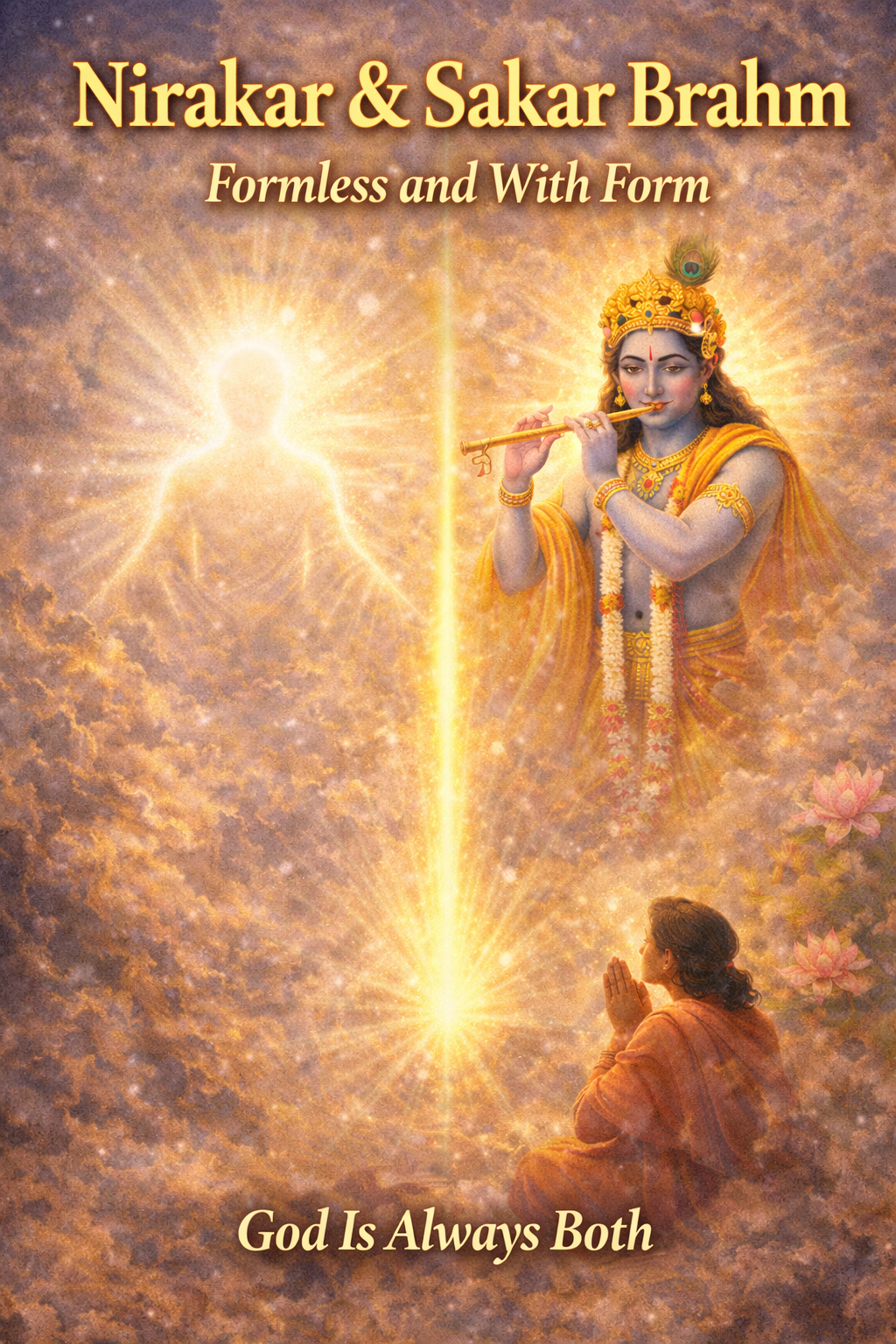
The Definitive Statement
God is one.
He is simultaneously:
- nirakar (formless)
- sakar (with a Divine form)
Both coexist eternally.
This has already been established in Brahm — The Supreme God.
The Problem
The mind seeks a form to attach to.
Yet God is also described as formless.
This creates a natural confusion.
The intellect objects:
- “If God has a form, how can He be everywhere?”
- “If He is formless, how can He take form?”
- “If He takes form, does He cease to be all-pervading?”
These doubts arise naturally.
They arise from a mistake.
The Root Error
God is judged using material logic.
In the material world:
- one state excludes another
- form and formless cannot coexist
So the mind concludes:
God must be either:
- nirakar
- or sakar
But not both.
Where the Confusion Arises
This is a contradiction for us.
But God is all-capable.
To declare something impossible for Him
based on our limitation
is a mistake born of our limited understanding.
To limit Him to one mode
is to impose limitation on the unlimited.
God is the abode of mutually contradictory qualities
(see Abode of Contradictory Qualities).
Common Misconceptions
“If God has a form, He cannot be omnipresent”
This assumes form creates limitation.
God’s form is not material.
It does not restrict Him.
“If God becomes personal, He stops being formless”
This assumes one state replaces another.
God does not transform like matter.
He remains as He is.
He remains both formless and with form simultaneously.
“Formless is higher, form is lower”
This arises from incomplete understanding.
Both are Divine.
But they are not experienced in the same way.
The formless is realized as undifferentiated existence.
The personal form is experienced in relationship.
Accordingly, the outcomes differ.
The formless grants Brahm realization (brahmgyan).
The personal form grants Divine Love (premanand).
Even a drop of the bliss of Divine Love
is described in the Vedas
as surpassing the bliss of the formless.
“If God has a form, He should be visible”
This ignores a simple fact:
His form is Divine.
Our senses are material.
Why God Is Not Seen
God is not hidden.
He is not perceived.
Material senses cannot perceive Divine reality.
When the mind is purified through Bhakti,
and Divine Grace is received:
He is experienced.
The Role of Bhakti
God is not revealed by reasoning.
He is revealed when the mind turns toward Him.
Bhakti does not produce God.
It reveals Him
and allows the soul to relate to Him.
What This Resolves
God is not limited to formlessness.
God is not limited to form.
Both are true.
Devotion to a personal form of God
is complete.
The Next Inquiry
God is all-pervading.
God is all-capable.
Then why descension?