Demystifying the Diverse Roop of God
One Actor, Infinite Roles
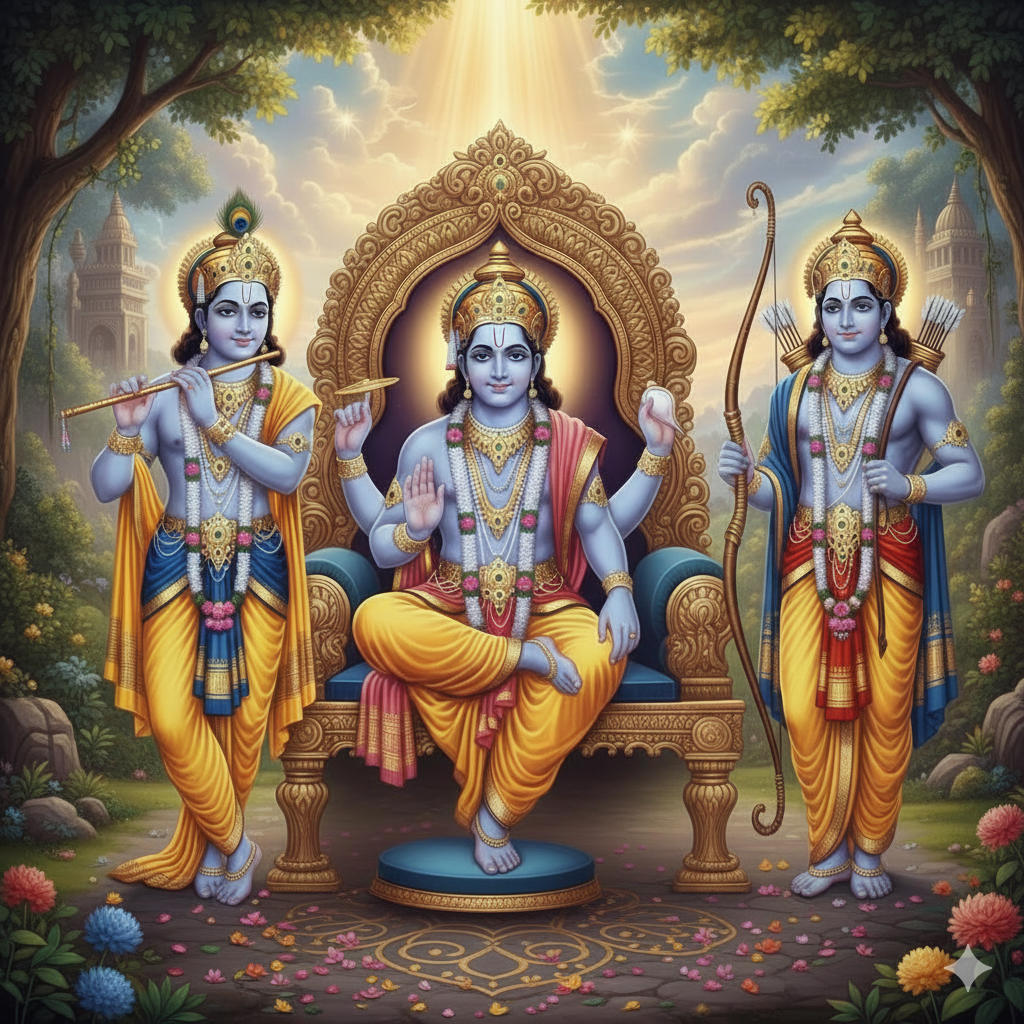
Have you ever wondered why the Supreme Lord appears in so many different ways? Sometimes He is the playful cowherd in Vrindavan, other times the majestic King of Dwarika, or even the white-complexioned Balarama. Are these different Gods, or just different "costumes" of the same Divine Reality?
Just as a single actor can play multiple roles—sometimes appearing as himself, sometimes in disguise, and sometimes merely voicing a character—the Supreme Lord manifests in various categories to reciprocate with the specific moods of His devotees.
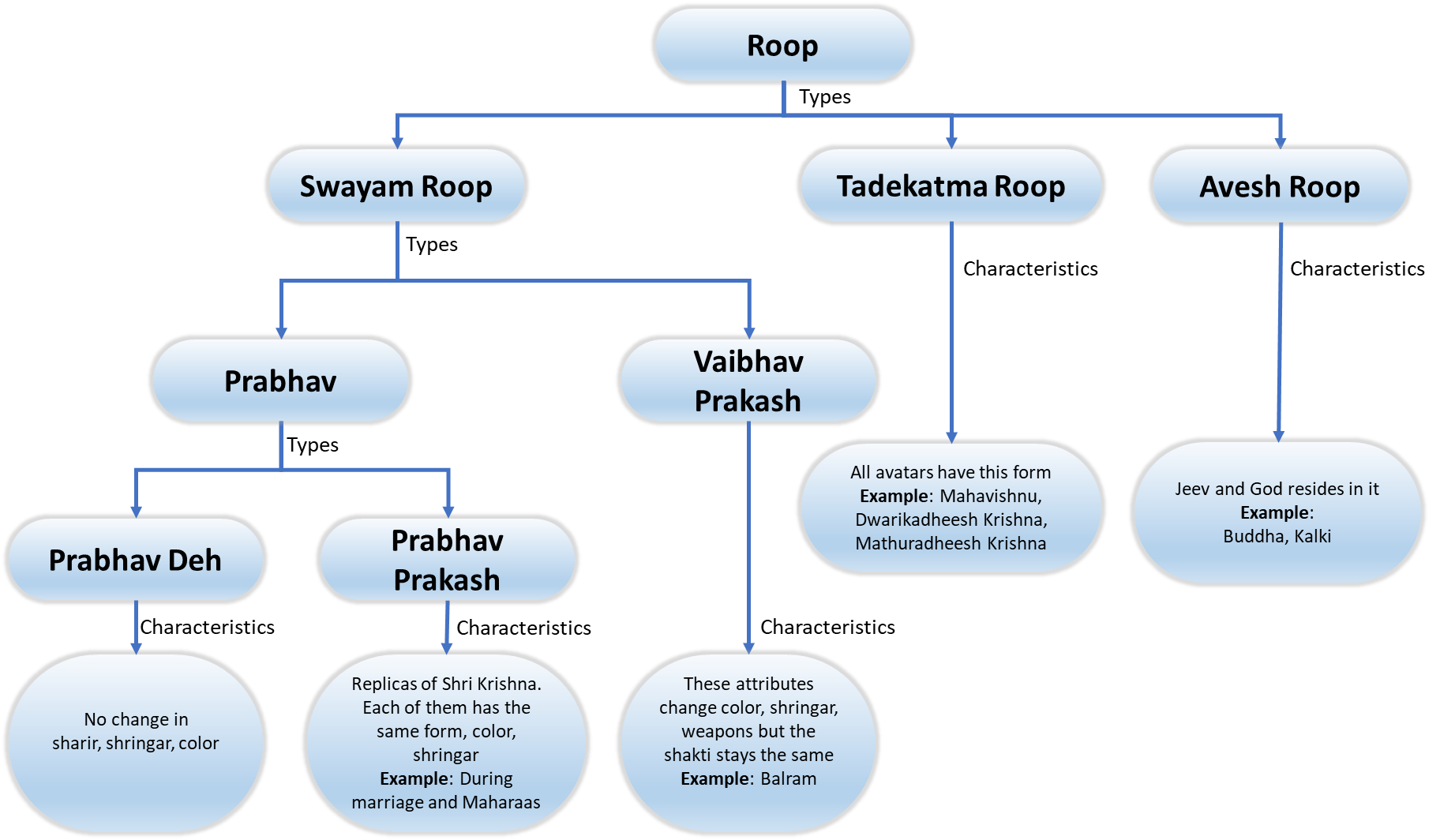
To understand this divine complexity, scriptures categorize His forms into three primary distinct types or Roop (रूप • rūpa).
1. Swayam Roop
Svayam Roop (स्वयं रूप • svayaṁ rūpa) refers to the original form of the Lord—Shri Krishna Himself in Vrindavan. This category is further divided into two types of manifestations: Prabhav and Vaibhav.
- Prabhav (प्राभव • prābhava): This category involves the expansion of forms that are identical to the original.
- Prabhav Deh (प्रभाव देह • prābhava dēha): This is the divine form of Shri Krishna in Golok. There is absolutely no change in the body (sharir), adornment (shringar), or color. It is the original form.
- Prabhav Prakash (प्रभाव प्रकाश• prābhava prakāśa): This involves the Lord making duplicates of Himself. Each duplicate possesses the exact same form, color, and adornment as the original.
- Example: The forms Krishna took during the Maharaas to dance with every Gopi, or the forms He assumed to marry the 16,108 queens.
- Vaibhav Prakash (वैभव प्रकाश • vaibhava prakāśa): In this manifestation, the attributes like body color, dress, and weapons change, but the internal identity and power (shakti) remain exactly the same as the Swayam Roop.
- Example: Lord Balarama is the primary example. He is identical to Krishna in power but differs in complexion (white vs. dark) and dress. His weapon of choice is a plough.
2. Tadekatma Roop
Tadekatma Roop (तदेकात्म रूप • tadēkātma rūpa) describes forms that are non-different from the Supreme Lord but may differ in physical appearance or mood to perform specific pastimes. This category generally encompasses the primary Avatars.
- Examples: Mahavishnu, Dwarikadheesh Krishna (The King of Dwarika), and Mathuradheesh Krishna (The King of Mathura).
3. Avesh Roop (The Empowered Form)
Avesh Roop (आवेश रूप • āvēśa rūpa) The Avesh Roop refers to instances where God does not descend in His direct form. Instead, He enters or resides (āvēśa) a qualified jeev with His specific potency to perform specific functions.
- Examples: Lord Buddha and Kalki (prophesied).