Understanding the Mind’s Endless Craving
Why do we crave infinite bliss? From ants to Brahma, every being seeks Ananda. Discover why material desires fail and the spiritual root of our endless longing.
The human mind is in a state of perpetual seeking. Whether it is a better job, a bigger house, or a new relationship, we are driven by an endless craving (Devanagari: अनन्त तृष्णा; ISO 15919: ananta tr̥ṣṇā). But have you ever wondered why, even after achieving our goals, the sense of satisfaction is so fleeting?
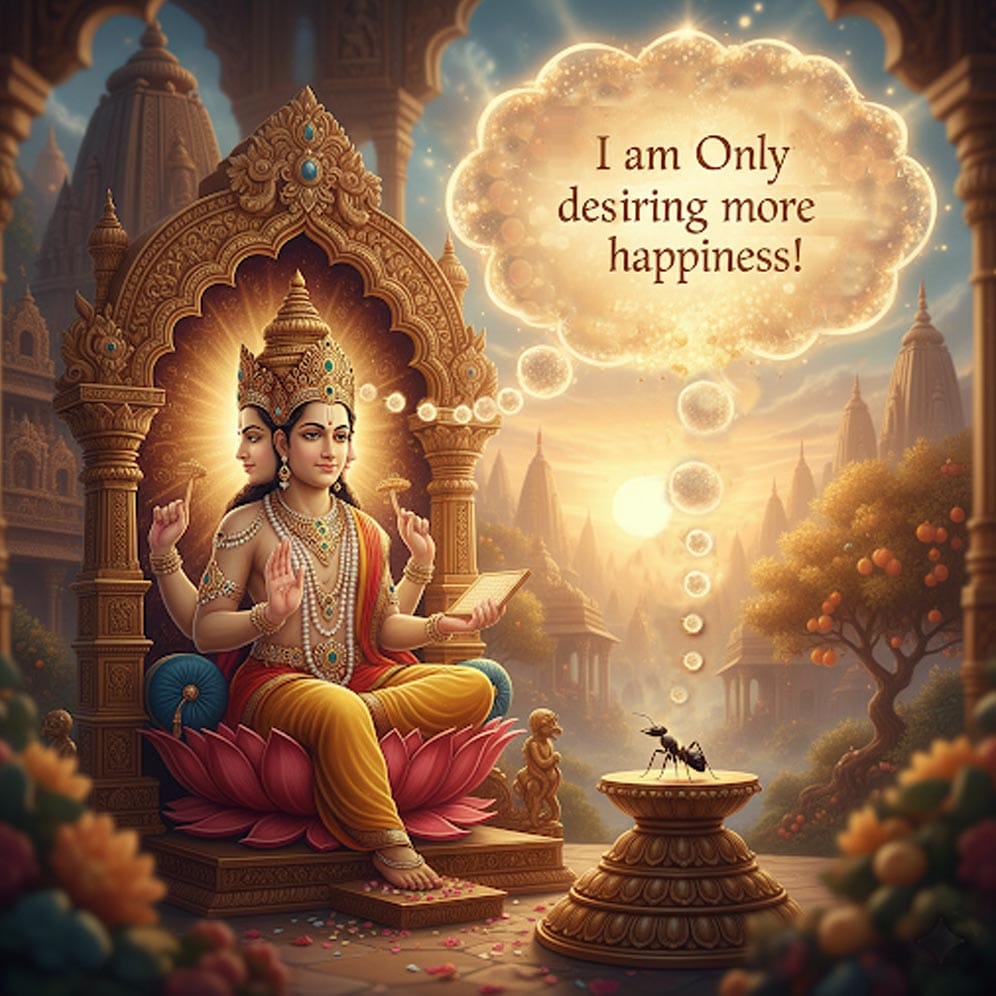
That is because from an insignificant ant or the creator Lord Brahma, all the living beings have only one desire; attainment of unending, ever growing and ever-new Bliss.
Upon deep contemplation, we understand that this desire is not an acquired habit but our innate nature. Through every action we perform—however contradictory they may appear—our sole objective is to attain that happiness.
The Vedic Explanation of Desires
This natural desire for bliss is constant and continuous. Unfortunately, the jeev does not know the real definition of bliss or the path to achieve it. In the absence of this crucial knowledge, the jeev develops numerous desires for material objects, hoping to derive satisfaction from them.
Some desires get fulfilled, while others do not. Yet, in either case, the dissatisfaction, discontentment and discord remain unchanged. This situation will not change until the jeev attains what it truly desires.
The Misguided Search
All material desires can be classified into five categories, corresponding to the five gyanendriyan (five senses of knowledge): sight, hearing, smell, taste and touch. Even abstract desires like fame, power, or wealth are ultimately enjoyed through these senses (e.g., hearing praise, seeing one's dominion).
However, no matter how much matter is fed to these senses, the craving never subsides. The eyes seek the most beautiful sights, and the tongue seeks the most delicious tastes. We naively aspire to extract unsurpassable bliss from limited objects.
Saint Tulsidas reveals the limitation of this approach:
गो गोचर जहँ लगि मन जाई । सो सब माया जानेहु भाई ॥
go gocara jaham̐ lagi mana jāī । so saba māyā jānehu bhāī ॥
"As far as the senses, mind and intellect can reach, know it all to be material realm"
Because the senses and mind are created from the material subtle elements (Panchtanmatra), their reach is limited strictly to the material realm. Despite all their effort the spiritual void continues to torment.
Why Material Objects Fail to Satisfy the Soul
Since this topic is beyond the reach of the material mind, we must seek clarification from the scriptures on who the seeker trying to please. God is Bliss, and the jeev is an eternal, sentient part of that Bliss. The jeev has to be pleased.
- Being a part (Ansha), the soul naturally seeks to become one with its Whole (Anshi).
- The senses, mind and intellect are mere servants of jeev. They work incessantly to please their master.
- However, jeev is divine. It cannot not derive satisfaction from inert material objects.
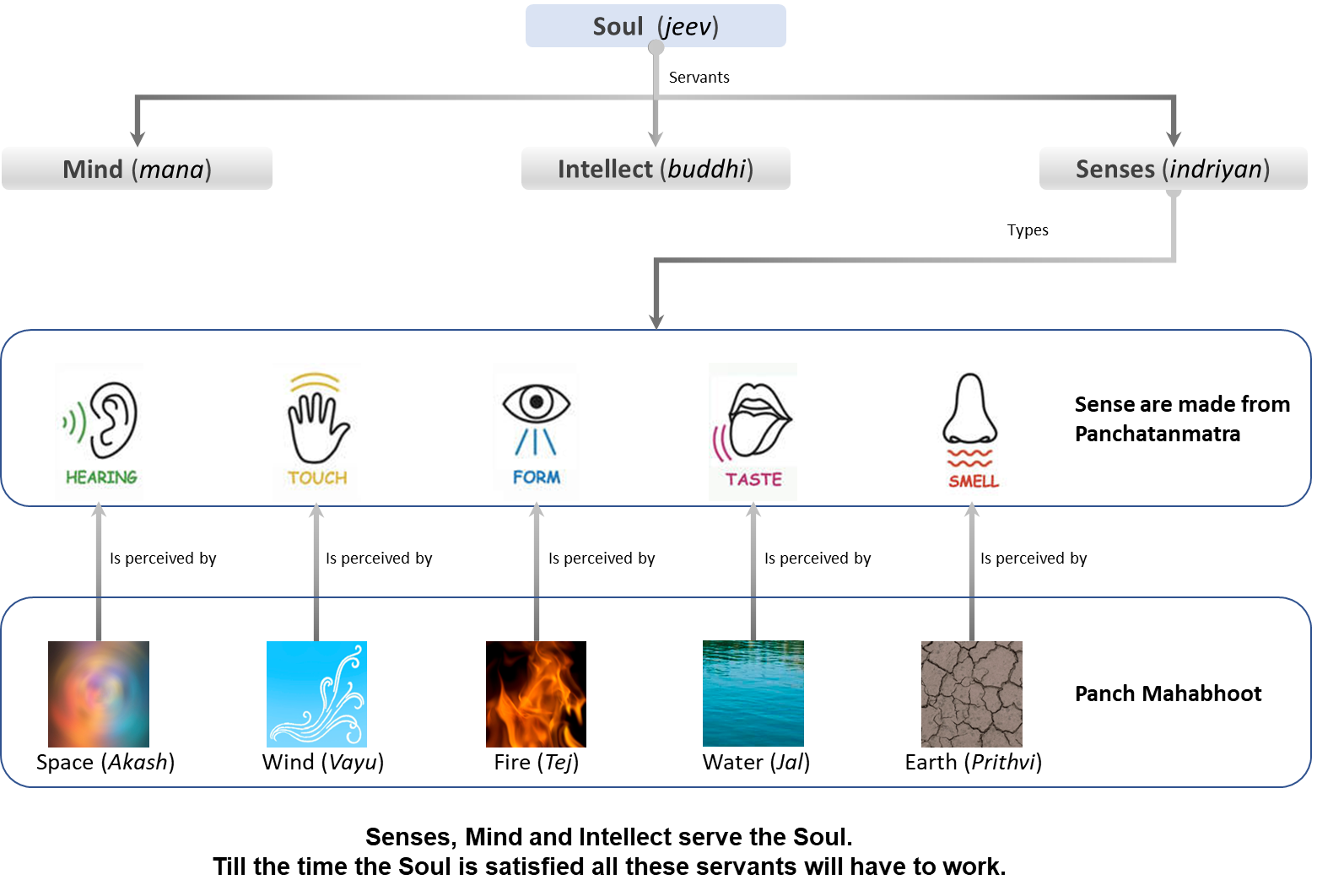
This is why, despite experiencing countless pleasures over lifetimes, the soul continues to search.
Sage Veda Vyasa asserts in the Bhagavatam:
Ved Vyas asserts –
यत्पृथिव्यां व्रीहि यवं हिरण्यं पशवस्त्रियः।
नालमेकस्य पर्याप्तं तस्मात्तृष्णां परित्यजेत् ॥
भागवत
yatpr̥thivyāṁ vrīhi yavaṁ hiraṇyaṁ paśavastriyaḥ।
nālamekasya paryāptaṁ tasmāttr̥ṣṇāṁ parityajet ॥
bhāgavata
" If the entire earth with all of its wealth, grain, gold, animals, and resources were given to one person, it would still not be enough to satisfy the person's desires. therefor, one should abondon this material thirst."
It is the intellect that will have to come to the realization that seeking happiness in the inert and insipid world is like churning white limestone water in anticipation of getting butter out of it. Limestone does not have butter, so no amount of churning can yield butter. So, continued effort in this area is simply a waste of time.

The Cycle of Misery
It is the intellect that mistakenly decides there is bliss in objects and inspires the mind to acquire them.
- Greed: If the object is acquired, the thirst is not quenched; instead, a desire for more arises.
- Anger: If the object is not acquired, it gives rise to anger, enmity, and repulsion.
The Bhagavad Gita (referenced here as Bhagavat 2.62-63) explains this chain reaction:
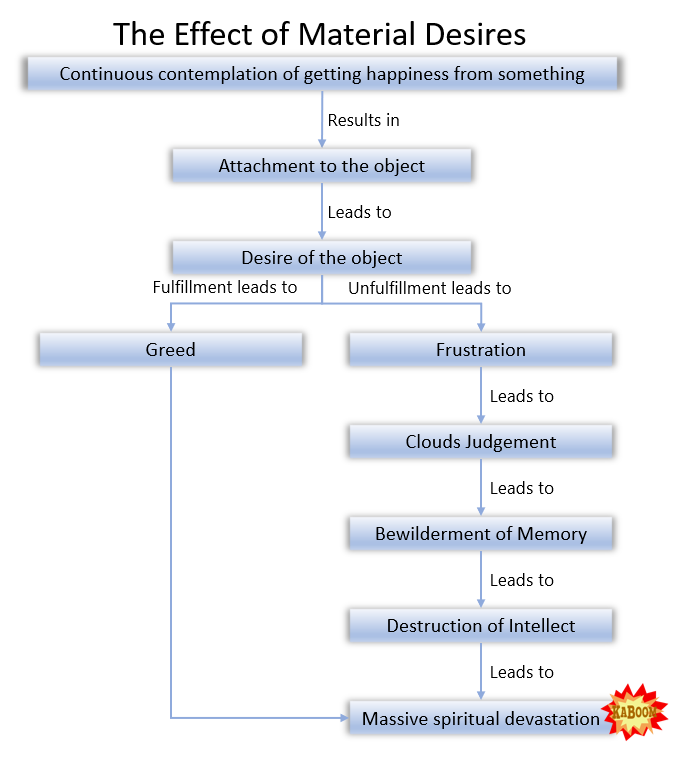
ध्यायतो विषयान्पुंस: सङ्गस्तेषूपजायते | सङ्गात्सञ्जायते काम: कामात्क्रोधोऽभिजायते ॥ dhyāyatō viṣayānpuṁsa: saṅgastēṣūpajāyatē | saṅgātsañjāyatē kāma: kāmātkrōdhō'bhijāyatē ||
"While contemplating the objects of the senses, one develops attachment. From attachment arises desire, and from unfulfilled desire arises anger."
क्रोधाद्भवति सम्मोह: सम्मोहात्स्मृतिविभ्रम: |
स्मृतिभ्रंशाद् बुद्धिनाशो बुद्धिनाशात्प्रणश्यति ||
krōdhādbhavati sammōha: sammōhātsmr̥tivibhrama: | smr̥tibhraṁśād buddhināśō buddhināśātpraṇaśyati ||
"Anger clouds judgment, resulting in bewilderment of memory. When memory is bewildered, the intellect is destroyed; and when the intellect is destroyed, it results in one’s downfall."
The Jeev continues to seek divine bliss. It derives no trace of happiness in any material matter.
The Plight of Humans: The Five-Fold Trap
This lack of satisfaction even after acquiring the objects of material desires results in an ongoing cycle of innumerable desires for each sense.
कुरङ्ग मातङ्ग पतङ्ग भृङ्ग. मीनाः हताः पंचभिरेव पञ्च।
एकःप्रमादी स कथं न हन्यते यः सेवते पंचभिरेव पञ्च॥
kuraṅga mātaṅga pataṅga bhr̥ṅga. mīnāḥ hatāḥ paṁcabhireva pañca।
ekaḥpramādī sa kathaṁ na hanyate yaḥ sevate paṁcabhireva pañca॥
- The Deer (Hearing): Loves music and is lured to its death by the hunter's sound.
- The Elephant (Touch): Is trapped in a pit by the lure of the female elephant's touch.
- The Moth (Sight): Is attracted to the light and burns itself in the fire.
- The Bumble Bee (Smell): Gets trapped inside the lotus flower while enjoying its fragrance.
- The Fish (Taste): bites the bait for the taste of flesh and dies.
If these creatures face destruction due to attachment to one sense, imagine the plight of human beings who are slaves to all five?

Conclusion
Constant contemplation of material objects creates Asakti (Devanagari: आसक्ति; ISO 15919: āsakti), or deep attachment. This path is ridden with misery.
Question: Can we attain the goal by just not making any desires?
Jagadguru Shri Kripalu Ji Maharaj: Yes. But we will have to make desires.
Question: Why?
Jagadguru Shri Kripalu Ji Maharaj: Because we are a part of Brahm, the embodiment of divine bliss (and every part naturally wants to be whole).
We cannot stop desiring, but we can change what we desire. The method to leverage this nature will be explained in the sequel:
Transforming desire into divine bliss .