The Sin Scale: From Minor to Unforgivable
Sin is the most despicable theme of religious philosophies all over the world. In Sanatan Dharm , which is commonly known as Hinduism, Dharma defines the ethics and morals of leading a human life. Transgressing from dharma is called adharma and is considered a sin. The intent to follow dharma is to promote socially acceptable behavior/practices and also implement punitive measures to maintain peace and harmony in the world. But the ultimate intent is to encourage us to act in a manner that will release us from the unending series of miseries and to lead us towards the path of unlimited divine bliss. Observing Dharma (धर्म) is called punya and observing adharma is called paap.
Paap and Punya are the twin fruits of karma (actions). They determine the fate or destiny of the beings on this earth. Another word which is used mostly in the Dharmashastras (scriptures) to denote sin is ‘Pātaka’. It is derived from the Sanskrit root word paat (to fall). Pātaka means the actions, responsible for one’s own downfall.
Just like a loving mother, all merciful God employs different tactics to discipline His Children. See the article narak [1] for more details on this.
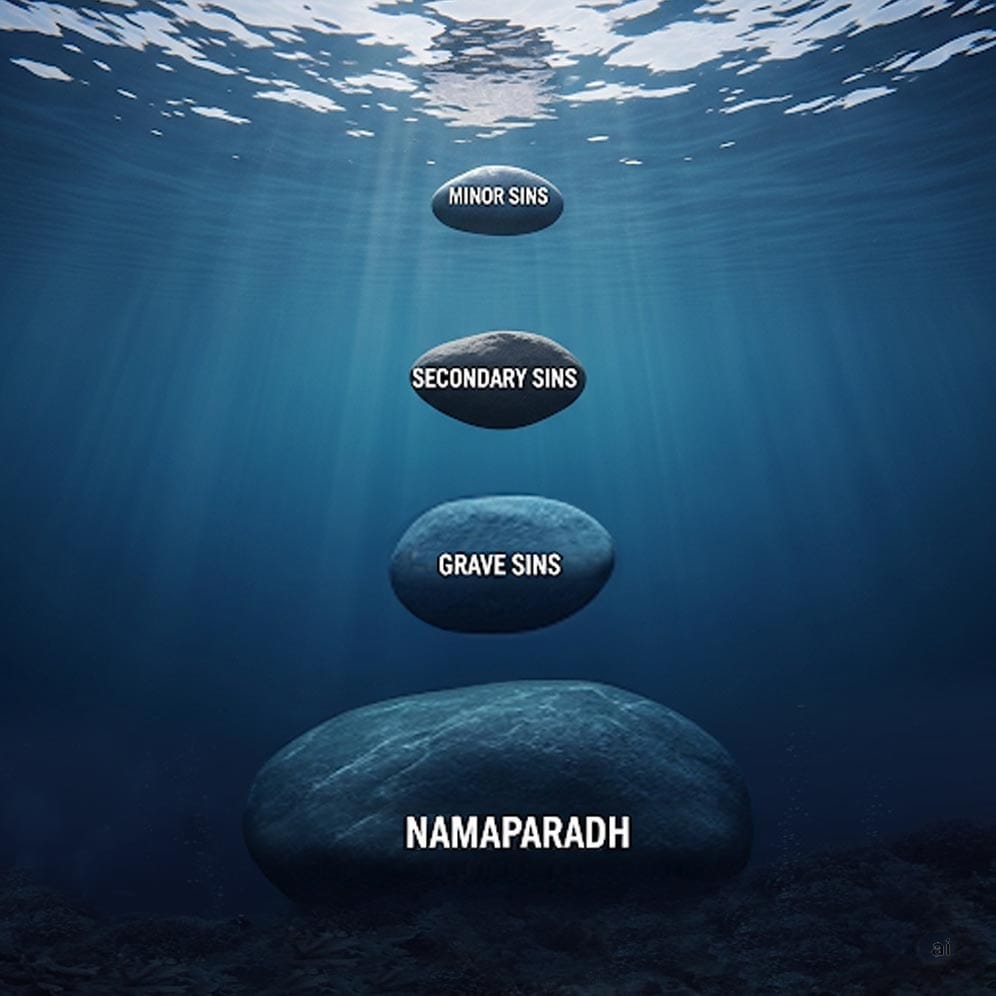
There are three classes of sins
- The grave sins called Maha Pataka
- The Secondary Sins The Upa Pataka
- The Minor sins The Prakirna Patak
And then there are Spiritual transgressions as Namaparadh [2] which are more heinous than all these sins.
Let us delve deeper into these.
The Grave Sins
The gravest of all sins are called Maha Patakas (Devanagari: महा पातक ISO15919: mahā pātaka) . The Dharmashastras identify five to be the gravest sins. So, they are also called the pancha mahapatakas (Devanagari: पंच महा पातक ISO15919: pañca mahā pātaka).
These lead to one’s downfall into the darkest narak [1]. In this narak there is a huge vat full of worms. The offending soul with its subtle body is thrown into that vat. These worms keep on biting into the body. In this narak one does not die to immense pain. Instead they stay alive and keep on yelling and screaming in pain.
Vedas do not prescribe any prayashchit karma [3] to wash away these sins or even reduce their intensity. One has to undergo the sufferings as a consequence of these sins.
Some Puranas suggest that these sins may be overcome through devotion or the grace of God.
According to the Chhandogya Upanishad (5:10.9), following 5 types of sins fall in the grave sins called category -
Killing Brahmin
a. Brahmahatya (Devanagari: ब्रह्म-हत्या ISO15919: brahma-hatyā) or murder of a Brahmin is a grave sin. The definition of Brahmin is,
ब्रह्मं एति इति ब्राह्मणाः ।
“The one who has realized God or the one who can read and teach the Vedas”. So, killing a learned Brahmin is like destroying a significant source of divine knowledge, and thus depriving many inquisitive souls from true knowledge.
Stealing Savings
b. Suvarna-steya (Devanagari: स्वर्ण-स्तेय ISO15919: svarṇa-stēya) or stealing any precious object as gold, or anything which was procured as an investment e.g. stealing life-long savings of a retiree or any such similar act of deception / covetousness. These acts immensely hurt someone, hence is a grave sin.
Intoxication
c. Sura-paan (Devanagari: सुरा-पान ISO15919: surā-pāna) which means consumption of alcohol or any intoxicating substance.
It is considered the worst of all grave sins because intoxication causes immediate imbalance of mind. Subsequently, it harms important parts of body as heart and liver etc. Addiction to alcohol causes the mental disposition to become demonic and one wreaks havoc in his own family. In that madness he can commit any severe sins like suicide and become violent towards others. For which he might be repentant for the rest of his life.
Those who perform other grave sins reap the consequences in later-lives e.g. if one kills a Brahmin but doesn't get caught then the consequences will be faced in after-life. If one steals gold he might not get caught and become rich in this life but will have to suffer in after-life.
Unlike all other maha pataka habitual drinking affects the quality of life in the present. It ruins the person’s mental and physical health. It impacts wealth, spiritual progress and the peace of entire family. That is why this is the gravest of the maha pataks.
Coveting Guru's Spouse
d. Guru-talpa-gaman (Devanagari: गुरु-तल्प-गमन ISO15919: guru-talpa-gamana) means seducing the spouse of gurujan. The word Guru denotes spiritual master, teacher, and mentor, priest etc. any elderly honorable person. It is extremely immoral to defile Guru's bed.
Helping in Performance of Grave Sins
e. Sahayakattva (Devanagari: पाप-सहायकत्व ISO15919: pāpa-sahāyakatva) or assisting in the performance of any of the above sins is also a severe sin. Helping an errant with the sin denotes one’s own intention and interest towards that sin. That is why, per God’s law the helper also undergoes the same punishment as the errant. The extent to which the help was rendered determines the extent of punishment in after-life.
The Secondary Sins
2. These arise from minor offenses and are called The upa patakas (Devanagari: उप पातक ISO15919: upa pātaka). They are not as grave as The maha pataka. The following five offences constitute upa pataka namely
a. Failure to perform daily Vedic rituals [4]
b. Incurring the displeasure of one’s preceptor
c. Selling intoxicating drinks
d. Bearing false witness, making false claims e. Performing a sacrifice for an unworthy person or unworthy cause.
Minor sins
3. Minor offenses which are committed intentionally or unintentionally due to ignorance or carelessness care called The Prakirna Pataks (Devanagari: प्रकीर्ण पातक ISO15919: prakīrṇa pātaka).
There are more than fifty minor sins such as being deceitful, killing a woman, studying Shastras which are prohibited by one’s spiritual master, killing insects and other creatures, adultery, cruelty, disobedience to parents, accepting alms without performing austerities or sacrifices, etc.
These sins can be washed away by performing Vedic rituals ceremoniously, sincere repentance, and seeking forgiveness. God is generous and forgiving. In the Vedas, He has documented a wide array of yagya, worships and ways of atonement to nullify the punishments of these sins [3].
In past uncountable human lives each being has performed uncountable actions. So atoning for uncountable sins will take infinitely long. Plus, a sin is performed in a short period of time whereas atonement takes a long time. So, all sins can never be atoned for; but All-Gracious God forgives all our sins once we completely submit ourselves unto His lotus feet.
Namaparadh
Among all transgressions, none is more serious than namaparadh - spiritual offenses against God, His names, saints, and scriptures. Unlike worldly sins, Namaparadh cannot be erased through rituals, penance, or even divine pardon. Scriptures unanimously warn that these offenses lead to spiritual ruin, resulting in the loss of love for God [5], suffering in lower life forms for several kalpa [6] , and repeated births in the material world.
There are 10 of these and you can know them in greater detail in Namaparadh-Spiritual Transgressions.
Disrespect toward saints is the gravest Namaparadh. Saints are God’s dearest, and dishonoring them—whether through anger, criticism, or apathy—deeply displeases God. Historical examples such as Prahalad and Durvasa, Gadadhar Bhatt and Pundarik Vidyanidhi, or Jagai-Madhai hurting Nityanand, show how storngly God reacts when His saints are mistreated. Similarly, treating one’s spiritual master as an ordinary person causes a catastrophic fall in bhakti.
Other major offenses include disrespecting divine scriptures, doubting or altering the sanctity of divine names, and manipulating them to suit personal ideologies. All names of God—whether Ram, Krishna, or Hari—are equally powerful, and trying to rank them or treat them as imaginary is spiritual ignorance. Even using God’s name casually while continuing sinful actions is a gross misuse of its divine potency.
The glory of God’s names is unmatched. So equating them to karma, dharma, or rituals is undermining their glory. So this is also a namaparadh. Scriptures assert that chanting divine names surpasses the sum of even the greatest of punya put together. Yet, neglecting these names despite knowing Their power—or forcing non-believers to chant them insincerely—are serious offenses that should be avoided with great care.
The Only Way to Overcome Namaparadh
There is no ritual-based atonement for Namaparadh. The only remedy is deep repentance, sincere prayer, and humble surrender [7] at the feet of a Rasik saint [8]. By following his guidance with complete faith and avoiding spiritual offenses—especially against saints, scriptures, and God’s names—one can hope to receive divine grace and attain the supreme goal of divine love and liberation.
LERAN MORE
[2] Namaparadh-Spiritual Transgressions
[4] Nitya karma