Test of Universality
Only in Bhakti, No One is Disqualified
The scriptures describe many ways to reach God—karma, gyan, and bhakti. Yet a sincere seeker often wonders: Are these paths open to me? Or are they only for saints, scholars, and ascetics?
If God is the compassionate Father of all souls, His path must surely be one that anyone can follow—regardless of learning, birth, or circumstance. To find out, let us put each path to the test of universality.
👉 The result is striking: while karma and gyan exclude the vast majority, bhakti alone welcomes every soul without exception.
The Mind – Cause of Bondage and Liberation
Since eternity, the human mind has been chasing the material world in search of bliss. Instead of finding peace, it has become increasingly impure [1] and restless. The scriptures tell us that purification of the mind is the only way to attain true bliss.
In our earlier discussions, we examined three litmus tests for identifying the right path to purification:
- Anvaya is Test of essentiality. This means by this expedient the goal can be attained.
- Vyatireka is Test of indispensability. This means the goal cannot be without this expedient.
- Anya-Nirapekshata is Test of independence. This means this expedient does not need any support from any other other expedient.
Through scriptural evidence and saintly wisdom, we saw that karma (ritualistic action) and gyan (knowledge) fail these tests, while bhakti alone satisfies them.
In this article, we turn to the fourth test—Universality or sarvatrakita (Devanagari: सार्वत्रिकता ISO15919: sārvatrikatā):
👉 Is the path easy and available for everyone, without discrimination or disqualification?
Why Karma Fails the Test
The karmakanda is governed by the ritualistic worship of devi-devatas in svarg. But the rules of karmakanda are so rigid that universality is impossible.
- To even understand the laws of karma requires deep Vedic knowledge.
- To execute them flawlessly is nearly impossible, especially in Kaliyuga.
- Many rituals are forbidden to women and non-Brahmins, immediately excluding a large section of society.
Moreover, the deities themselves are under the bondage of Maya. Just as a servant in a wealthy household must follow strict rules to serve the master, those performing karmakanda must observe six extremely strict conditions. A single violation—even the slightest—angers the deity and results in severe punishment for the host.
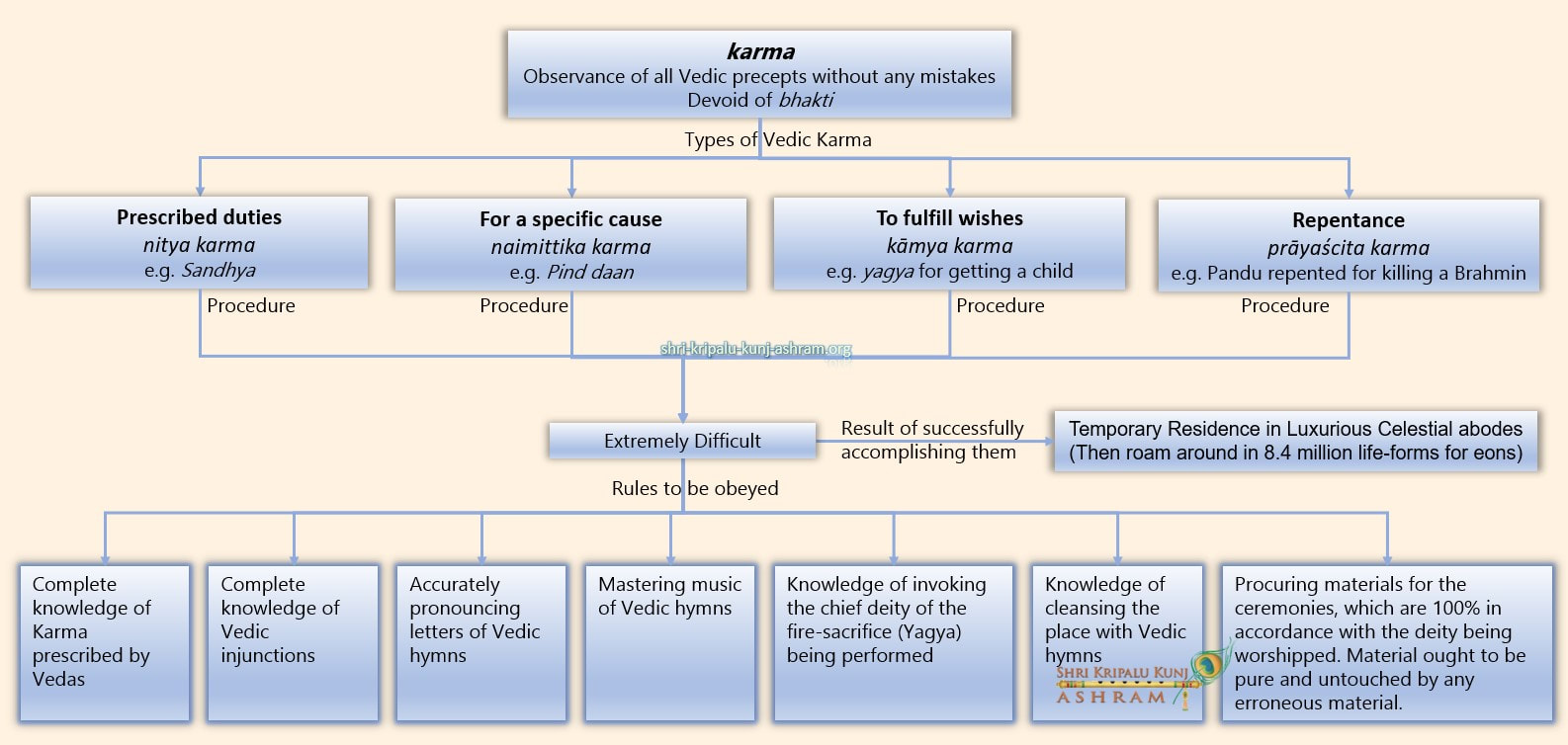
If such rituals were difficult in earlier yugas, in Kaliyuga they are practically impossible. Clearly, karma cannot be universal.
Why Gyan Fails the Test
The path of gyan (knowledge) is even more restrictive.
The scriptures declare:
कहत कठिन समुझत कठिन, साधन कठिन विवेक ।
होहि घुणाक्षर न्याय ज्यों, त्यों प्रत्युष अनेक ॥
kahata kaṭhina samujhata kaṭhina, sādhana kaṭhina vivēka .
hōhi ghuṇākṣara nyāya jyōṁ, tyōṁ pratyuṣa anēka .
“It is difficult to speak of gyan, more difficult to understand, and even rarer to practice.”
ग्यान अगम प्रत्यूह अनेका, साधन कठिन ना मन कहँ टेका ।
gyāna agama pratyūha anēkā, sādhana kaṭhina nā mana kahm̐ ṭēkā.
"The path of gyan is difficult as there is nothing to focus on".
Shankaracharya — The greatest propagator of Gyanmarg — affirmed that Before stepping on this path, one must achieve Sadhan-Chatushtaya—the fourfold discipline :
- Deep discrimination between real and unreal
- An intense longing for mukti
- Detachment from the world
- Control of the mind and senses
Only then can one attempt the meditation and contemplation required to realize Brahm.
Its level of difficulty is so great that even 8 people out of 8 billion will not be eligible to walk on this path. That is a bold statement, so let me illustrate “What does mind control look like?” consider the example of King Janak.
Yagyavalkya was the revered Guru of King Janak. In his classes, he always made King Janak sit in the front row. The other disciples did not like this. They felt it was only because Janak was a king that Guruji gave him such importance.
When Yagyavalkya came to know of their jealousy, he decided to reveal the truth through a divine play of Yogmaya. One day, while teaching, he caused a fire to break out in the huts of the disciples. In those days, students in the ashram owned almost nothing—just a spare loincloth and a kamandal (water pot). As soon as the flames appeared, all the students ran away from the class to save their little belongings.
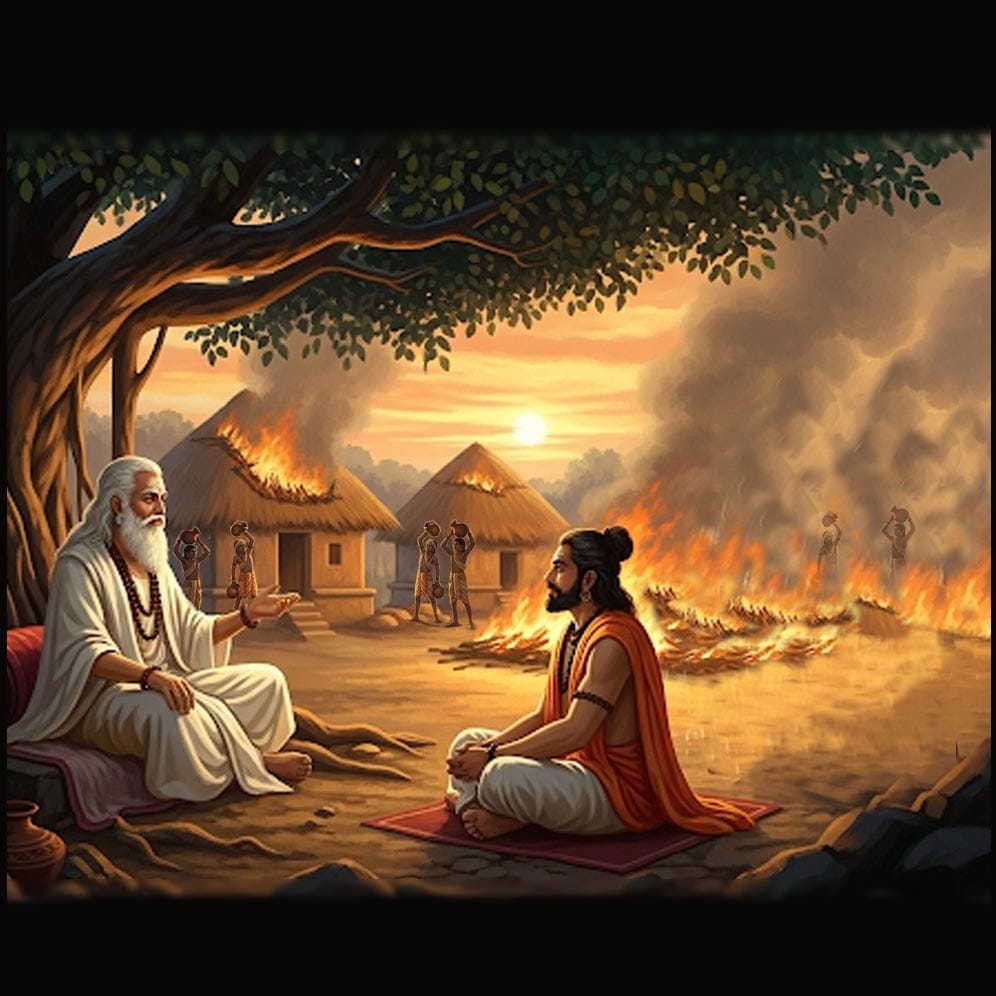
After some time, the fire subsided, and the disciples returned. Yagyavalkya resumed his teaching, but then, through his yogic power, he set Janakpuri—the capital of King Janak—ablaze. Soldiers rushed in and reported that the city was burning. But Janak remained unmoved. Folding his hands, he apologized to his Guru for the disturbance and humbly requested, “Guruji, please continue to explain the characteristics of Brahm.”
A while later, more soldiers arrived breathlessly and cried out, “Maharaj! The queens’ palaces are burning, and the queens themselves are in danger!” Janak calmly reprimanded them: “Go and put out the fire, but do not disturb us again.”
Yagyavalkya then asked him, “Janak, why do you not go when your entire kingdom and even your family are burning?” To this, Janak replied with folded hands, “Gurudev, all these things are temporary. What you are giving me—the knowledge of Brahm—is eternal and will stay with me even after death. That is why I will not leave your feet.”
Turning to the other disciples, Yagyavalkya said, “Do you see the difference? King Janak remained steady, unaffected, and absorbed in knowledge even while his entire kingdom was in flames. Yet all of you abandoned Brahm-gyan the moment your loincloth and water pot were threatened. Now tell me, who truly deserves to sit in the front?”
👉 That level of detachment is the entry requirement for gyan. How many today can meet it? Even in Satya Yuga such souls were rare; in Kaliyuga, they are virtually nonexistent. And after becoming eligible to walk on the path of gyan, the Sadhana to attain Brahmanand is even more difficult.
Thus, gyan too is not universal.
Why Bhakti Alone Passes the Test
At first glance, one may wonder: if even deities require strict rules of worship, shouldn’t worship of the Supreme God require infinitely stricter rules?
Surprisingly, the opposite is true.
Why?
Because God is not only Supreme, but also our eternal Father —gracious, forgiving, and compassionate [2]. Just as a loving father overlooks the faults of his children and patiently guides them, God too has removed all preconditions from the path of bhakti. REMEMBER: He is the one who made the rules and lack there of!
Bhakti requires no prior qualification.
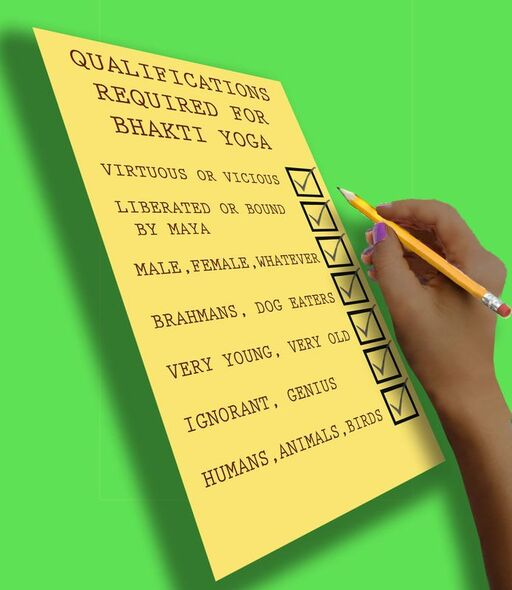
Whether one is learned or ignorant, virtuous or sinful, man or woman, child or elder—everyone is equally eligible. This is because every jiva has at least some detachment from the world (since no worldly joy is lasting) and some natural attraction towards God (since He alone is bliss).
Hence, bhakti is universal.
Who is Entitled To Do Bhakti?
Everyone!
Really? Everyone?
Yes.
Saint Tulsidas says in the Ramayan,
पुरुष नपुंसक नारि नर जीव चराचर कोइ।
सर्व भाव भज कपट तजि मोहि परम प्रिय सोइ।
साधक सिद्ध विमुक्त उदासी, कवि कोविद कृतज्ञ सन्यासी ।
योगी शूर सुतापस ज्ञानी, धर्मनिरत पंडित विज्ञानी ।
तरइ न बिनु सेये मम स्वामी, राम नमामि नमामि नमामि ।
puruṣa napuṁsaka nāri nara jīva carācara koi।
sarva bhāva bhaja kapaṭa taji mohi parama priya soi।
sādhaka siddha vimukta udāsī, kavi kovida kr̥tajña sanyāsī ।
yogī śūra sutāpasa jñānī, dharmanirata paṁḍita vijñānī ।
tarai na binu seye mama svāmī, rāma namāmi namāmi namāmi ।
“Every living being who abandons deceit and sincerely performs devotion to God, is very dear to God”.
To understand this better, let us look at pairs of complete opposites—and see how both are equally entitled to devotion.
Swansh and Vibhinnansh
The three governors of a brahmand—Brahma, Vishnu, and Shankar [3]—are together known as the Tridev. They are not ordinary beings but direct parts (swansh) of God’s and are divine personalities. They govern Swaroop Shakti (God’s inner power) and, despite their exalted position, they too perform bhakti of Shri Krishna.
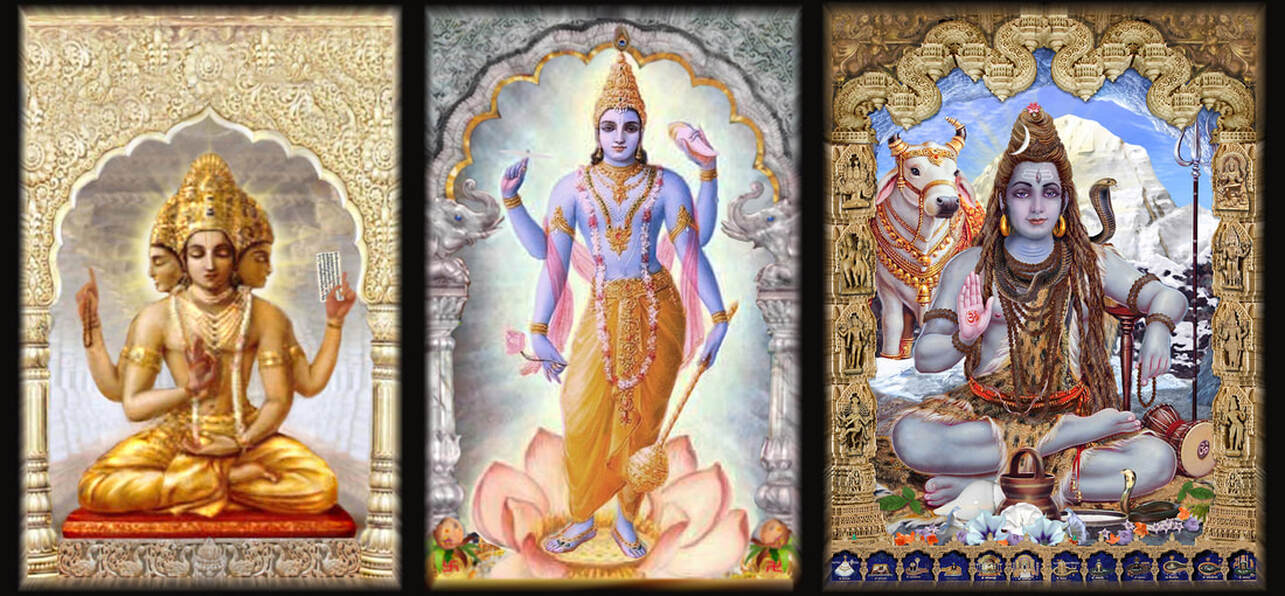
All other living beings like us, who belong to Jeev Shakti, are called vibhinnansh. Though different in category, both swansh and vibhinnansh are equally eligible to perform devotion.
Virtuous as well as Vicious
One who is full of divine qualities is called virtuous. Yet without devotion, such virtues cannot be steady or abundant. Even if someone cultivates good qualities by sheer willpower, they remain temporary. True virtues reside only in those who have attain the bhakti of God [4].
At the same time, even miscreants and sinners have the right to do bhakti. Examples abound—Ajamil, who had lived a sinful life, attained God through remembrance of God at the end [5]. Ganika, a courtesan, reached the highest goal through devotion. Even the dreaded dacoit Ratnakar [6], who was so sinful that he could not even utter the word “Ram,” became the great sage Valmiki through bhakti.
Knowledgeable as well as Ignorant
True knowledge is that which increases love for God. Naturally, learned people are expected to worship Him, yet even the unlearned are equally entitled to devotion.
Dhanna Jat, a simple farmer with no scholarly learning, bound God through his unswerving faith and love [7]. In fact, such innocent love often pleases God where are mere intellectual scholarship does not.
Detached from the World as well as Attached
Some, like King Janak, are deeply detached from worldly attractions. He was so unaffected by material pleasures that he earned the title Videha. Yet even he was enchanted by the divine beauty of Shri Ram in the garden—showing that even the detached do bhakti.
On the other hand, those attached to the material world are the very ones for whom the Vedas and Shastras are written. Though turned away from God since eternity, such souls too have the right to begin devotion and move towards divine love.
Those Under Maya as well as Those Beyond Maya
The mind can never remain empty—it must be attached either to the world or to God. Thus, the truly detached automatically turn toward God.
Even those still bound by Maya are eligible for devotion. The story of Tulsidas is an example: once so infatuated with his wife that he used a snake as a rope to reach her room. When a full grown man climbs up holding a snake, then that would stress the snake. With the pain the snake must have twitched and contorted its body. Tulsidas was so pre-occupied with thoughts of his wife that he didn’t perceive any of that. he later transformed into one of the greatest saints through bhakti.
Those who are enslaved by the sense objects are also entitled to do devotion.
Both liberated and bound souls alike are entitled to devotion.
Liberated Gyanis as well as Gyanis Bound by Maya
Those still bound by Maya must do bhakti to rise beyond it (Mayateet). Even liberated gyanis who had merged in Nirakar Brahm sometimes take human form again for the sole purpose of experiencing divine love.
Shri Maharaj Ji explained that in Lord Ram’s kingdom, not even one person was bound by Maya—all had descended with Him to participate in His divine leelas. Similarly, many great Paramhansas descended into Braj as trees and creepers, just to relish the pastimes of Shri Krishna. They stood rooted in the soil yet inwardly they danced in bliss at the sight of Shyamsundar.
Scholars as well as Illiterates
Great Jagadgurus and learned scholars like Madhusudan Saraswati performed devotion. Yet fools and illiterates are also entitled to worship. In fact, the majority of saints have been simple souls, not scholars. Their innocence and sincerity in bhakti carried them straight to their goal.
Men as well as Women
History remembers countless male saints—Tulsidas, Soordas, Kabir, Nanak, Tukaram, and the five Jagadgurus. But devotion is not limited to men. The Gopis of Braj, simple cowherd women, are the very emblem of bhakti, teaching the world the highest form of divine love.
Children as well as Elderly
God does not look at age. Dhruva [8] and Prahlad [9] attained Him at just five years old. On the other hand, saints like Guru Vashishtha and Kabir continued devotion into their old age. Thus, young or old—or anywhere in between—all are entitled to perform bhakti.
Brahmins as well as non-Brahmins
God is untouched by caste, clan, or social standing. Saints like Raidas [10] and Kabir, though born outside Brahmin families, became supremely dear to Him. God is not bound by religion either. There have been many Sufi saints who have been very dear to God.
At the same time, high-born devotees such as Chaitanya Mahaprabhu and Shri Maharaj Ji also enjoyed God’s grace through bhakti.
Humans as well as Animals, Birds, and Trees
Humans naturally have the right to worship, but even animals, birds, and trees are not excluded from bhakti.
- The mighty elephant Gajraj [12] overcame the ocean of Maya through devotion.
- In Tretayuga, the crow Kagbhushundi became a great devotee of Shri Ram, and the vulture Jatayu gave his very life for the Lord.
- In Dwaparyuga, exalted Paramhansas assumed the forms of trees, showering flowers upon Shri Radha and Krishna (Shyama Shyam) as They swung in divine joy upon swings tied to their branches.
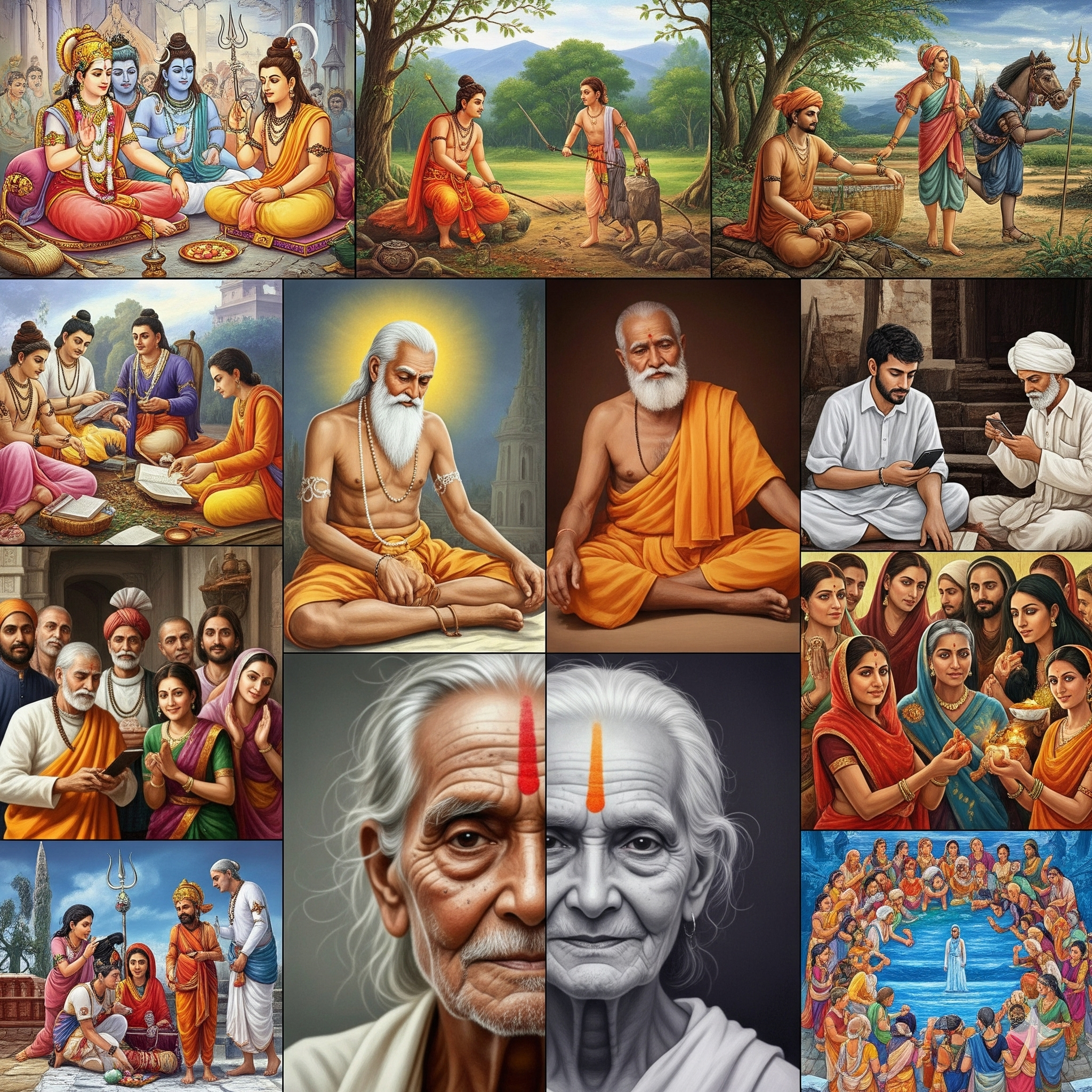
✨ Thus, whether swansh or vibhinnansh, virtuous or sinful, learned or ignorant, detached or attached, liberated or bound, men or women, young or old, Brahmins or those in lower strata, humans or even animals, birds, and trees—all are entitled to devotion. Bhakti is universal, and God accepts the love of every heart.
LEARN MORE
(1) Materialism and Spiritualism
(3) Are Shri Krishna and MahaVishnu Different?
(4) How to Inculcate Divine Virtues
(5) Power of Faith
(6) Is Reciting Names of God Sufficient?
(7) When Does God Show His Divine Form
(8) How to be child-like and survive in this world
(9) Selfless Devotion as Taught by Prahlad
(10) God Loves "Love"
(11) Caste System